The dish is a starting point for exploring a wider food story. The guide below looks more closely at its background and different forms. When you want to cook, visit the recipe collection for ingredient quantities and step-by-step methods.
Overview
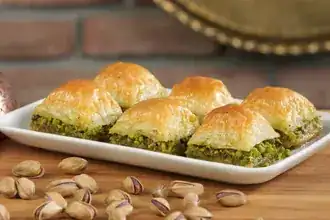
Baklava (or ) is a layered pastry dessert made of filo pastry, filled with chopped nuts, and sweetened with either syrup or honey.
There are several theories for the origin of this pastry, but it is considered a traditional dessert among the cuisines of countries in West Asia, Southeast Europe, Central Asia, and North Africa.
Placenta cake
Many claim that the placenta cake, and therefore baklava, derived from a recipe from Ancient Greece. Homer's Odyssey, written around 800 BC, mentions thin breads sweetened with walnuts and honey. In the fifth century BC, Philoxenos states in his poem "Dinner" that, in the final drinking course of a meal, hosts would prepare and serve cheesecake made with milk and honey that was baked into a pie.
The word "placenta" originally comes from the Greek language plakous (πλακοῦς), which means something "flat and broad". An early Greek language mention of plakous as a dessert (or second table delicacy) comes from the poems of Archestratos from the 5th century BC. He describes plakous as served with nuts or dried fruits and commends the honey-drenched Athenian version of plakous. The earliest known detailed recipe for placenta, from the 2nd century BC, is a honey-covered baked layered-dough dessert which food historian Patrick Faas identifies as the origin of baklava.
In the Byzantine Empire, the traditional placenta cake (known as "koptoplakous", κοπτοπλακοῦς), a dish similar to baklava, was consumed.
According to a number of scholars, koptoplakous (κοπτοπλακοῦς) was a precursor to the modern baklava. Historian Speros Vryonis describes koptoplakous as a "Byzantine favorite" and "the same as the Turkish baklava", as do other writers. The name plakous (πλακοῦς) is used today on the island of Lesbos for thin layered pastry leaves with crushed nuts, baked, and covered in syrup.
Lauzinaj
Baklava is a common dessert in modern Arab cuisines, but the Arabic language cookbook Kitab al-Tabikh, compiled by Ibn Sayyar al-Warraq in the 10th century, does not contain any recipe for baklava. Its recipe for lauzinaj refers to small pieces of almond paste wrapped in very thin pastry ("as thin as grasshoppers' wings") and drenched in syrup. Some writers say that this is the dessert that most closely resembles the modern baklava. Charles Perry, however, has written that "it was not much like baklava".
There are similar recipes for lauzinaj in the 13th-century Kitab al-Tabikh by Muhammad bin Hasan al-Baghdadi. Written in 1226 in today's Iraq, the cookbook was based on an earlier collection of 9th century Persian-inspired recipes. According to Gil Marks, Middle Eastern pastry makers later developed the process of layering the ingredients.
Preparation
Baklava is prepared in large pans of various shapes. Multiple layers of filo dough are separated from each other by melted butter and starch that gives baklava its unique texture. During the layering process, finely chopped nuts—typically walnuts or pistachios, occasionally hazelnuts and almonds—are added partway through the layers. Most recipes have multiple layers of filo and nuts, though some have the pastry only at the top and the bottom.
Before baking, the dough is cut into regular pieces, often parallelograms (lozenge-shaped), triangles, diamonds or rectangles. After baking, a syrup, which may include honey, rosewater, or orange flower water, is poured over the cooked baklava and allowed to soak. The parallelograms are separated into individual pastries after baking.
Baklava is usually served at room temperature, and is often garnished with nuts that have been ground up.
Armenia
Armenian baklava, (Փախլավա) is made of layers of filo dough, a filling of cinnamon-spiced chopped walnuts, and a syrup made from cloves, cinnamon, lemon juice, sugar and water. It is diamond-shaped and often has either one hazelnut, almond, or half a walnut placed on each piece. It is often served at special occasions like Armenian Christmas or Armenian Easter.
Armenian baklava has some variations on how many filo layers are supposed to be used. One variation uses 40 sheets of dough to align with the 40 days of Lent that Jesus spent in the desert where he fasted. Another variation is similar to the Greek style of baklava, which is supposed to be made with 33 dough layers, referring to the years of Jesus's life.
The city of Gavar makes its own version of baklava. It is made with 25 dough layers, has a filling of cleaned and dried chopped walnuts and sugar, and a syrup that is poured over the finished baklava consisting of honey and flowers. This type of baklava used to be prepared in the then-Armenian city of Bayazet, but the people living there immigrated to Gavar and surrounding regions in 1830.
The tradition of pakhlava preparation in Kyavar (Gavar) is included in the intangible cultural heritage list of Armenia.
Greece
Greek baklava (Μπακλαβάς) comes in many regional guises, with different names such as samousades, zournadakia, and masourakia. In Greek cuisine, walnuts are more common than pistachios and the dessert is flavored with cinnamon. Generally speaking, in southern Greece baklava is mostly made with chopped almonds and in the north with walnuts. Some recipes use hazelnuts, sesame, or even raisins. The syrup is made of sugar, honey, water, cinnamon, and orange or lemon zest and juice. Greek baklava is supposed to be made with 33 filo dough layers, referring to the years of Jesus's life.
On the island of Lesbos in Greece, a type of baklava is still known as plakous (πλακοῦς), which is the name of an Ancient Greek pastry that is seen as the predecessor of baklava. The latter is a baked dessert with very thinly made pastry layers and chopped nuts. The base for this modern placenta is made with leaves of filo dough, and nuts stacked upon each other. After baking, it is soaked in simple syrup and sprinkled with cinnamon.
Iran
Iranian baklava (باقلوا) is less crisp and uses less syrup than other baklava variations. The cities of Yazd, Tabriz, Qazvin, Kashan, and the Gilan province are famous for their baklava variations, which are widely distributed in Iran. Iranian baklava uses a combination of chopped almonds, hazelnuts, or walnuts and pistachios spiced with saffron, cardamom, or jasmine. For the syrup, rose water, lemon juice, sugar, honey, and water are used. Iranian baklava may be cut into diamonds or squares. When it is finished, it is often garnished with chopped pistachios, rose petals, jasmine or coconut powder depending on the region.
More to savor
Apple Crisp I
Kanafeh (Egyptian Sweet Cheese Pastry)
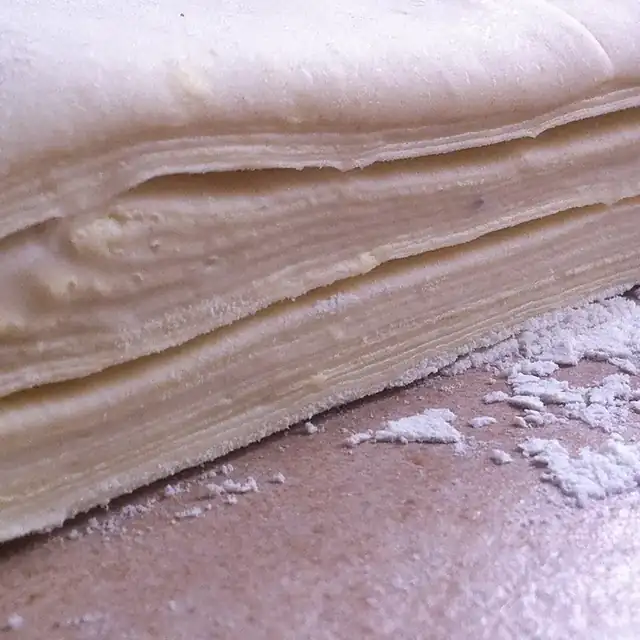
Puff Pastry: The Layers Behind a Light, Flaky Bite