This longer reference provides the background behind the topic. Read it alongside the recipe collection when you want to connect an ingredient or food idea with a dish to prepare.
In this story
OverviewDescriptionPhytochemistrySimilar speciesCultivarsHybridsDistribution and habitatGrowing conditionsCulinaryOverview
Basil (Ocimum basilicum), also called great basil, is a culinary herb of the family Lamiaceae (mints). It is a tender plant and is used in cuisines worldwide. In Western cuisine, the generic term "basil" refers to the variety also known as Genovese basil or sweet basil. Basil is native to tropical and subtopical Asia and Australasia from India and Sri Lanka east to southeastern China, Taiwan, and south through Southeast Asia, the Philippines, New Guinea, to northern Australia. In temperate climates basil is treated as an annual plant, but it can be grown as a short-lived perennial or biennial in warmer horticultural zones with tropical or Mediterranean climates.
There are many cultivars of basil including sweet basil, Thai basil (O.basilicum 'Thyrsiflora'), and Mrs. Burns' Lemon (O.basilicum 'Citriodorum'). Ocimum basilicum can cross-pollinate with other species in the genus Ocimum, producing hybrids such as lemon basil (O. × africanum) and African blue basil (O. × kilimandscharicum).
Description
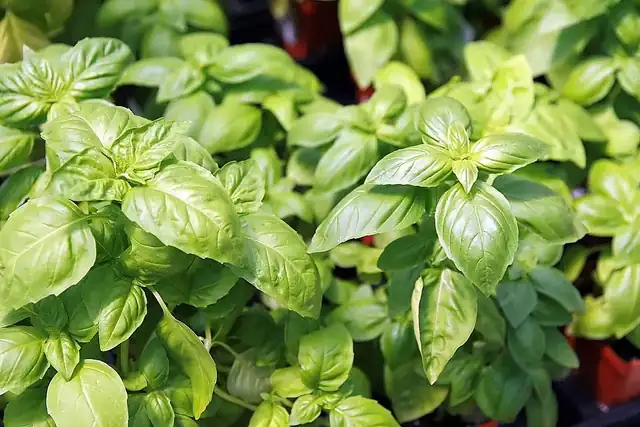
Basil is an annual, or sometimes perennial, herb. Depending on the variety, plants can reach heights of between 30 and 150 cm. Basil leaves are glossy and ovate, with smooth or slightly toothed edges that typically cup slightly; the leaves are arranged in opposite pairs along the square stems. The leaves are usually green, but can be purple in some cultivars such as 'Purple Ruffles'. Its flowers are small and white, and grow from a central inflorescence, or spike, that emerges from the central stem atop the plant. Unusual among Lamiaceae, the four stamens and the pistil are not pushed under the upper lip of the corolla, but lie over the inferior lip. After entomophilous pollination, the corolla falls off and four round achenes develop inside the bilabiate calyx.
Phytochemistry
The various basils have such distinct scents because the volatile aromatic compounds vary with cultivars. The essential oil from European basil contains high concentrations of linalool and methyl chavicol (estragole), in a ratio of about 3:1. Other constituents include: 1,8-cineole, eugenol, and myrcene, among others. The clove scent of sweet basil is derived from eugenol. The aroma profile of basil includes 1,8-cineole and methyl eugenol. In this species eugenol is synthesised from coniferyl acetate and NADPH.
Similar species
Some similar species in the same genus may be commonly called "basil", although they are not varieties of Ocimum basilicum.
Camphor basil, African basil (O. kilimandscharicum)
Clove basil, also African basil (Ocimum gratissimum)
Holy basil (Ocimum tenuiflorum, formerly known as O. sanctum)
Cultivars
Most basils are cultivars of sweet basil. Most basil varieties have green leaves, but a few are purple, such as, 'Purple Delight'.
Anise basil, Licorice basil, or Persian basil (O. basilicum 'Liquorice')
Cinnamon basil (Ocimum basilicum 'Cinnamon')
Dark opal basil (Ocimum basilicum 'Dark Opal')
Genovese basil or Sweet Basil (Ocimum basilicum)
Greek basil (Ocimum basilicum var. minimum)
Globe basil, dwarf basil, French basil (Ocimum basilicum 'Minimum')
Lettuce leaf basil (Ocimum basilicum 'Crispum')
Napolitano basil, also known as Napoletano basil, Neapolitan basil, Mammoth basil, Bolloso Napoletano basil, Napolitano Mammoth-Leafed basil, or Italian Large-Leaf basil (Ocimum basilicum)
Purple basil (Ocimum basilicum 'Purpurescens')
Rubin basil (Ocimum basilicum 'Rubin')
Thai basil (Ocimum basilicum var. thyrsifolium)
Hybrids
African blue basil (Ocimum basilicum × O. kilimandscharicum)
Lemon basil (Ocimum basilicum × O. americanum)
Spice basil (Ocimum basilicum × O. americanum), which is sometimes sold as holy basil
Distribution and habitat
Basil is native to India and other tropical and subtropical regions stretching across Southeast Asia to northern Australia, but has now become globalised due to human cultivation.
Growing conditions
Basil is sensitive to cold, with best growth in hot, dry conditions. Basil prefers high light conditions and grows best under full sun conditions. Increasing light intensity, particularly the photosynthetic photon flux density, can significantly enhance the plant's fresh weight, dry matter content, and height.
However, due to its common use, basil is cultivated in many countries around the world. Production areas include countries in the Mediterranean area, those in the temperate zone, and others in subtropical climates.
In northern Europe, Canada, the northern states of the U.S., and the South Island of New Zealand, basil grows best if sown under glass in compost in a pot, then planted out in late spring/early summer (when there is little chance of a frost); however, it can also thrive when planted outside in these climates. Additionally, it may be sown in soil once chance of frost is past. It fares best in well-drained soil with direct exposure to the sun.
Although basil grows best outdoors, it can be grown indoors in a pot and, like most herbs, will do best on a sun-facing windowsill, kept away from cold drafts. A greenhouse or row cover is ideal if available. It can, however, even be grown in a basement under fluorescent lights. Supplemental lighting produces greater biomass and phenol production, with red + blue specifically increasing growth and flower bud production. UV-B increases the volatiles in O. basilicum essential oil, which has not been reproducible in other plants, and so may be unique to the genus or even to this species.
Basil prefers well-drained organic soils, as adequate oxygen availability in the root zone is essential for optimal plant growth. Poor soil drainage can lead to root hypoxia, which negatively affects overall plant development and essential oil yield.
Culinary
Basil is most commonly used fresh in recipes. In general, it is added last, as cooking quickly destroys the flavour. The fresh herb can be kept for a short time in plastic bags in the refrigerator, or for a longer period in the freezer, after being blanched quickly in boiling water. It has a flavour resembling that of liquorice.
More to savor

Chicken Vindaloo
Marinara Sauce
Kaffir lime in the Kitchen: Exploring an Everyday Ingredient