The dish is a starting point for exploring a wider food story. The guide below looks more closely at its background and different forms. When you want to cook, visit the recipe collection for ingredient quantities and step-by-step methods.
Overview
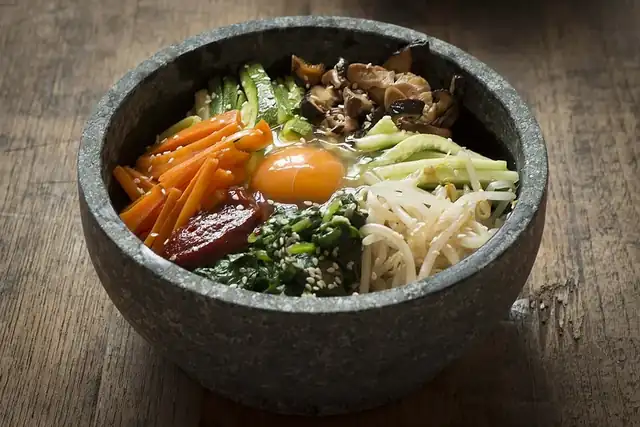
Bibimbap , sometimes romanised as bi bim bap or bi bim bop, is a Korean rice dish. It is served as a bowl of warm white rice topped with namul (sautéed or blanched seasoned vegetables) and gochujang (chili pepper paste). Egg and sliced meat (usually beef) are common additions, stirred together thoroughly just before eating. The term bibim means "mixing" and bap is cooked rice.
South Korean cities such as Jeonju, Jinju, and Tongyeong are known for their versions of bibimbap.
Etymologies
The earliest names for bibimbap appear in Korean hanja texts. Its first name was hondon-ban (混沌飯). This name appeared in the Yeokjogumun (역조구문) portion of the book Historical Notes of Gijae , which was written by Bak Dongnyang (박동량) around 1590. In the Diary of Cheongdae by another Joseon scholar Gwon Sang-il (1679–1760), it was recorded as goldong-ban (骨董飯). The dish was also recorded in Complete Works of Seongho by Yi Ik (1681–1764) as goldong (骨董), in Complete Works of Cheongjanggwan by Yi Deok-mu (1741–1793) as goldong-ban (汩董飯), and in Works of Nakhasaeng by Yi Hak-gyu (1770–1835) as both goldong-ban (骨董飯) and goldong (骨董).
The hangul transcription beubwieum (브뷔음) first appears in the 1810 encyclopedia Mongyupyeon by Jang Hon. The 1870 encyclopedia Myeongmul giryak states that the dish name is written as goldong-ban (骨董飯) in hanja but is read as bubaeban (捊排飯), a probable transcription of the native Korean bubim-bap (부빔밥). Another name is beubwieumbap (브뷔음밥). The hanja dictionary (한대자전) indeed contained "bubwida (부뷔다)" or "bubwium (부뷔움), Dong " (董) in hanja, which meant "mix" or "bibida" in Korean.
By the late 19th century, it went by a number of names in hangul: bubwiumbap (부뷔움밥), bubieumbap (부비음밥), bubwimbap (부뷤밥), bubuimbap (부븸밥), bubwinbap (부뷘밥), and bubimbap (부빔밥)bubaeban (捊排飯) and goldongban (骨董飯). Other names in hanja include goldongban (骨董飯, 汩董飯), hondonban (混沌飯), and bubaeban (捊排飯) and also banyuban (盤遊飯).
Preparation
Bibimbap uses various ingredients. Common vegetables include julienned oi (cucumber), aehobak (courgette/zucchini), mu (radish), mushrooms, doraji (bellflower root), gim (seaweed), spinach, soybean sprouts, and gosari (bracken fern stems). Dubu (tofu), either plain or sautéed, or a leaf of lettuce may be added, or chicken or seafood may be substituted for beef. For visual appeal, the vegetables are often placed so adjacent colors complement each other. In the South Korean version, sesame oil, red pepper paste (gochujang), and sesame seeds are added.
Jeonju
Jeonju bibimbap along with kongnamul-gukbap (bean sprout and rice soup) are signature dishes of Jeonju. Jeonju bibimbap is usually topped with soy bean sprouts, hwangpo-muk, gochujang, jeopjang, and seasoned raw beef and served with kongnamul-gukbap. The rice of Jeonju bibimbap is specially prepared by being cooked in beef shank broth for flavor and finished with sesame oil for flavor and nutrients. Jeonju also holds a Jeonju Bibimbap Festival every year.
Jinju
Jinju bibimbap is a regional variety of bibimbap associated with Jinju, South Gyeongsang Province. It is typically made by mixing rice with assorted seasoned vegetables, beef yukhoe, broth known as potangguk or botangguk, and red-pepper paste seasoning.
Although local tradition connects Jinju bibimbap with the sharing of mixed rice and vegetables during the Battles of Jinju in the Imjin War, the Hansik Culture Dictionary notes that no surviving documentary evidence establishes its exact origin. By the 1920s, however, Jinju bibimbap was already recognized as a famous local dish. It was mentioned in a 1923 account by Cha Sang-chan, introduced as a representative food of Gyeongsang Province in a 1925 issue of Gaebyeok, and described as a Jinju specialty in a 1929 issue of Byeolgeon-gon.
Distinctive features of Jinju bibimbap include finely seasoned vegetables, the addition of botangguk, beef yukhoe, and a special red-pepper paste known as yeot-gojang. The dish has also been called hwaban, meaning "flower bowl", because of the colorful arrangement of vegetables and other toppings over white rice.
Hot stone pot (dolsot bibimbap)
Hot stone pot bibimbap (dolsot-bibimbap, 돌솥 비빔밥) is a variation of bibimbap served in a very hot dolsot (stone pot) in which a raw egg is cooked against the sides of the bowl. The bowl is so hot that anything that touches it sizzles for minutes. Before the rice is placed in the bowl, the bottom of the bowl is coated with sesame oil, making the layer of the rice touching the bowl cook to a crisp, golden brown known as nurungji (누릉지). This variation of bibimbap is typically served to order, with the egg and other ingredients mixed in the pot just before consumption.
Stone pots, especially vessels made of gopdol (soapstone), had long been used in Korean cuisine before the modern form of dolsot bibimbap appeared. Historical sources describe stone pots as suitable for cooking rice and porridge, and they were also used for preparing tea and medicinal decoctions.
The modern restaurant dish known as dolsot bibimbap is commonly attributed to Jungang Hoegwan, a bibimbap restaurant located near the Jeonju Post Office. According to the Hansik Culture Dictionary, its owner Namgung Seong developed a stone bowl in 1969 in order to keep bibimbap warm for a longer time. The restaurant then sold bibimbap in these stone bowls under the registered name "Jeonju gopdol bibimbap", and the dish later spread to Seoul after attracting attention at a folk food event organized by Shinsegae Department Store.
In Japan it is called by Ishiyaki bibimbap. It was popularized in Japan through Korean restaurants in Tsuruhashi, Osaka, a district known for Korean cuisine. One commonly cited example is Hakuundai (白雲台), a long-established yakiniku restaurant founded in Tsuruhashi in 1975. Kansai TV reported that Hakuundai is regarded as a restaurant that helped spread ishiyaki bibimbap in Japan. According to the restaurant's owner, Yong-o Oh, when Hakuundai began serving the dish in the late 1980s, stone bowls were not yet available in Japan, and his father, who had come from Korea, brought stone pots from Korea because he believed the dish would become popular in Japan.
In a 2022 interview, Oh similarly recalled that, at a time when stone bowls for the dish were unavailable in Japan, he and his brother were taken to Korea to purchase them, importing around 300 bowls. He also stated that Hakuundai may have been the first restaurant in Japan to serve ishiyaki bibimbap, while noting that he had no documentary proof for this claim.
Yakcho
Yakcho-bibimbap (약초비빔밥) is from Jecheon. Yak is a historical term for medicinal. Jecheon is a great place for medicinal herbs to grow. People could get a thicker root and more medicinal herb than in other areas. The combination of the medicinal herbs and popular bibimbap made it one of the most popular foods in Jecheon.
More to savor
Apple Crisp I
Spaghetti alla Carbonara
Gimbap: A Korean Meal Rolled into Bite-Sized Pieces