The dish is a starting point for exploring a wider food story. The guide below looks more closely at its background and different forms. When you want to cook, visit the recipe collection for ingredient quantities and step-by-step methods.
In this story
OverviewNameBiscuits for travelConfectionery biscuitsIntroduction in South AsiaTypesCrackersOverview
A biscuit is a flour-based baked food item. Biscuits are typically hard, flat, and unleavened. They are usually sweet and may be made with sugar, chocolate, icing, jam, ginger, or cinnamon. Savoury biscuits are called crackers or biscuits for cheese.
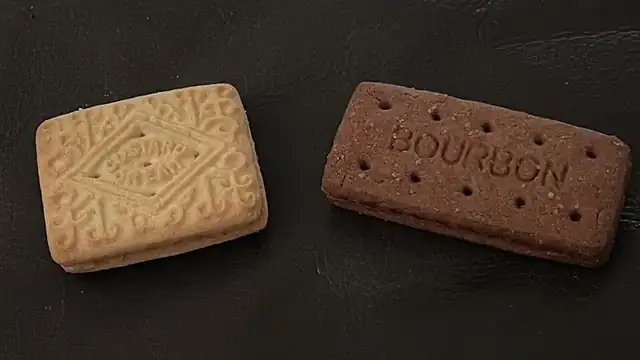
Types of biscuit include biscotti, sandwich biscuits (such as custard creams), digestive biscuits, ginger biscuits, shortbread biscuits, chocolate chip cookies, Anzac biscuits, and speculaas.
The term biscuit is used in many English-speaking countries. In the United States and parts of Canada, sweet biscuits are nearly always called cookies while flat savoury biscuits are called crackers and the term biscuit is used to refer to a type of quick bread.
Name
Small, hard, flour-based baked products are known in many English-speaking countries as biscuits. In the United States and sometimes Canada, this word refers to a quick bread that is like a scone, but with a fluffier texture (see biscuit (bread)), and what are known as biscuits in other English-speaking countries are called either a cookie or a cracker. Canadians sometimes distinguish the quick bread with the name "tea biscuit". In the United Kingdom, the Isle of Man and Ireland, cookie refers to a single type of biscuit: the sweeter baked dough typically containing chocolate chips or raisins. In Scotland, cookie is also used to refer to some specific types of biscuits or breads. Historically in the United Kingdom, quick breads were known as biscuits.
This practice has ended in England, although it has remained in Scotland and Guernsey.
The word biscuit comes from the Old French word bescuit, which was derived from the Latin words bis ('twice') and coquere, coctus ('to cook', 'cooked'), and, hence, means 'twice-cooked'. This is because biscuits were originally cooked in a twofold process: first baked, and then dried out in a slow oven.
Biscuits for travel
The need for nutritious, easy-to-store, easy-to-carry, and long-lasting foods on long journeys, in particular at sea, was initially solved by taking livestock along with a butcher/cook. However, this took up additional space on what were either horse-powered treks or small ships, reducing the time of travel before additional food was required. This resulted in early armies' adopting the style of hunter-foraging.
The introduction of the baking of processed cereals, including the creation of flour, provided a more reliable source of food. Egyptian sailors carried a flat, brittle loaf of millet bread called dhourra cake while the Romans had a biscuit called buccellum. Roman cookbook Apicius describes: "a thick paste of fine wheat flour was boiled and spread out on a plate. When it had dried and hardened, it was cut up and then fried until crisp, then served with honey and pepper."
Many early physicians believed that most medicinal problems were associated with digestion. Hence, for both sustenance and avoidance of illness, a daily consumption of a biscuit was considered good for health.
Confectionery biscuits
Early biscuits were hard, dry, and unsweetened. They were most often cooked after bread, in a cooling bakers' oven; they were a cheap form of sustenance for the poor.
By the 7th century AD, cooks of the Sassanian Empire had learnt from their forebears the techniques of lightening and enriching bread-based mixtures with eggs, butter, and cream, and sweetening them with fruit and honey. One of the earliest spiced biscuits was gingerbread, in French, pain d'épices, meaning "spice bread", brought to Europe in 992 by the Armenian monk Grégoire de Nicopolis. He left Nicopolis Pompeii, of Lesser Armenia to live in Bondaroy, France, near the town of Pithiviers. He stayed there for seven years and taught French priests and Christians how to cook gingerbread. This was originally a dense, treaclely (molasses-based) spice cake or bread. As it was so expensive to make, early ginger biscuits were a cheap form of using up the leftover bread mix.
With the combination of knowledge spreading from Al-Andalus, and then the Crusades and subsequent spread of the spice trade to Europe, the cooking techniques and ingredients of Arabia spread into Northern Europe. By mediaeval times, biscuits were made from a sweetened, spiced paste of breadcrumbs and then baked (e.g., gingerbread), or from cooked bread enriched with sugar and spices and then baked again. King Richard I of England (aka Richard the Lionheart) left for the Third Crusade (1189–92) with "biskit of muslin", which was a mixed corn compound of barley, rye, and bean flour.
Introduction in South Asia
Biscuits and loaves were introduced in Bengal during the British colonial period and became popular within the Sylheti Muslim community. However, the middle-class Hindus of Cachar and Sylhet were very suspicious of biscuits and breads as they believed they were baked by Muslims. On one occasion, a few Hindus in Cachar caught an Englishman eating biscuits with tea, which caused an uproar. The information reached the Hindus of Sylhet and a small rebellion occurred. In response to this, companies started to advertise their bread as "machine-made" and "untouched by (Muslim) hand" to tell Hindus that the breads were "safe for consumption". This incident is mentioned in Bipin Chandra Pal's autobiography and he mentions how culinary habits of Hindus gradually changed and biscuits and loaves eventually became increasingly popular.
Types
Biscuits can be divided into four categories, separated by their process and ingredients:
Crackers
Crackers are savoury biscuits with a "crispy, open texture". They include biscuits such as cream crackers, "Ritz-type" crackers, saltines, snack crackers (e.g. Arnott's Shapes) and water biscuits. Cracker doughs often have some of the following features: they are leavened, have a water content between 15 and 25%, are laminated and rise during the first part of baking.
In a general process to make crackers, dough is mixed and fermented. It is fed through a dough feed conveyor to be laminated, sheeted and cut. It is baked, sprayed with oil and cooled, before finally being packed. Baking surfaces differ by the country biscuits are baked in: traditional British biscuits being baked on light wire mesh, while American biscuits are baked on heavy mesh. The baking process requires high amounts of energy to get the relatively high hydration doughs to a final biscuit that is 1.5–2.5% water.
More to savor
Vanillekipferl (Almond Crescent Cookies)
Coconut Chicken
Pudding: Why One Word Can Mean So Many Different Dishes