The dish is a starting point for exploring a wider food story. The guide below looks more closely at its background and different forms. When you want to cook, visit the recipe collection for ingredient quantities and step-by-step methods.
Overview
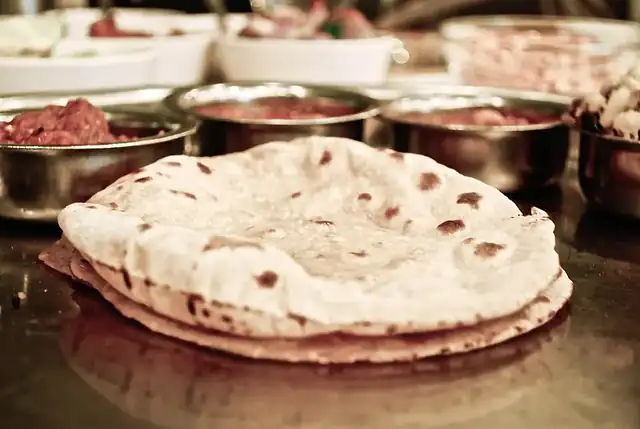
Chapati is an unleavened flatbread originating from the Indian subcontinent. Chapatis are made of atta, a type of whole-wheat flour, mixed into dough with water. It is cooked on an iron griddle known as a tava, then puffed up over direct heat. Another version, in East African cuisine, is instead fried. Chapati is a form of roti, and the two are sometimes conflated. It is common in South Asia—even in areas where rice is the typical staple—as well as in most East African countries. It is also eaten by the South Asian diaspora.
Evidence of foods resembling chapati dates back to the Indus Valley Civilization, and chapati is recorded in Sanskrit and Mughal-era texts. During the British era, chapatis were consumed by South Asians throughout the British Empire. They were introduced to East Africa by trade and immigration, including by Indian indentured railway workers. In the 21st century, it is common for households to purchase chapati rather than make it.
Terminology
The word chapati entered English from the Hindi चपाती (carpatī). It is derived from the Sanskrit word चर्पटी (carpaṭī), a derivative of Sanskrit *चर्प (carpata, 'flat'). This describes the way dough is shaped by slapping it between the hands. It is also spelled chapatti or chapathi. In British India, the spellings chewpatty and chowpatty were used. The word has been used in English since the early 19th century.
Ingredients
Chapatis are made of atta, a common type of whole wheat flour that is ground using a chakki (a stone mill). The flour is mixed with water, typically 60 to 80 percent the weight of the flour, to form a smooth, soft dough. Optionally, it may have small amounts of salt—about 0.5 to 2 percent, according to taste. Oil is also optional, with about 5 millilitres per 100 grams of flour; it is kneaded into the dough after the other ingredients. The dough does not contain yeast.
The atta used in chapati is typically milled to high extraction—about 70 to 100 percent extraction, commonly 90 percent in rural kitchens and 80 percent in industrial settings. It is often sifted to remove the coarsest grains. The byproduct of sifting, known as resultant atta, may also be used for chapati. In some villages, including many in Rajasthan, the flour is milled on a quern-stone. The flour typically uses the species common wheat, which results in a soft, pliable texture. Durum wheat is added in some parts of India. Wheat varieties' ability to produce good chapati is a large consideration when farming wheat or developing new varieties. Although wheat is typically sold without distinguishing between varieties, Indian consumers prefer wheat that produces better chapati, and varieties such as Sharbati wheat are priced higher due to such qualities.
Kneading and shaping
The dough is kneaded by hand for 10 to 15 minutes, reaching a firm consistency and developing gluten, which gives it a viscoelastic texture that enables it to be rolled out. The dough may be kneaded mechanically, using a planetary mixer or a horizontal bread mixer.
It is left to rest for 30 to 120 minutes, though mechanically mixed dough may be rested for only 15 to 20 minutes. Resting enables gluten formation, and the dough becomes softer and more relaxed. If excess dough is prepared, it may then be refrigerated for one day.
Cooking
The rolled-out dough is thrown on a hot, dry tava—a type of iron griddle—and cooked on both sides. It cooks at 200 to 220 C for 1 to 2 minutes—about 45 seconds on one side and 90 seconds on the other, being flipped once bubbles start to form. This rapid cooking on a hot surface is similar to the method used for Arab breads.
A chapati puffs up as moisture in the dough changes into steam. Sometimes, it is only partially cooked on the skillet, and then cooked directly over a flame or hot coals for a few seconds to puff up. It is also possible to puff up the roti directly on the tava, applying pressure with a dry cloth, or in an oven at about 350 C.
Serving
Chapatis are served while hot and fresh. They are often topped with butter or ghee for flavor and softness. They may be stacked in a container until consumption. According to a 2020 survey in Delhi, the median portion size of chapati is 70 grams, averaging 2 chapatis for women and 3 chapatis for men. According to a 2013 study in the United Kingdom, the mean portion size is 90 g for adults, 64 g for school-aged children, and 44 g for preschool children. Because it quickly becomes stale, chapati is typically eaten while fresh. In India, stale chapati may also used as cattle feed, or it may be mashed to make baby food.
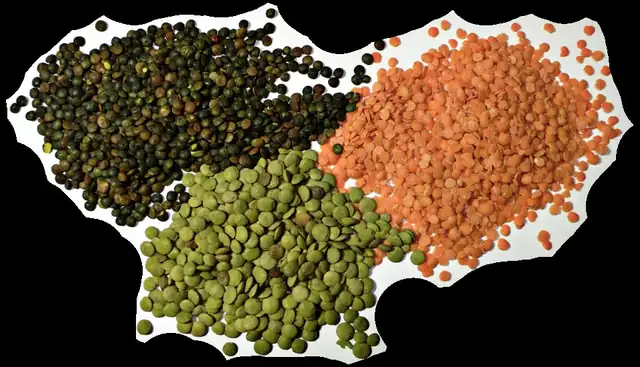
Chapati may be served for any meal. Like other Indian flatbreads, it is served as the central component of a typical meal; it is eaten by using a hand to tear the bread and pick up the accompanying food, or it may be dipped into soup. Chapati is the main source of carbohydrates in a meal with other, non-starchy dishes. It is commonly paired with curries, vegetable dishes (such as sabzi), stews, or chutneys. In Indian and Sri Lankan cuisine, it is commonly eaten with dal, a legume-based dish, an example of grains paired with legumes that provide protein. In Pakistani cuisine, it may be paired with dishes such as halwa for breakfast. In East African cuisine, chapati is eaten with mashes or stews.
Consumption
Chapati is the most consumed flatbread in the Indian subcontinent, and, according to food scientist Jalal Qarooni, in the world. It is frequently consumed in India, Pakistan, Bangladesh, Tibet, and Afghanistan. Nearly 90 percent of wheat produced in Pakistan, 80 to 85 percent of wheat produced in India, and most wheat produced in Bangladesh goes toward chapati. It is also eaten in most East African countries, a region with strong influence from Indian cuisine.
Chapati is commonly homemade in India and in Kenya. Large-scale settings of chapati production include restaurants and canteens. Mechanised production is relatively uncommon, and most commercial production is from informal producers that sell chapatis with a low shelf life in a limited area. Ready-to-eat chapati is produced as a convenience food, manufactured mechanically and distributed in individual packs. Grocery stores specialising in Indian food sell fresh chapati.
More to savor
South Indian Millet Swallow (Mudde)
Reindling (Austrian Yeasted Easter Cake)
Dal: The Pulse of an Everyday Meal