This longer reference provides the background behind the topic. Read it alongside the recipe collection when you want to connect an ingredient or food idea with a dish to prepare.
In this story
OverviewMiddle AgesProductionFood usesTextureFlavour, aroma and tasteAlcohol flavourantOverview
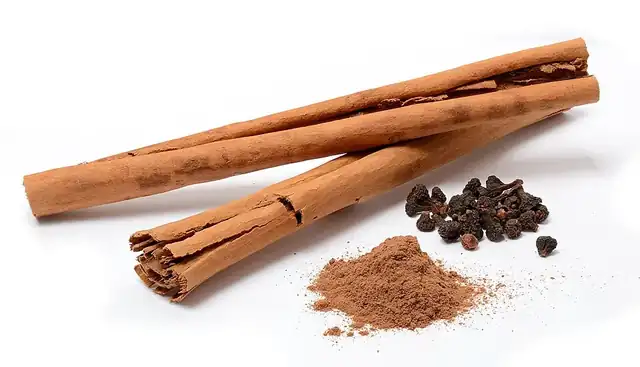
Cinnamon is a spice obtained from the inner bark of several tree species from the genus Cinnamomum. Cinnamon is used mainly as an aromatic condiment and flavouring additive in a wide variety of cuisines, in particular sweet and savoury dishes such as biscuits, breakfast cereals, snack foods, bagels, teas, hot chocolate, and traditional foods. The characteristic aroma and flavour of cinnamon derive from its essential oil and principal component, cinnamaldehyde, as well as numerous other constituents, including eugenol.
Cinnamon is the name for several species of trees and the commercial spice products that some of them produce. All are members of the genus Cinnamomum in the family Lauraceae. Only a few Cinnamomum species are grown commercially for spice. Cinnamomum verum (alternatively C. zeylanicum), known as "Ceylon cinnamon" after its origins in Sri Lanka (formerly Ceylon), is considered to be "true cinnamon", but most cinnamon in international commerce is derived from four other species, usually and more correctly referred to as "cassia": C. burmanni (Indonesian cinnamon or Padang cassia), C. cassia (Chinese cinnamon or Chinese cassia), C. loureiroi (Saigon cinnamon or Vietnamese cassia), and the less common C. citriodorum (Malabar cinnamon).
In 2023, world production of cinnamon was 238,403 tonnes, led by China with 39% of the total.
Middle Ages
Through the Middle Ages, the cinnamon-based cameline sauce was among the most common at tables in Western Europe. However, the source of the spice remained a mystery to the Western world. From reading Latin writers who quoted Herodotus, Europeans had learned that cinnamon came up the Red Sea to the trading ports of Egypt, but where it came from was less than clear. When the Sieur de Joinville accompanied his king, Louis IX of France to Egypt on the Seventh Crusade in 1248, he reported—and believed—what he had been told: that cinnamon was fished up in nets at the source of the Nile out at the edge of the world (i.e., Ethiopia). Marco Polo avoided precision on the topic.
The first mention that the spice grew in the area of India was in Maimonides's Mishneh Torah, about 1180. The first mention that the spice grew specifically in Sri Lanka was in Zakariya al-Qazwini's Athar al-bilad wa-akhbar al-'ibad ("Monument of Places and History of God's Bondsmen") about 1270. This was followed shortly thereafter by John of Montecorvino in a letter of about 1292.
Indonesian rafts transported cinnamon directly from the Moluccas to East Africa (see also Rhapta), where local traders then carried it north to Alexandria in Egypt. Venetian traders from Italy held a monopoly on the spice trade in Europe, distributing cinnamon from Alexandria. The disruption of this trade by the rise of other Mediterranean powers, such as the Mamluk sultans and the Ottoman Empire, was one of many factors that led Europeans to search more widely for other routes to Asia.
Production
In 2023, four countries accounted for 98% of the world's cinnamon production, a total of 238,403 tonnes: China, Vietnam, Indonesia, and Sri Lanka.
Food uses
Cinnamon bark is used as a spice. It is principally employed in cookery as a condiment and flavouring material. It is used in the preparation of chocolate, especially in Mexico. Cinnamon is often used in savoury dishes of chicken and lamb. In the United States and Europe, cinnamon and sugar are often used to flavour cereals, bread-based dishes such as toast, and fruits, especially apples; a cinnamon and sugar mixture (cinnamon sugar) is sold separately for such purposes. It is also used in Portuguese and Turkish cuisine for both sweet and savoury dishes. Cinnamon can also be used in pickling, and in Christmas drinks such as eggnog and mulled wine. Cinnamon powder has long been an important spice in enhancing the flavour of Persian cuisine, used in a variety of thick soups, drinks, and sweets.
Cinnamon is a common ingredient in Jewish cuisine across various communities. In Sephardic cooking, it is incorporated into vegetable stews and desserts such as tishpishti and travados, both of which are soaked in honey. In Ashkenazi cuisine, cinnamon features in dishes like honey cakes, and kugels. It is also one of "four sibling spices" (rempah empat beradik) essential in Malay cuisine along with clove, star anise and cardamom.
Texture
Ceylon cinnamon may be crushed into small pieces by hand, while Indonesian cinnamon requires a powerful blender.
Flavour, aroma and taste
The flavour of cinnamon is due to the aromatic essential oils that make up 0.5 to 1% of its composition.
Cinnamon bark can be macerated, then extracted in 80% ethanol, to a tincture.
Cinnamon essential oil can be prepared by roughly pounding the bark, macerating it in sea water, and then quickly distilling the whole. It is golden-yellow, with the characteristic odour of cinnamon and a very hot aromatic taste.
Cinnamon oil nanoemulsion can be made with polysorbate 80, cinnamon essential oil, and water, by ultrasonic emulsification.
Cinnamon oil macroemulsion can be made with a dispersing emulsifying homogeniser.
Cinnamaldehyde is responsible for the pungent taste and scent, and constitutes about 90% of cinnamon bark essential oil. Cinnamaldehyde decomposes, in high humidity and high temperatures, to styrene, and, by reaction with oxygen as it ages, it darkens in colour and forms resinous compounds.
Cinnamon constituents include some 80 aromatic compounds, including eugenol, found in the oil from leaves or bark of cinnamon trees.
Alcohol flavourant
Cinnamon is used as a flavouring in cinnamon liqueur, such as cinnamon-flavoured whiskey in the United States, and rakomelo, a cinnamon brandy in Greece.
More to savor

Chicken Vindaloo

Atomic Fudge Cake
Kaffir lime in the Kitchen: Exploring an Everyday Ingredient