This longer reference provides the background behind the topic. Read it alongside the recipe collection when you want to connect an ingredient or food idea with a dish to prepare.
In this story
OverviewCuisineTypesAustralia and New ZealandCanadaFranceRussiaSwedenSwitzerlandUnited KingdomOverview
Cream is a dairy product composed of the higher-fat layer skimmed from the top of milk before homogenization. The butterfat, which is less dense, rises to the top and is skimmed off, resulting in gravity cream. The industrial production of cream instead uses centrifugal separators to make separator cream. Cream is often sold in grades defined by their butterfat content. It contains high levels of saturated fat, in ascending proportion from light cream to heavy cream.
Cream skimmed from milk may be called "sweet cream" to distinguish it from cream skimmed from whey, a by-product of cheese-making. Whey cream has a lower fat content and tastes more salty, tangy, and "cheesy". In many countries, partially fermented cream is also sold as sour cream, crème fraîche, and so on. Both forms have many culinary uses in both sweet and savoury dishes.
Cream produced by cattle (particularly Jersey cattle) grazing on natural pasture often contains some fat-soluble carotenoid pigments derived from the plants they eat; traces of these intensely coloured pigments concentrated during separation give cream a slightly yellow hue, hence the name of the yellow-tinged off-white colour cream. Carotenoids are also the origin of butter's yellow colour. Cream from goat's milk, water buffalo milk, or from cows fed indoors on grain or grain-based pellets, is white.
Dehydrated cream is cream powder.
Cuisine
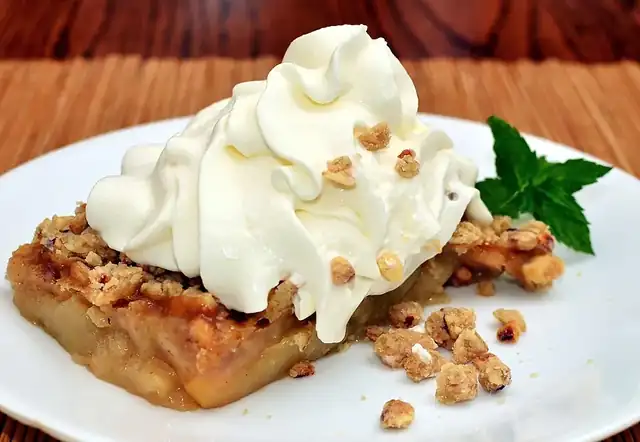
Cream is used as an ingredient in many foods, including ice cream, many sauces, soups, stews, puddings, and some custard bases, and is also used for cakes. Whipped cream is served as a topping on ice cream sundaes, milkshakes, lassi, eggnog, sweet pies, strawberries, blueberries, or peaches. Cream is also used in Indian curries such as masala dishes. Both single and double cream (see Types for definitions) can be used in cooking. Double cream or full-fat crème fraîche is often used when the cream is added to a hot sauce, to prevent it separating or "splitting". Double cream can be thinned with milk to make an approximation of single cream.
Cream (usually light/single cream or half and half) may be added to coffee.
The French word crème denotes not only dairy cream but also other thick liquids such as sweet and savory custards, which are normally made with milk, not cream.
Types
Different grades of cream are distinguished by their fat content, whether they have been heat-treated, whipped, and so on. In many jurisdictions, there are regulations for each type.
Australia and New Zealand
The Australia New Zealand Food Standards Code – Standard 2.5.2 – Defines cream as a milk product comparatively rich in fat, in the form of an emulsion of fat-in-skim milk, which can be obtained by separation from milk. Cream sold without further specification must contain no less than 350 g/kg (35%) milk fat.
Manufacturers labels may distinguish between different fat contents, a general guideline is as follows:
Canada
Canadian cream definitions are similar to those used in the United States, except for "light cream", which is very low-fat cream, usually with 5 or 6 percent butterfat. Specific product characteristics are generally uniform throughout Canada, but names vary by both geographic and linguistic area and by manufacturer: "coffee cream" may be 10 or 18 percent cream and "half-and-half" (crème légère) may be 3, 5, 6 or 10 percent, all depending on location and brand.
Regulations allow cream to contain acidity regulators and stabilizers. For whipping cream, allowed additives include skim milk powder (≤ 0.25%), glucose solids (≤ 0.1%), calcium sulphate (≤ 0.005%), and xanthan gum (≤ 0.02%). The content of milk fat in canned cream must be displayed as a percentage followed by "milk fat", "B.F", or "M.F".
France
In France, the use of the term "cream" for food products is defined by the decree 80-313 of April 23, 1980. It specifies the minimum rate of milk fat (12%) as well as the rules for pasteurisation or UHT sterilisation. The mention "crème fraîche" (fresh cream) can only be used for pasteurised creams conditioned on production site within 24h after pasteurisation. Even if food additives complying with French and European laws are allowed, usually, none will be found in plain "crèmes" and "crèmes fraîches" apart from lactic ferments (some low cost creams (or close to creams) can contain thickening agents, but rarely). Fat content is commonly shown as "XX% M.G." ("matière grasse").
Russia
Russia, as well as other EAC countries, legally separates cream into two classes: normal (10–34% butterfat) and heavy (35–58%), but the industry has pretty much standardized around the following types:
Sweden
In Sweden, cream is usually sold as:
Matlagningsgrädde ("cooking cream"), 10–15%
Kaffegrädde ("Coffee cream"), 10–12%, earlier mostly 12%
Vispgrädde (whipping cream), 36–40%, the 36% variant often has additives.
Mellangrädde (27%) is, nowadays, a less common variant.
Gräddfil (usually 12%) and Creme Fraiche (usually around 35%) are two common sour cream products.
Switzerland
In Switzerland, the types of cream are legally defined as follows:
Sour cream and crème fraîche (German: Sauerrahm, Crème fraîche; French: crème acidulée, crème fraîche; Italian: panna acidula, crème fraîche) are defined as cream soured by bacterial cultures.
Thick cream (German: verdickter Rahm; French: crème épaissie; Italian: panna addensata) is defined as cream thickened using thickening agents.
United Kingdom
In the United Kingdom, these types of cream are produced. Fat content must meet the Food Labelling Regulations 1996.
More to savor

Chicken Vindaloo

Chicken Tikka Masala
Beyond the Shopping List: The Story of Cream cheese