This longer reference provides the background behind the topic. Read it alongside the recipe collection when you want to connect an ingredient or food idea with a dish to prepare.
In this story
OverviewSpecies and cultivarsFuzzy kiwifruitGold kiwifruitRed kiwifruitProductionHuman consumptionOverview
Kiwifruit (often shortened to kiwi), or Chinese gooseberry , is the edible berry of several species of woody vines in the genus Actinidia. The most common cultivar group of kiwifruit (Actinidia chinensis var. deliciosa 'Hayward') is oval, about the size of a large hen's egg: 5 - 8 cm in length and 4.5 - 5.5 cm in diameter. Kiwifruit has a thin, fuzzy, fibrous, light brown skin that is tart but edible, and light green or golden flesh that contains rows of tiny black edible seeds. The fruit has a soft texture with a sweet, sour and unique flavour.
Kiwifruit is native to central and eastern China, with the first recorded description dating back to the 12th century during the Song dynasty. In the early 20th century, cultivation of kiwifruit spread from China to New Zealand, where the first commercial plantings took place. It gained popularity among British and American servicemen stationed in New Zealand during World War II, and later became commonly exported, first to the United Kingdom and Australia from 1953, followed by California in 1959.
From the late 20th century, countries beyond New Zealand initiated independent kiwifruit breeding programmes, including China and Italy. As of 2023, China accounted for 55% of the world's total kiwifruit production, making it the largest global producer.
Species and cultivars
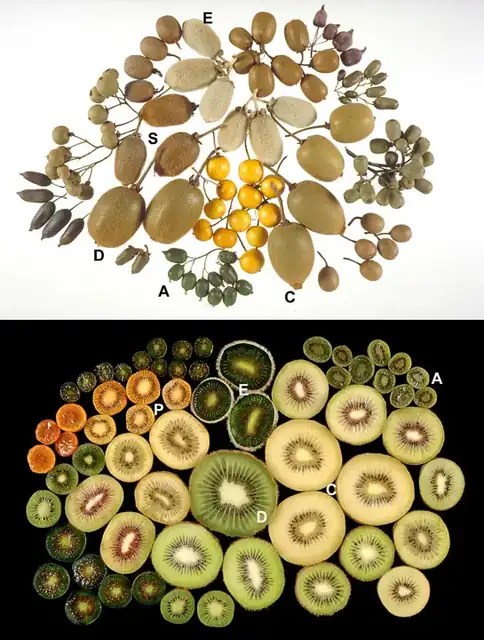
The genus Actinidia comprises around 60 species. Their fruits are quite variable, although most are easily recognised as kiwifruit because of their appearance and shape. The skin of the fruit varies in size, hairiness, and colour. The flesh varies in colour, juiciness, texture, and taste. Some fruits are unpalatable, while others taste considerably better than most commercial cultivars.
The most commonly sold kiwifruit is derived from Actinidia chinensis var. deliciosa (fuzzy green kiwifruit) and A. chinensis var. chinensis (golden and red kiwifruit). Other species that are commonly eaten include A. arguta (hardy kiwifruit, also known as kiwiberries), A. rubricaulis var. coriacea (Chinese egg gooseberry), A. kolomikta (Arctic kiwifruit), A. melanandra (purple kiwifruit) and A. polygama (silver vine). Some commercial cultivars are hybrids, such as 'Jinyan', which is a hybrid of A. eriantha and A. chinensis var. chinensis, and 'Issai', a hybrid of A. arguta and A. polygama, known for having relative large fruit, the ability to self-pollinate, and being less hardy than most A. arguta.
Fuzzy kiwifruit
Most kiwifruit sold belongs to a few cultivars of Actinidia chinensis var. deliciosa (fuzzy kiwifruit): 'Hayward', 'Blake' and 'Saanichton 12'. They have a fuzzy, dull brown skin and bright green flesh. The familiar cultivar 'Hayward' was developed by Hayward Wright in Avondale, New Zealand, around 1924. It was initially grown in domestic gardens, but commercial planting began in the 1940s.
'Hayward' is the most commonly available cultivar in stores. It is a large, egg-shaped fruit with a sweet flavour. 'Saanichton 12', from British Columbia, is somewhat more rectangular than 'Hayward' and comparably sweet, but the inner core of the fruit can be tough. 'Blake' can self-pollinate, but has a smaller, more oval fruit, and the flavour is considered inferior.
Gold kiwifruit
The gold kiwifruit, also known as the yellow kiwi or golden kiwifruit, has smooth, bronze skin, with a beak shape at the stem attachment. Gold varieties are typically cultivars of Actinidia chinensis var. chinensis. The flesh colour varies from bright green to a clear, intense yellow. This species is 'sweeter and more aromatic' in flavour compared to Actinidia chinensis var. deliciosa. One of the most attractive varieties has a red 'iris' around the centre of the fruit and yellow flesh outside. The yellow fruit obtains a higher market price and, being less hairy than the fuzzy kiwifruit, tastes better without peeling.
Hort16A is a golden kiwifruit cultivar developed by HortResearch, now Plant & Food Research Institute, during the 1980s and 1990s. It is marketed worldwide as Zespri Gold. This cultivar suffered significant losses in New Zealand in 2010–2013 due to the PSA bacterium. A new cultivar of golden kiwifruit, Gold3, was found to be more disease-resistant, and most growers have now changed to this cultivar. 'Gold3', marketed by Zespri as SunGold is not quite as sweet as 'Hort16A', and lacks its usually slightly pointed tip. Clones of the new variety SunGold have been used to develop orchards in China, resulting in partially successful legal efforts in China by Zespri to protect their intellectual property. In 2021, Zespri estimated that around 5,000 hectares of Sungold orchards were being cultivated in China, mainly in the Sichuan province.
Red kiwifruit
Red kiwifruits are cultivars of Actinidia chinensis var. chinensis, distinguished by their red coloured flesh. Its origin can be traced back to China from a natural mutation of gold kiwifruit found in the wild in 1982, which became the Hongyang variety, China's first commercially viable red kiwifruit cultivar. By 2020, Hongyang became the most grown kiwifruit cultivar in China across all types and varieties.
International varieties include Oriental Red, a licensed version of Donghong variety kiwifruit grown in Italy, Zespri RubyRed, which was independently bred in New Zealand in 2007, and EnzaRed, a cultivar that descends from the Hongyang variety grown by Turners & Growers in New Zealand.
Production
In 2023, world kiwifruit production was 4.4 million tonnes, led by China with 55% of the total (table). In China, kiwifruit is grown mainly in the mountainous area upstream of the Yangtze River, as well as Sichuan. Other major producers were New Zealand and Italy (table).
Human consumption
Kiwifruit may be eaten raw, made into juices, used in baked goods, prepared with meat, or used as a garnish. The whole fruit, including the skin, is suitable for human consumption; however, the skin of the fuzzy varieties is often discarded due to its texture. Sliced kiwifruit is often used as a garnish on top of whipped cream on pavlova, a meringue-based dessert. Traditionally in China, kiwifruit was not eaten for pleasure but was given as medicine to children to help them grow and to women who had given birth to help them recover.
Raw kiwifruit contains actinidain (also spelled actinidin) which is commercially useful as a meat tenderiser and possibly as a digestive aid. Actinidain also makes raw kiwifruit unsuitable for use in desserts containing milk or any other dairy products because the enzyme digests milk proteins. This applies to gelatine-based desserts since the actinidain will dissolve the proteins in gelatine, causing the dessert to either liquefy or prevent it from solidifying.
More to savor

Chicken Vindaloo
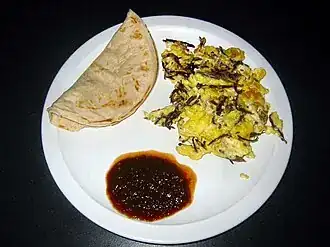
Machacado con Huevo (Eggs with Shredded Beef)
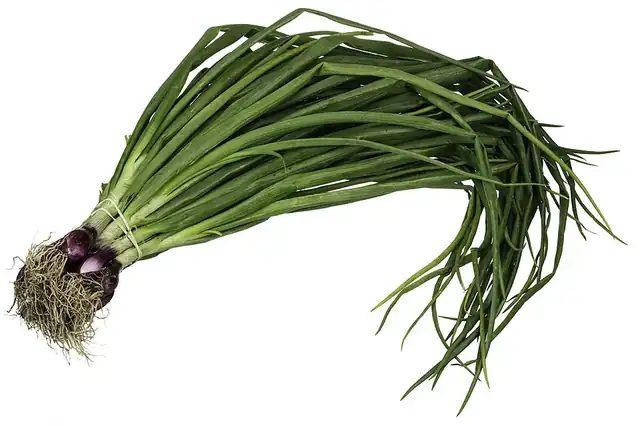
Beyond the Shopping List: The Story of Scallion