The dish is a starting point for exploring a wider food story. The guide below looks more closely at its background and different forms. When you want to cook, visit the recipe collection for ingredient quantities and step-by-step methods.
In this story
OverviewNameEarliest recipeMethodFranceIndiaJapanSwitzerlandUnited StatesSouth KoreaPopularityOverview
A macaron
or French macaroon
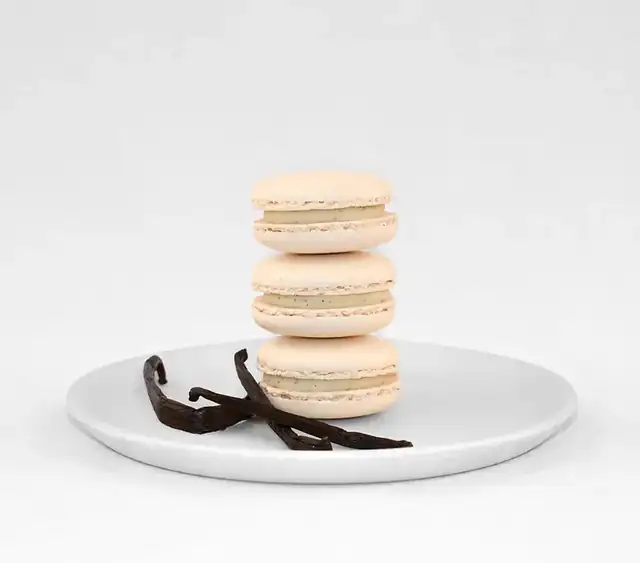
is a sweet meringue-based confection made with egg white, icing sugar, granulated sugar, almond meal, and often food colouring.
Since the 19th century, a typical Parisian-style macaron has been filled with a ganache, buttercream or jam. As baked, the circular macaron displays a smooth, square-edged top, a ruffled circumference—referred to as the "crown" or "foot" (or "pied")—and a flat base. It is mildly moist and easily melts in the mouth. Macarons can be found in a wide variety of flavours that range from traditional sweet such as raspberry or chocolate to savoury (as a foie gras).
Name
The names "macaron" and "macaroon" both derive from the French word macaron, which in turn derives from the Italian maccheroni (also the source of "macaroni"). French words ending with "-on" that were borrowed into English in the 16th and 17th centuries usually end with "-oon" (for example: "balloon", "cartoon", "platoon"). In North America, most bakers use the term "macaron", distinguishing it from the related coconut or almond macaroon. In addition to "macaron", in the UK they are also referred to as "French macaroons" (or just "macaroons").
Earliest recipe
The earliest known recipe dates back to the early 17th century and appears to be inspired by a French version of the recipe:
Method
There are two main methods for making a macaron – using either French or Italian meringue (which also originated in France despite its name).
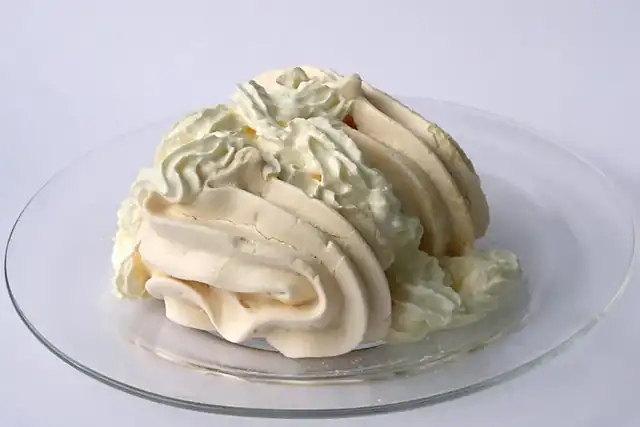
In the French method, egg whites are whisked until stiff-peaked meringue forms. From there, sifted, ground almonds and powdered sugar are folded in slowly until the desired consistency is reached. This process of knocking out air and folding is called macaronage.
In the Italian method, egg whites are whisked with hot sugar syrup to form a meringue. Sifted almonds and icing sugar are separately mixed with raw egg whites to form a paste. The meringue and almond paste are mixed together to form the macaron mixture. This method is often deemed more structurally sound yet also sweeter and also requires a candy thermometer for the sugar syrup.
A vegan variation involves the use of aquafaba in place of egg white. All other ingredients are essentially the same.
Either Italian or French meringue can be combined with ground almonds. The two elements are then folded together until they are the consistency of "shaving foam", and then are piped, left to form a skin, and baked. Sometimes, a filling is added.
France
Several French cities and regions claim long histories and variations, notably Lorraine (Nancy and Boulay), Basque Country (Saint-Jean-de-Luz), Saint-Émilion, Amiens, Montmorillon, Le Dorat, Sault, Chartres, Cormery, Joyeuse and Sainte-Croix in Burgundy.
Macarons d'Amiens, made in Amiens, are small, round-shaped biscuit-type macarons made from almond paste, fruit and honey, which were first recorded in 1855.
The city of Montmorillon is well known for its macarons and has a museum dedicated to them. The Maison Rannou-Métivier is the oldest macaron bakery in Montmorillon, dating back to 1920. The traditional recipe for Montmorillon macarons has remained unchanged for over 150 years.
The town of Nancy in the Lorraine region has a storied history with the macaron. It is said that the abbess of Remiremont founded an order of nuns called the "Dames du Saint-Sacrement" with strict dietary rules prohibiting the consumption of meat. Two nuns, Sisters Marguerite, and Marie-Elisabeth are credited with creating the Nancy macaron to fit their dietary requirements. They became known as the 'Macaron Sisters' (Les Soeurs Macarons). In 1952, the city of Nancy honoured them by giving their name to the Rue de la Hache, where the macaron was invented.
India
Thoothukudi in Tamil Nadu has its own variety of macaroon made with cashews instead of almonds, adapted from macarons introduced in colonial times.
Japan
Macarons in Japan are a popular confection known as マカロン (makaron). There is also another widely available version of makaron which substitutes peanut flour for almond and a wagashi-style flavouring. The makaron is featured in Japanese fashion through cell phone accessories, stickers, and cosmetics aimed towards women.
Switzerland
In Switzerland, Luxemburgerli (also Luxembourger) are a brand name of macaron made by Confiserie Sprüngli in Zürich. A Luxemburgerli comprises two disks of almond meringue with a buttercream filling in of many available flavours. Luxemburgerli are smaller and lighter than macarons from many other vendors.
United States
Pastry chefs in the US have expanded the classic macaron to include such varied flavours as mint chocolate chip, peanut butter and jelly, Snickers, peach champagne, pistachio, strawberry cheesecake, candy corn, salted pretzel, chocolate peanut butter, oatmeal raisin, candy cane, cinnamon, maple bacon, pumpkin, and salted caramel popcorn.
South Korea
In addition to macarons, fat-carons (뚱까롱, thick macarons), also called ttungcarons, were invented and became popular in South Korea. The bakers intentionally overfill the macaron filings and later decorate them as well. The appearance can resemble more to that of a small ice cream sandwich.
Popularity
In Paris, the Ladurée chain of pastry shops has been known for its macarons for about As of 2009.
In Portugal, Spain, Australia, France, Belgium, Switzerland, and New Zealand McDonald's sells macarons in their McCafés (sometimes using advertising that likens the shape of a macaron to that of a hamburger). McCafé macarons are produced by Château Blanc, which, like Ladurée, is a subsidiary of Groupe Holder, though they do not use the same macaron recipe.
Outside of Europe, the French-style macaron can be found in Canada and the United States.
More to savor
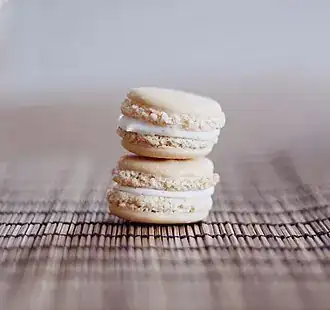
Basic French Macarons
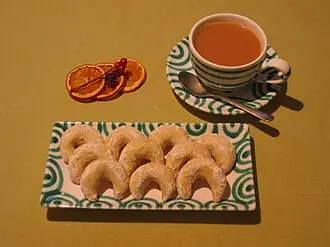
Vanillekipferl (Almond Crescent Cookies)
Brioche: Where Bread Meets a Rich, Tender Bite