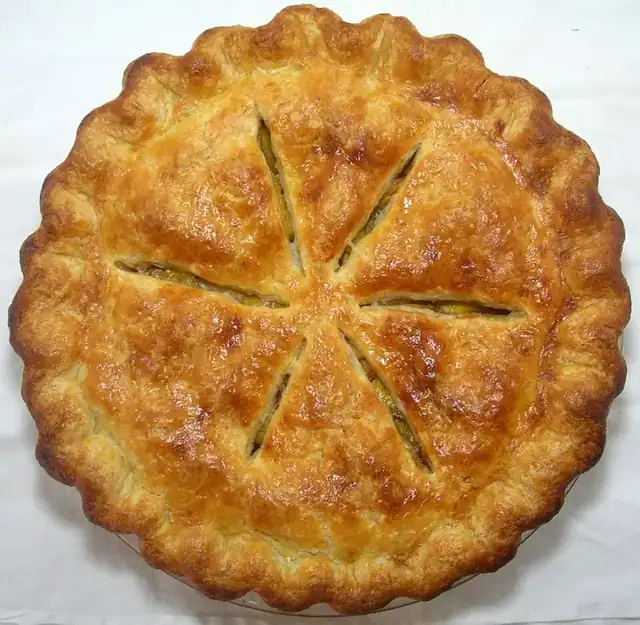
The dish is a starting point for exploring a wider food story. The guide below looks more closely at its background and different forms. When you want to cook, visit the recipe collection for ingredient quantities and step-by-step methods.
In this story
OverviewAntiquity15th to 17th centuriesRegional variationsIn literatureIn popular cultureFruitOverview
A pie is a baked dish which is usually made of a pastry dough casing that contains a filling of various sweet or savoury ingredients. Sweet pies may be filled with fruit (as in an apple pie), nuts (pecan pie), fruit preserves (jam tart), brown sugar (tarte au sucre), sweetened vegetables (rhubarb pie), or with thicker fillings based on eggs and dairy (as in custard pie and cream pie). Savoury pies may be filled with meat (as in a steak pie or a bacon and egg pie), eggs and cheese (such as quiches or British flans), or a mixture of meat and vegetables (pot pie or Corned beef pie).
Pies can be made from two pieces of pastry dough, known as a base and a top (also known as a two-crust or double crust) or just a top (also known as a top-crust), or just a base (also known as a single-crust or bottom-crust). Common pastry used include Shortcrust pastry, Puff pastry and Filo. However, some pies may use
baking powder biscuits, mashed potatoes, Digestive biscuits and crumbs.
Antiquity
Early pies were in the form of flat, round or freeform crusty cakes similar to galettes consisting of a crust of ground oats, wheat, rye, or barley containing honey inside. These pies developed into a form of early sweet pastry or desserts, evidence of which can be found on the tomb walls of the Pharaoh Ramesses II, who ruled from 1304 to 1237 BC, located in the Valley of the Kings. Sometime before 2000 BC, a recipe for chicken pie was written on a tablet in Sumer.
The Romans made a plain pastry of flour, oil, and water to cover meats and fowls which were baked, thus keeping in the juices. The Roman approach of covering "...birds or hams with dough" has been called more of an attempt to prevent the meat from drying out during baking than an actual pie in the modern sense. The covering was not meant to be eaten. It filled the role of what was later called puff paste. A richer pastry, intended to be eaten, was used to make small pasties containing eggs or little birds which were among the minor items served at banquets. The first written reference to a Roman pie is for a rye dough that was filled with a mixture of goat's cheese and honey.
15th to 17th centuries
Until the start of the 15th century, most pies were expected to contain meat or fish. Fresh fruit did not become widely used until sugar dropped in price during the 16th century due to the extensive use of slavery in sugar plantations. The first cherry pie is recorded in the late 16th century, when Queen Elizabeth I was served cherry pie. Elizabeth was often given gifts of quince or pear pies for New Year.
During the Shakespearean era, fruit pies were served hot, but others were served at room temperature, as they would be brought to the "...table more than once". Apple pies were popular in Tudor and Stuart times. Pippins were baked with cloves, cinnamon, dates and candied orange peels. Rosewater was often added to apple pies.
During the Puritan era of Oliver Cromwell, some sources claim mince pie eating was banned as a frivolous activity for 16 years, so mince pie making and eating became an underground activity; the ban was lifted in 1660, with the Restoration of the monarchy. Food historian Annie Gray suggests that the myth of the Puritans "actively" banning mince pies came about "due to the defenders of Christmas" who reported Puritan vitriol "with a certain amount of exaggeration".
Regional variations
Meat pies with fillings such as steak, cheese, steak and kidney, beef and ale, lamb and mint, minced beef, or chicken and mushroom are popular in the United Kingdom, Australia, South Africa and New Zealand as take-away snacks. They are also served with chips as an alternative to fish and chips at British chip shops.
Pies with a flaky crust and bottom are also a popular dish in North America, typically with a filling of meat (particularly beef, chicken, or turkey), gravy, and mixed vegetables (potatoes, carrots, and peas). Frozen pot pies are often sold in individual serving size.
Fruit pies may be served with a scoop of ice cream, a style known in North America as pie à la mode. Many sweet pies are served this way. This combination, and possibly the name as well, is thought to have been popularised in the mid-1890s in the United States. Cream and custard are other popular serving suggestions.
In literature
Cold pigeon pies and venison pasties appear in novels by Jane Austen, but also more generally in writing in the 18th century. The character Mrs Elton, from the 1815 novel Emma, believes herself to be modern, but nevertheless plans to take 'pigeon-pies and cold lamb' to a country outing to Box Hill and consults George Turberville's 1575 work The Noble Art of Venerie (1575) for advice.
In the 1817 novel Persuasion, Jane Austen includes pies in her description of an old-fashioned Christmas spread, mentioning 'tressels and trays, bending under the weight of brawn and cold pies'. In the whole of Persuasion, brawn and cold pies are the only specific mention of food; they are also the only Christmas foods to be mentioned in any of Jane Austen's novels.
In popular culture
In the United States, a popular idiom is "American as apple pie". There pie, especially apple pie, became intertwined to the point that in 1902, The New York Times asserted that "pie is the food of the heroic" and "no pie-eating people can ever be permanently vanquished". However, The Washington Post said the phrase "as American as apple pie" should really be ""as American as a cobbler".
The slang expression "to eat humble pie" comes from the umble pie, which was made with chopped animal offal. "It's a piece of pie", meaning that something is easy, dates from 1889. "Pie-eyed", meaning drunk, dates from 1904. The expression "pie in the sky", to refer to an unlikely proposal or idea, comes from "The Preacher and the Slave", a 1911 Joe Hill song.
Fruit
Many fruit and berry pies are very similar, varying only the fruit used in filling. Fillings for sweet or fruity are often mixed, such as strawberry rhubarb pie.
Apple pie
Banoffee pie – named for the combination of bananas and toffee
Blackberry pie
Blueberry pie
More to savor
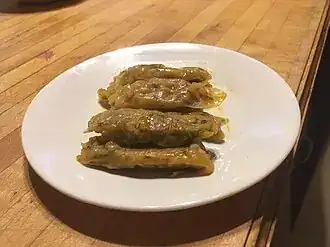
Egyptian Cabbage Rolls (Mahshi Malfoof)
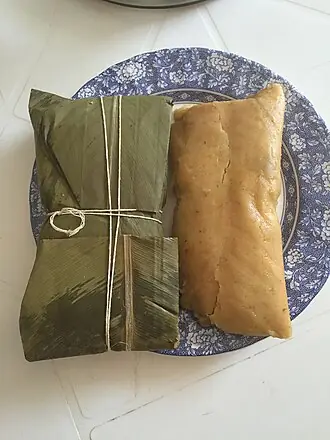
Hallaca (Venezuelan Stuffed Corn Dough)
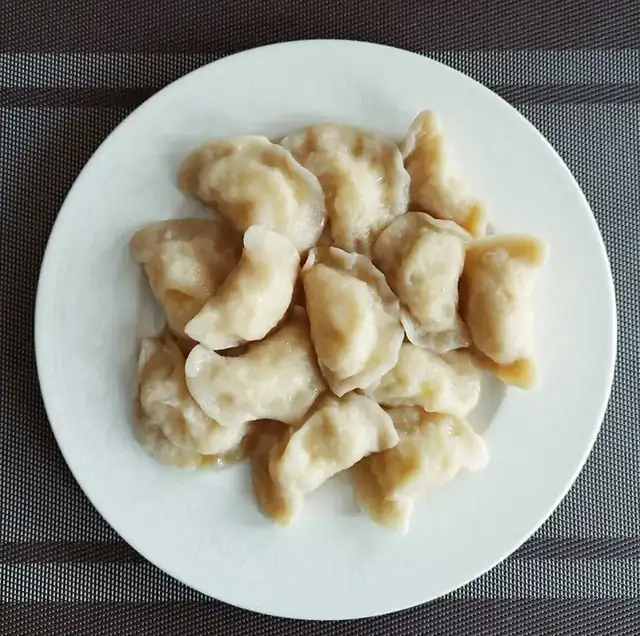
Pierogi: The Filled Dumplings Made for a Comforting Meal