This longer reference provides the background behind the topic. Read it alongside the recipe collection when you want to connect an ingredient or food idea with a dish to prepare.
In this story
OverviewPhylogenyDescriptionFlavour and fragranceAllergyVarietiesProductionCulinary useIn art, literature and cultureOverview
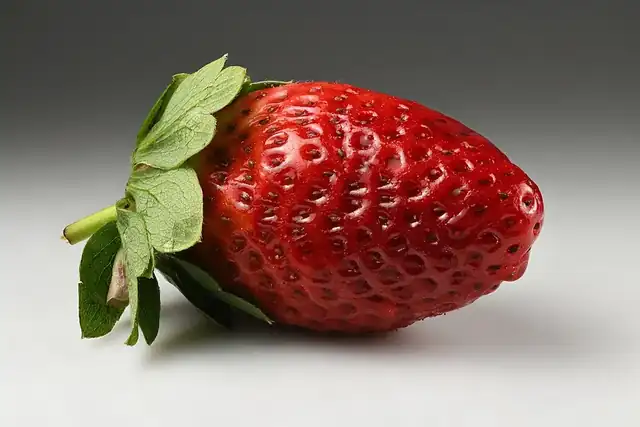
The garden strawberry (or simply strawberry; Fragaria × ananassa) is a widely grown hybrid plant cultivated worldwide for its fruit. The genus Fragaria, the strawberries, is in the rose family, Rosaceae. The fruit is appreciated for its aroma, bright red colour, juicy texture, and sweetness. It is eaten either fresh or in prepared foods such as jam, ice cream, and chocolates. Artificial strawberry flavourings and aromas are widely used in commercial products. Botanically, the strawberry is not a berry, but an aggregate accessory fruit. Each apparent 'seed' on the outside of the strawberry is actually an achene, a botanical fruit with a seed inside it.
The garden strawberry was first bred in Brittany, France, in the 1750s via a cross of F. virginiana from eastern North America and F. chiloensis, which was brought from Chile by Amédée-François Frézier in 1714. Cultivars of F. × ananassa have replaced the musk strawberry F. moschata in commercial production. In 2024, world production of strawberries exceeded ten million tons, led by China with 38% of the total.
Strawberries have appeared in literature and art from Roman times; Virgil wrote about the snake lurking beneath the strawberry, an image reinterpreted by later writers including Shakespeare. Strawberries appear in Italian, Flemish, and German paintings, including Hieronymus Bosch's The Garden of Earthly Delights. It has been understood to symbolise the ephemerality of earthly joys or the benefit that blessed souls get from religion, or to allegorise death and resurrection. By the late 20th century, its meaning had shifted: it symbolised female sexuality.
Phylogeny
The phylogeny of the cultivated strawberry within the genus Fragaria of the Rosaceae family was determined by chloroplast genomics in 2021. The polyploidy (number of sets of chromosomes) is shown as "2N" etc. by each species.
Description
In culinary terms, a strawberry is an edible fruit. From a botanical point of view, it is not a berry but an aggregate accessory fruit, because the fleshy part is derived from the receptacle. Each apparent seed on the outside of the strawberry is actually an achene, a botanical fruit with a seed inside it.
Flavour and fragrance
Sweetness, fragrance and complex flavour are important attributes of strawberries. In plant breeding and farming, emphasis is placed on sugars, acids, and volatile compounds, which improve the taste and fragrance of the ripe fruit. Esters, terpenes, and furans are the chemical compounds having the strongest relationships to strawberry flavour, sweetness and fragrance, with a total of 31 out of some 360 volatile compounds significantly correlated to desirable flavour and fragrance. In breeding strawberries for the commercial market in the United States, the volatile compounds methyl anthranilate and gamma-decalactone, prominent in aromatic wild strawberries, are especially desired for their "sweet and fruity" aroma characteristics. As strawberry flavour and fragrance appeal to consumers, they are used widely in manufacturing, including foods, beverages, perfumes and cosmetics.
Allergy
Some people experience an anaphylactoid reaction to eating strawberries. The most common form of this reaction is oral allergy syndrome, but symptoms may also mimic hay fever or include dermatitis or hives, and, in severe cases, may cause breathing problems. Proteomic studies indicate that the allergen may be tied to a protein for the red anthocyanin biosynthesis expressed in strawberry ripening, named Fra a1 (Fragaria allergen1). White-fruited strawberry cultivars, lacking Fra a1, may be an option for people allergic to strawberries. They ripen but remain pale, appearing like immature berries. A virtually allergen-free cultivar named 'Sofar' is available.
Varieties
Strawberries are often grouped according to their flowering habit. Strawberries occur in three basic flowering habits: short-day, long-day, and day-neutral. These describe the day-length sensitivity of the plant and the type of photoperiod that induces flower formation. Day-neutral cultivars produce flowers regardless of the photoperiod. Strawberry cultivars vary widely in attributes such as disease resistance, dessert and freezing quality, yield, and season of ripening.
Production
In 2024, world production of strawberries was 10.7million tonnes, led by China with 38% of the total and the United States as a secondary producer (table).
Culinary use
Strawberries were eaten fresh with cream in the time of Thomas Wolsey in the court of King Henry VIII. Strawberries can be frozen or made into jam or preserves, as well as dried and used in prepared foods, such as cereal bars. In the United Kingdom, strawberries and cream is a popular dessert at the Wimbledon tennis tournament. Desserts using strawberries include pavlova, fraisier, and strawberry shortcake.
In art, literature and culture
The Roman poet Ovid wrote that in the past Golden Age, people had lived on wild fruits such as mountain strawberries. Virgil wrote in his Eclogues that "Ye who cull flowers and low-growing strawberries, / Away from here lads; a chill snake lurks in the grass", and his imagery was taken up by medieval and early modern writers, the snake beneath the strawberry standing for dangerous literature, or beautiful but unfaithful women, or eventually any risky pleasure. In this vein, Shakespeare's King Richard III asks for a dish of strawberries while feigning friendship to his enemy; while in Othello, Iago shows Desdemona's handkerchief "spotted with strawberries", implying she has been unfaithful and hinting at Iago's own devious plans.
The wild strawberry is found in Italian, Flemish, and German art, and in English miniatures. In medieval depictions, the strawberry often appears in the Virgin Mary's garden, while in the Madonna of the Strawberries, she is seated on a strawberry bed and garlanded with strawberry leaves.
In the work of the late medieval painter Hieronymus Bosch, strawberries feature in The Garden of Earthly Delights amongst "frolicking nude figures". Fray Jose de Siguenza described the painting as embodying the strawberry as a symbol of the ephemerality of earthly joys. More recently, scholars have seen the symbolism entirely differently: Clément Wertheim-Aymes believed it meant the blessed souls' benefit from religion; Pater Gerlach supposed it meant spiritual love; and Laurinda Dixon asserted it was part of an allegory of death and resurrection. By the late 20th century, the strawberry (and the raspberry) had become "traditional symbols of the mouth and female sexuality".
More to savor

Chicken Vindaloo

Koko da Kosai (Fermented Corn Porridge and Bean Fritters)

A Closer Look at Yogurt: From Ingredient to Meal