This longer reference provides the background behind the topic. Read it alongside the recipe collection when you want to connect an ingredient or food idea with a dish to prepare.
In this story
OverviewPreparation and storageCulinary usesFor sweetsArmeniaChinaCyprusEgyptGreeceIranOverview
Tahini (طحينة, or, in Iraq, راشي) is a Middle Eastern condiment (a seed butter) made from ground sesame seeds. The most common variety comes from hulled seeds, but unhulled ones can also be used; the latter variety is slightly bitter, but more nutritious. The seeds are more commonly roasted than raw. Tahini can be served by itself (as a dip), made into a salad dressing, or used as a major ingredient in hummus, baba ghanoush, or halva.
Tahini is used in the cuisines of the Middle East and Eastern Mediterranean, the South Caucasus, the Balkans, South Asia, Central Asia, and amongst Cypriots, Ashkenazi Jews, as well as parts of Russia and North Africa. Sesame paste, used in some East Asian cuisines, may differ only slightly from tahini.
Preparation and storage
Tahini is made from sesame seeds that are soaked in water and then crushed to separate the bran from the kernels. The crushed seeds are then soaked again in salt water with a high salt content that causes the bran to sink. The floating kernels are skimmed off the surface, toasted, and ground to produce an oily paste. It can also be prepared with untoasted seeds and called "raw tahini".
Because of tahini's high oil content, some manufacturers recommend refrigeration to prevent spoilage. Others do not recommend refrigeration, as it makes the product more viscous and more difficult to serve.
The color of the produced tahini is affected by the kind of sesame used, untoasted sesame produces a bright-colored tahini; toasted or unshelled sesame produces tahini with a darker color, black sesame produces a tahini with a deep black color (dubbed "black tahini").
Culinary uses
Tahini-based sauces are common in Middle Eastern restaurants as a side dish or as a garnish, usually including lemon juice, salt, and garlic, and thinned with water. Hummus is made of cooked, mashed chickpeas typically blended with tahini, lemon juice and salt. Tahini sauce is also a popular topping for meat and vegetables in Middle Eastern cuisine. A sweet spread, ḥalawa ṭaḥīniyya ("sweet tahini"), is a type of halva sweet. It sometimes has mashed or sliced pistachio pieces sprinkled inside or on top.
In many parts of the Middle East, it is spread on bread and eaten as a quick snack or breakfast. Alternatively, bread can be dipped into tahini sweetened by a syrup such as grape syrup, carob syrup, or date syrup; the sweetener may vary by region.
For sweets
Tahini is also used in sweet dishes such as cakes, cookies, halva, and ice cream.
Armenia
In Armenia, tahini can be used as a sauce to put on lahmajoun.
China
In Chinese cuisine, sesame paste (zhīmájiàng) is used as a condiment in many dishes. Chinese sesame paste differs from the Middle Eastern tahini in that the sesame is roasted; the paste is much darker, and has far less astringency. Often, white sesame paste is used in salty dishes, while black sesame paste is used in desserts (not to be confused with black sesame soup, which is made in a different manner from sesame paste). Sesame paste is a primary condiment in the hot dry noodles of Hubei cuisine and ma jiang mian (sesame paste noodles) of Northeastern Chinese cuisine and Taiwanese cuisine. Sesame paste is also used as a bread or mantou spread, and may be paired with or baked into bing (Chinese flatbread).
Sesame paste is used as a seasoning, condiment and dip in cold dishes (such as liangfen) and hot pot.
Cyprus
In Cyprus, tahini, locally pronounced as tashi, is used as a dip for bread and sometimes in pitta souvlaki rather than tzatziki, which is customary in Greece; it is also used to make "tahinopitta" (tahini pie).
Egypt
In Egypt, tehina is a fundamental component of the country's cuisine, serving as an ingredient, a condiment, and a dipping sauce. Derived from toasted, hulled sesame seeds ground into a creamy paste, tehina boasts a rich, nutty flavor with a slightly bitter undertone.
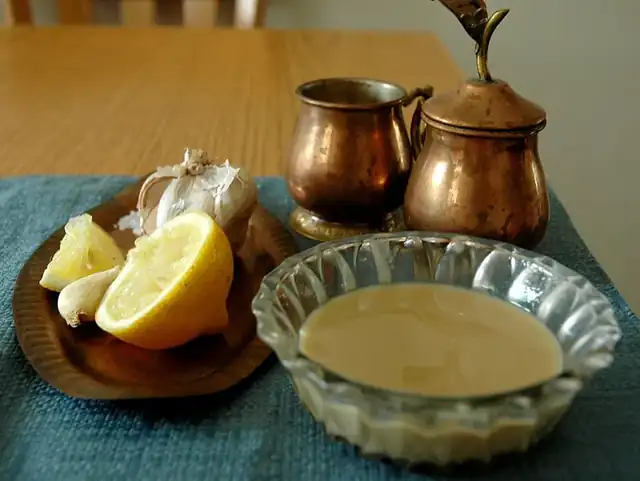
In Egyptian culinary traditions, tehina is often made by blending it with lemon juice, garlic, and water, resulting in a smooth, ivory-colored condiment. This sauce is commonly seasoned with salt and cumin to enhance its flavor. The consistency can be adjusted by varying the amount of water, making it suitable as a dip, dressing, or accompaniment to various dishes.
Tehina sauce holds a prominent place in Egyptian cuisine, frequently accompanying dishes such as ta'miya, ful medames and grilled meats like kofta. Its creamy texture and tangy profile complement the robust flavors of most foods, making it a staple on Egyptian dining tables.
Greece
In Greece, tahini is used as a spread on bread either alone or topped with honey or jam. Jars of tahini ready-mixed with honey or cocoa are available in the breakfast food aisles of Greek supermarkets.
Iran
In Iran, tahini is called ardeh in Persian. It is used to make halvardeh, a kind of halva made of tahini, sugar, egg whites, and other ingredients. It is also eaten during breakfast, usually with an accompanying sweet substance, such as grape syrup, date syrup, honey, or jam. Ardeh and halvardeh are among the souvenirs of the Iranian cities of Yazd and Ardakan.
More to savor

Chicken Vindaloo
Butternut Squash Soup
A Closer Look at Cumin: From Ingredient to Meal