This longer reference provides the background behind the topic. Read it alongside the recipe collection when you want to connect an ingredient or food idea with a dish to prepare.
In this story
OverviewDescriptionSimilar speciesDistribution and habitatModern productionCulinaryRegional namesOverview
Taro (Colocasia esculenta), also known as "dasheen", is a root vegetable. It is the most widely cultivated species of several plants in the family Araceae that are used as vegetables for their corms, leaves, stems and petioles. Taro corms are a food staple in African, Caribbean, Oceanian, East Asian, Southeast Asian and South Asian cultures (similar to yams).
Description
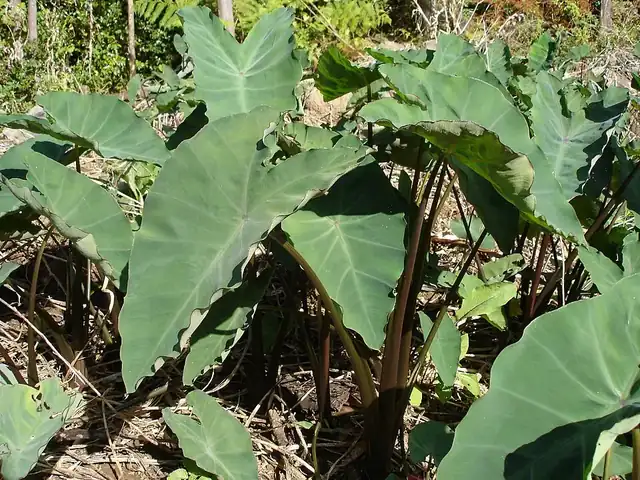
Colocasia esculenta is a perennial, tropical plant primarily grown as a root vegetable for its edible, starchy corm. The plant has rhizomes of different shapes and sizes. Leaves are up to 40 x 25 cm and sprout from the rhizome. They are dark green above and light green beneath. They are triangular-ovate, sub-rounded and mucronate at the apex, with the tip of the basal lobes rounded or sub-rounded. The petiole is .8-1.2 m high. The path can be up to 25 cm long. The spadix is about three fifths as long as the spathe, with flowering parts up to 8 mm in diameter. The female portion is at the fertile ovaries intermixed with sterile white ones. Neuters grow above the females, and are rhomboid or irregular orium lobed, with six or eight cells.
The appendage is shorter than the male portion.
Similar species
Taro is among the most widely grown species in the group of tropical perennial plants that are colloquially referred to as "elephant ears", when grown as ornamental plants. Other plants with the same nickname include certain species of related aroids possessing large, heart-shaped leaves, usually within such genera as Alocasia, Caladium, Monstera, Philodendron, Syngonium, Thaumatophyllum, and Xanthosoma.
Taro is related to Xanthosoma and Caladium, plants commonly grown ornamentally, and like them, it is sometimes loosely called elephant ear. Similar taro varieties include giant taro (Alocasia macrorrhizos), swamp taro (Cyrtosperma merkusii), and arrowleaf elephant's ear (Xanthosoma sagittifolium).
Distribution and habitat
Colocasia esculenta is thought to be native to Southern India and Southeast Asia, but is widely naturalised. Colocasia is thought to have originated in the Indomalayan realm, perhaps in East India, Nepal, and Bangladesh. It spread by cultivation eastward into Southeast Asia, East Asia and the Pacific Islands; westward to Egypt and the eastern Mediterranean Basin; and then southward and westward from there into East Africa and West Africa, where it spread to the Caribbean and Americas.
Taro was probably first native to the lowland wetlands of Malaysia, where it is called talas. In modern times it is also called keladi Cina (literally Chinese yam).
In Australia, C. esculenta var. aquatilis is thought to be native to the Kimberley region of Western Australia; the common variety esculenta is now naturalised and considered an invasive weed in Western Australia, the Northern Territory, Queensland and New South Wales.
In Europe, C. esculenta is cultivated in Cyprus and it's called Colocasi, (Κολοκάσι in Greek) and it is certified as a PDO product. It is also found in the Greek island of Ikaria and cited as a vital source of food for the island during World War II.
Modern production
In 2022, world production of taro was 18 million tonnes, led by Nigeria with 46% of the total (table).
Taro has the fifth largest production among root and tuber crops worldwide. The average yield of taro is around 7 tons per hectare.
Taro can be grown in paddy fields where water is abundant or in upland situations where water is supplied by rainfall or supplemental irrigation. Taro is one of the few crops (along with rice and lotus) that can be grown under flooded conditions. Flooded cultivation has some advantages over dry-land cultivation: higher yields (about double), out-of-season production (which may result in higher prices), and weed control (which flooding facilitates). Manmade floodplains particular to taro cultivation are commonly found throughout tropical Polynesian societies called repo.
Like most root crops, taro and eddoes do well in deep, moist or even swampy soils where the annual rainfall exceeds 2,500 mm. Eddoes are more resistant to drought and cold. The crop attains maturity within six to twelve months after planting in dry-land cultivation and after twelve to fifteen months in wetland cultivation. The crop is harvested when the plant height decreases and the leaves turn yellow.
Culinary
Taro is a food staple in various African, Asian and Oceanic cultures.
People usually consume its edible corm and leaves. The corms, which have a light purple color due to phenolic pigments, are roasted, baked or boiled. The natural sugars give a sweet, nutty flavor. The starch is easily digestible, and since the grains are fine and small it is often used for baby food.
In its raw form, the plant is toxic to pets and humans, due to the presence of calcium oxalate and the presence of needle-shaped raphides in the plant cells. However, the toxin can be minimized and the tuber rendered palatable by cooking, or by steeping in cold water overnight.
Corms of the small, round variety are peeled and boiled, then sold either frozen, bagged in their own liquids, or canned.
Regional names
In Cyprus, Colocasia has been in use since the Roman Empire. Today it is known as kolokasi (Kολοκάσι). It is usually fried or cooked with corn, pork, or chicken, in a tomato sauce in casserole. "Baby" kolokasi is called poulles: after being fried dry, red wine and coriander seed are added, and then it is served with freshly squeezed lemon. Lately, some restaurants have begun serving thin slices of kolokasi deep fried, calling them "kolokasi chips".
In the Caribbean and West Indies, taro is known as dasheen in Trinidad and Tobago, Saint Lucia, Saint Vincent and the Grenadines and Jamaica. The leaves are known as aruiya ke bhaji by Indo-Trinidadian and Tobagonians.
In Portuguese, it is known simply as taro, as well as inhame, inhame-coco, taioba, taiova, taioba-de-são-tomé or matabala; in Spanish, it is called malanga.
In the Philippines, the whole plant is usually referred to as gabi, while the corm is called taro. Taro is a very popular flavor for milk tea in the country, and just as popular ingredient in several Filipino savory dishes such as sinigang.
Other names include idumbe in the KwaZulu-Natal region, and boina in the Wolaita language of Ethiopia. In Tanzania, it is called magimbi in the Swahili language. It is also called eddo'' in Liberia.
More to savor

Chicken Vindaloo
Chicken Tikka Masala
Getting to Know Camembert: A Food Lover’s Guide