This longer reference provides the background behind the topic. Read it alongside the recipe collection when you want to connect an ingredient or food idea with a dish to prepare.
In this story
OverviewReproductionAlcoholic beveragesWineIndustrial ethanol productionNonalcoholic beveragesFoods andOverview
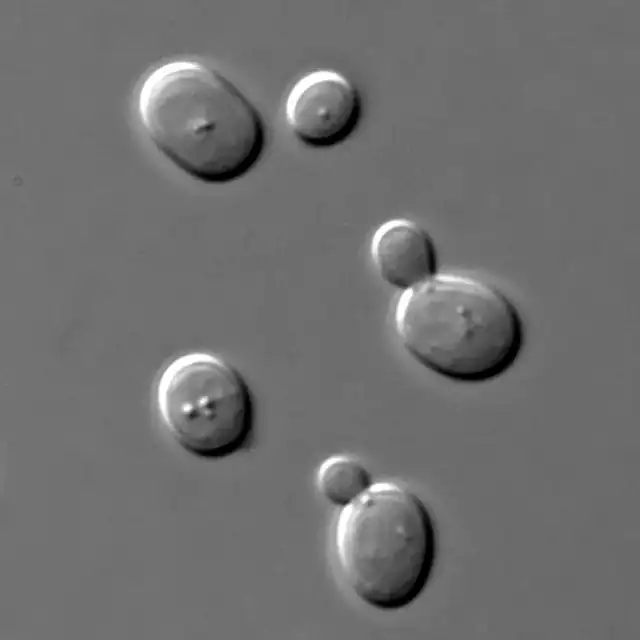
A yeast is any species of fungus that grows primarily in a unicellular form and reproduces via budding or fission. Yeasts are eukaryotic microorganisms that originated hundreds of millions of years ago, with at least 1,500 species currently recognized. They constitute about 1% of all described fungal species.
Some yeast species have the ability to develop multicellular characteristics by forming strings of connected budding cells known as pseudohyphae or false hyphae or in some cases true hyphae, or quickly evolve into a multicellular cluster with specialised cell organelle functions. Yeast sizes vary greatly, depending on species and environment, typically measuring 3–4 μm in diameter, although some yeasts can grow to 40 μm in size. Most yeasts reproduce asexually by mitosis, and many do so by the asymmetric division process known as budding. With their single-celled growth habit, yeasts can be contrasted with molds, which grow hyphae. Fungal species that can take both forms (depending on temperature or other conditions) are called dimorphic fungi.
Reproduction
Yeasts, like all fungi, may have asexual and sexual reproductive cycles. The most common mode of vegetative growth in yeast is asexual reproduction by budding, where a small bud (also known as a bleb or daughter cell) is formed on the parent cell. The nucleus of the parent cell splits, producing a daughter nucleus that migrates into the daughter cell. The bud then continues to grow until it separates from the parent cell, forming a new cell. The daughter cell produced during the budding process is generally smaller than the mother cell. Some yeasts, including Schizosaccharomyces pombe, reproduce by fission instead of budding, and thereby creating two identically sized daughter cells.
In general, under high-stress conditions such as nutrient starvation, haploid cells will die; under the same conditions, however, diploid cells can undergo sporulation, entering sexual reproduction (meiosis) and producing a variety of haploid spores, which can go on to mate (conjugate), reforming the diploid.
Alcoholic beverages
Alcoholic beverages are defined as beverages that contain ethanol (C2H5OH). This ethanol is almost always produced by fermentation – the metabolism of carbohydrates by certain species of yeasts under anaerobic or low-oxygen conditions. Beverages such as mead, wine, beer, or distilled spirits all use yeast at some stage of their production. A distilled beverage is a beverage containing ethanol that has been purified by distillation. Carbohydrate-containing plant material is fermented by yeast, producing a dilute solution of ethanol in the process. Spirits such as whiskey and rum are prepared by distilling these dilute solutions of ethanol. Components other than ethanol are collected in the condensate, including water, esters, and other alcohols, which (in addition to that provided by the oak in which it may be aged) account for the flavour of the beverage.
Wine
Yeast is used in winemaking, where it converts the sugars present (glucose and fructose) in grape juice (must) into ethanol. Yeast is normally already present on grape skins. Fermentation can be done with this endogenous "wild yeast", but this procedure gives unpredictable results, which depend upon the exact types of yeast species present. For this reason, a pure yeast culture is usually added to the must; this yeast quickly dominates the fermentation. The wild yeasts are repressed, which ensures a reliable and predictable fermentation.
Most added wine yeasts are strains of S. cerevisiae, though not all strains of the species are suitable. Different S. cerevisiae yeast strains have differing physiological and fermentative properties, therefore the actual strain of yeast selected can have a direct impact on the finished wine. Significant research has been undertaken into the development of novel wine yeast strains that produce atypical flavour profiles or increased complexity in wines.
The growth of some yeasts, such as Zygosaccharomyces and Brettanomyces, in wine can result in wine faults and subsequent spoilage. Brettanomyces produces an array of metabolites when growing in wine, some of which are volatile phenolic compounds. Together, these compounds are often referred to as "Brettanomyces character", and are often described as "antiseptic" or "barnyard" type aromas. Brettanomyces is a significant contributor to wine faults within the wine industry.
Industrial ethanol production
The ability of yeast to convert sugar into ethanol has been harnessed by the biotechnology industry to produce ethanol fuel. The process starts by milling a feedstock, such as sugar cane, field corn, or other cereal grains, and then adding dilute sulfuric acid, or fungal alpha amylase enzymes, to break down the starches into complex sugars. A glucoamylase is then added to break the complex sugars down into simple sugars. After this, yeasts are added to convert the simple sugars to ethanol, which is then distilled off to obtain ethanol up to 96% in purity.
Saccharomyces yeasts have been genetically engineered to ferment xylose, one of the major fermentable sugars present in cellulosic biomasses, such as agriculture residues, paper wastes, and wood chips. Such a development means ethanol can be efficiently produced from more inexpensive feedstocks, making cellulosic ethanol fuel a more competitively priced alternative to gasoline fuels.
Nonalcoholic beverages
A number of sweet carbonated beverages can be produced by the same methods as beer, except the fermentation is stopped sooner, producing carbon dioxide, but only trace amounts of alcohol, leaving a significant amount of residual sugar in the drink.
Root beer, originally made by Native Americans, commercialized in the United States by Charles Elmer Hires and especially popular during Prohibition
Foods and
Yeast is used as an ingredient in foods for its umami flavor, in much of the same way that monosodium glutamate (MSG) is used and, like MSG, yeast often contains free glutamic acid. Examples include:
Yeast extract, made from the intracellular contents of yeast and used as food additives or flavours. The general method for making yeast extract for food products such as Vegemite and Marmite on a commercial scale is heat autolysis, i.e. to add salt to a suspension of yeast, making the solution hypertonic, which leads to the cells' shrivelling up. This triggers autolysis, wherein the yeast's digestive enzymes break their own proteins down into simpler compounds, a process of self-destruction. The dying yeast cells are then heated to complete their breakdown, after which the husks (yeast with thick cell walls that would give poor texture) are removed. Yeast autolysates are used in Vegemite and Promite (Australia); Marmite (the United Kingdom); the unrelated Marmite (New Zealand); Vitam-R (Germany); and Cenovis (Switzerland).
More to savor

Chicken Vindaloo
Seaweed Salad
Curry tree at the Table: The Food Behind the Name