This longer reference provides the background behind the topic. Read it alongside the recipe collection when you want to connect an ingredient or food idea with a dish to prepare.
In this story
OverviewCulinary usesFranceItalyBritainMiddle East and AfricaAustralia and the AmericasOverview
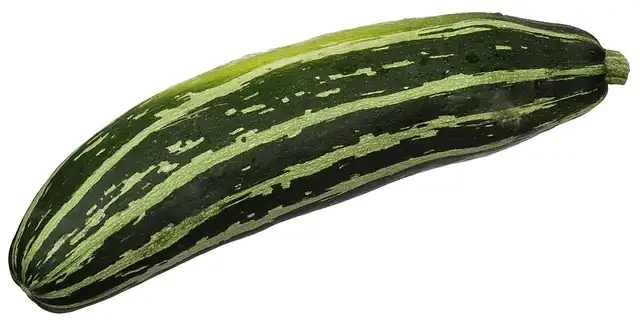
Zucchini (or zucchinis; in Australia and North America), courgette (in France and Britain), or Cucurbita pepo var. cylindrica is a summer squash, a vining herbaceous plant whose fruit are harvested when their immature seeds and epicarp (rind) are still soft and edible. It is closely related, but not identical, to the marrow; its fruit may be called marrow when mature.
Ordinary zucchini fruit are any shade of green, though the golden zucchini is a deep yellow or orange. At maturity, they can grow to nearly 1 meter in length, but they are normally harvested at about 15–25 cm. In botany, the zucchini's fruit is a pepo, a berry (the swollen ovary of the zucchini flower) with a hardened epicarp. In cookery, it is treated as a vegetable, usually cooked and eaten as an accompaniment or savory dish, though occasionally used in sweeter cooking.
Zucchini descend from squashes first domesticated in Mexico and Central America over 7,000 years ago, but the zucchini itself was bred in Milan in the late 19th century. Zucchini occasionally contain toxic cucurbitacins, making them extremely bitter, and causing severe gastro-enteric upsets. Causes include stressed growing conditions, and cross pollination with ornamental squashes.
Culinary uses
When used for food, zucchini are usually picked when under 20 cm in length, when the seeds are still soft and immature. Mature zucchini can be 1 m long or more. These larger ones often have mature seeds and hard skins, requiring peeling and seeding. Zucchini with the flowers attached are a sign of a truly fresh and immature fruit, and are especially sought after for their sweeter flavor.
Zucchini are usually served cooked. They can be prepared using a variety of cooking techniques, including steamed, boiled, grilled, stuffed and baked, barbecued, fried, or incorporated in other recipes such as soufflés. Raw grated zucchini can also be combined with flour and spices in a zucchini bread.
Zucchini have a delicate flavor and can be found simply cooked with butter or olive oil and herbs, or in more complex dishes. The skin is usually left in place. When frying zucchini, it is recommended to pat down cut sections to make them drier, similarly to what may be done with eggplant, in order to keep the slices' shape while cooking. Zucchini can also be eaten raw, sliced or shredded, in a cold salad, as well as lightly cooked in hot salads, as in Thai or Vietnamese recipes. Mature (larger-sized) zucchini are well-suited for cooking in breads.
Zucchini can be cut with a spiralizer into noodle-like spirals and used as a low-carbohydrate substitute for pasta or noodles, often referred to as 'zoodles'.
Zucchini can be shredded with a grater into and combined with shredded carrots, parmesan cheese, garlic, egg and flour. The resulting mixture can be then be formed into patties which can be cooked in vegetable oil on a stovetop.
France
Zucchini are much used in the cuisine of France, where they are known as courgettes. Among the recipes in two standard culinary works of reference – Louis Saulnier's Le répertoire de la cuisine and Walter Bickel's Hering's Dictionary of Classical and Modern Cookery – are:
Courgettes au fromage – With cheese: filled with grated cheese mixed with beaten egg, dipped in frying batter, deep fried.
Courgettes à la crème – Creamed: simmered in butter, bound with light cream sauce.
Courgettes à l'anglaise – English Style: peeled, cut in small pieces, steamed and served with melted butter or Hollandaise
Courgettes frites – Fried: peeled, cut in slices, seasoned, coated with flour and fried in oil.
Courgette beignets – Fritters: cut in slices, salted dipped in batter and deep-fried.
Courgettes glacées – Glazed: peeled, cut lengthwise in quarters, cooked with butter, salt and pinch of sugar and a few drops of water to glaze.
Courgettes à la grecque – Greek Style: cooked in a marinade of white wine. vinegar, garlic, onions. fennel, peppercorns and dried orange peel; served cold.
Italy
Italian dishes using zucchini include:
Spaghetti con salsa di zucchine (spaghetti with zucchini)
Sformato di vitello e zucchine (veal and zucchini pie)
Zucchine fritte (as for courgette beignets, above)
Zucchine in agrodolce (in sweet-sour sauce)
Zucchine stufate (stew)
Zucchine ripiene (with numerous possible stuffings – such as minced cold meat, rice, cheese, breadcrumbs, and parsley).
Britain
In Britain, zucchini (called "courgettes" there) were known in the 1930s but were rare until after the Second World War. In the 1989 revised edition of her Italian Food, Elizabeth David wrote, "I think it worth recording here that, when I was writing this book in 1954 ... zucchini or courgettes were rare and expensive luxuries, imported from France". By 1957 a leading nursery in Surrey initiated the cultivation of the vegetable for the British market and, in David's words, "before long they were to be found in many enterprising greengrocers’ shops [with] the general acceptance today of this attractive and versatile vegetable". In 2005, a poll of 2,000 people revealed the courgette to be Britain's 10th most popular culinary vegetable.
Middle East and Africa
In Egypt, zucchini may be cooked with tomato sauce, garlic, and onions. In Sephardic Jewish cuisine, medias (from Judeo-Spanish, meaning "halves") is a dish of halved zucchini stuffed with meat and a mixture of ingredients, and cooked in a sour lemon sauce.
Stuffed zucchini are found in many cuisines. As an example, in Lebanon, zucchini can be used to create Kousa Mahshi, which translates to "stuffed zucchini" in Arabic. The dish is made by coring the squash and then stuffing it with rice and spiced ground beef. Vegetables and other protein substitutes such as lamb may also be used. The contents of the zucchini are cooked by first boiling it and then reducing the heat of the zucchini's pot or container before letting it simmer for an hour. There's also Lebanese Zucchini Stew, or Mnazelah, a stew consisting of zucchini, potatoes, tomatoes, meat, and varied spices. Typical stuffings in the Middle Eastern family of dolma include rice, onions, tomato, and sometimes meat.
Australia and the Americas
In Australia, a popular dish is a frittata-like dish called zucchini slice.
In Mexico, the flower (known as flor de calabaza) is often cooked in soups or used as a filling for quesadillas. The fruit is used in stews, soups (i.e. caldo de res, de pollo, or de pescado, mole de olla, etc.) and other preparations. The flower, as well as the fruit, is eaten often throughout Latin America.
More to savor

Chicken Vindaloo

Pancakes (Vegan)
Leek at the Table: The Food Behind the Name