This longer reference provides the background behind the topic. Read it alongside the recipe collection when you want to connect an ingredient or food idea with a dish to prepare.
In this story
OverviewPhysical propertiesCulinaryAsian culinaryOther culinaryAgar plateMotility assaysOverview
Agar ( or ), or agar-agar, is a jelly-like substance consisting of polysaccharides obtained from the cell walls of some species of red algae (phylum Rhodophyta) primarily from the Gracilaria genus (Irish moss, ogonori) and the Gelidiaceae family (tengusa). These algae are known as agarophytes.
As found in nature, agar is a mixture of two components, the linear polysaccharide agarose and a heterogeneous mixture of smaller molecules called agaropectin. It forms the supporting structure in the cell walls of certain species of algae, and is released on boiling. The processing of food-grade agar removes the agaropectin, and the commercial product is essentially pure agarose.
Agar has been used as an ingredient in desserts throughout Asia and also as a solid substrate to contain culture media for microbiological work. Agar can be used as a laxative; an appetite suppressant; a vegan substitute for gelatin; a thickener for soups; in fruit preserves, ice cream, and other desserts; as a clarifying agent in brewing; and for sizing paper and fabrics.
Physical properties
Agar exhibits a phenomenon known as hysteresis whereby, when mixed with water, it solidifies and forms a gel below about 32–42 C, which is called the gel point, and melts above 85 C, which is the melting point. Hysteresis is the property of having a difference between the gel point and melting point temperatures. This property lends a suitable balance between easy melting and good gel stability at relatively high temperatures. Since many scientific applications require incubation at temperatures close to human body temperature (37 °C), agar is more appropriate than other solidifying agents that melt at this temperature, such as gelatin.
Culinary
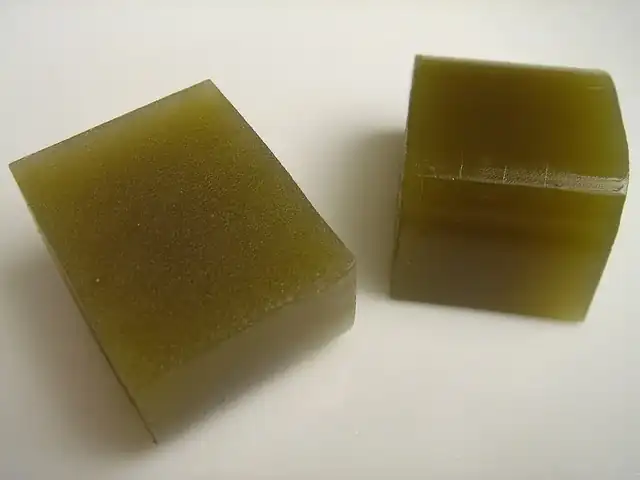
Agar-agar is a natural vegetable gelatin counterpart. It is white and semi-translucent when sold in packages as washed and dried strips or in powdered form. It can be used to make jellies, puddings, and custards. When making jelly, it is boiled in water until the solids dissolve. Sweetener, flavoring, coloring, fruits and or vegetables are then added, and the liquid is poured into molds to be served as desserts and vegetable aspics or incorporated with other desserts such as a layer of jelly in a cake.
Agar-agar is approximately 80% dietary fiber, so it can serve as an intestinal regulator. Its bulking quality has been behind fad diets in Asia, for example the kanten (the Japanese word for agar-agar) diet. Once ingested, kanten triples in size and absorbs water. This results in the consumers feeling fuller.
Asian culinary
One use of agar in Japanese cuisine is in anmitsu, a dessert made of small cubes of agar jelly and served in a bowl with various fruits or other ingredients. It is also the main ingredient in mizu yōkan, another popular Japanese food. In Philippine cuisine, it is used to make the jelly bars in the various gulaman refreshments like sago't gulaman, samalamig, or desserts such as buko pandan, agar flan, halo-halo, fruit cocktail jelly, and the black and red gulaman used in various fruit salads. In Vietnamese cuisine, jellies made of flavored layers of agar-agar, called thạch, are a popular dessert, and are often made in ornate molds for special occasions. In Indian cuisine, agar is used for making desserts. In Burmese cuisine, a sweet jelly known as kyauk kyaw is made from agar.
Agar jelly is used as a topping in Taiwanese bubble tea.
Other culinary
It can be used as addition to (or as a replacement for) pectin in jelly, jam, or marmalade, as a substitute to gelatin for its superior gelling properties, and as a strengthening ingredient in souffles and custards. Another use of agar-agar is in a Russian dish ptich'ye moloko (bird's milk), a rich jellified custard (or soft meringue) used as a cake filling or chocolate-glazed as individual sweets.
Agar-agar may also be used as the gelling agent in gel clarification, a culinary technique used to clarify stocks, sauces, and other liquids. Mexico has traditional candies made out of Agar gelatin, most of them in colorful, half-circle shapes that resemble a melon or watermelon fruit slice, and commonly covered with sugar. They are known in Spanish as Dulce de Agar (Agar sweets)
Agar-agar is an allowed nonorganic/nonsynthetic additive used as a thickener, gelling agent, texturizer, moisturizer, emulsifier, flavor enhancer, and absorbent in certified organic foods.
Agar plate
An agar plate or Petri dish is used to provide a growth medium using a mix of agar and other nutrients in which microorganisms, including bacteria and fungi, can be cultured and observed under the microscope. Agar is indigestible for many organisms so that microbial growth does not affect the gel used and it remains stable. Agar is typically sold commercially as a powder that can be mixed with water and prepared similarly to gelatin before use as a growth medium. Nutrients are typically added to meet the nutritional needs of the microbes organism, the formulations of which may be "undefined" where the precise composition is unknown, or "defined" where the exact chemical composition is known. Agar is often dispensed using a sterile media dispenser.
Different algae produce various types of agar. Each agar has unique properties that suit different purposes. Because of the agarose component, the agar solidifies. When heated, agarose has the potential to melt and then solidify. Because of this property, they are referred to as "physical gels". In contrast, polyacrylamide polymerization is an irreversible process, and the resulting products are known as chemical gels.
Motility assays
As a gel, an agar or agarose medium is porous and therefore can be used to measure microorganism motility and mobility. The gel's porosity is directly related to the concentration of agarose in the medium, so various levels of effective viscosity (from the cell's "point of view") can be selected, depending on the experimental objectives.
A common identification assay involves culturing a sample of the organism deep within a block of nutrient agar. Cells will attempt to grow within the gel structure. Motile species will be able to migrate, albeit slowly, throughout the gel, and infiltration rates can then be visualized, whereas non-motile species will show growth only along the now-empty path introduced by the invasive initial sample deposition.
More to savor

Chicken Vindaloo
Spaghetti alla Puttanesca
Gooseberry in the Kitchen: Exploring an Everyday Ingredient