This longer reference provides the background behind the topic. Read it alongside the recipe collection when you want to connect an ingredient or food idea with a dish to prepare.
In this story
OverviewModernBiologyPlantingDirect consumptionFlour-based foodsProduction and trade commoditiesOverview
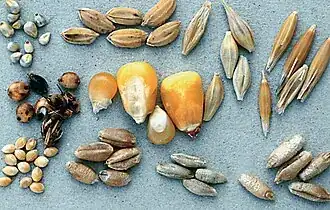
A cereal is a grass (family Poaceae) cultivated for its edible grain. Cereals are the world's largest crops, and are therefore staple foods. They include rice, wheat, rye, oats, barley, millet, and maize (US: corn). Edible grains from other plant families, such as amaranth, buckwheat and quinoa, are pseudocereals. Most cereals are annuals, producing one crop from each planting, though rice is sometimes grown as a perennial. Winter varieties are hardy enough to be planted in the autumn, becoming dormant in the winter, and harvested in spring or early summer; spring varieties are planted in spring and harvested in late summer. The term cereal is derived from the name of the Roman goddess of grain crops and fertility, Ceres.
Cereals were domesticated in the Neolithic around 8,000 years ago. Wheat and barley were domesticated in the Fertile Crescent. Rice and some millets were domesticated in East Asia, while sorghum and other millets were domesticated in Sudan. Maize was domesticated by Indigenous peoples of the Americas in Mexico about 9,000 years ago. In the 20th century, cereal productivity was greatly increased by the Green Revolution. This increase in production has accompanied a growing international trade, with some countries producing large portions of the cereal supply for other countries.
Cereals provide food eaten directly as whole grains, usually cooked, or they are ground to flour and made into bread, porridge, and other products. Cereals have a high starch content, enabling them to be fermented into alcoholic drinks such as beer. Cereal farming has a substantial environmental impact, and is often produced in high-intensity monocultures. The environmental harms can be mitigated by sustainable practices which reduce the impact on soil and improve biodiversity, such as no-till farming and intercropping.
Modern
Between 1964 and 2023, cereal production increased by 213%, mostly through higher yields: harvested area rose only by 10%. Yields of wheat and rice rose in the Green Revolution, a technological change funded by development organizations. The strategies included mechanized tilling, monoculture, nitrogen fertilizers, and breeding of new strains of seeds. These innovations fended off starvation and increased yield-per-plant, but paid less attention to nutritional quality. The high-yield cereal crops tend to have low-quality proteins, with essential amino acid deficiencies, are high in carbohydrates, and lack balanced essential fatty acids, vitamins, and minerals. So-called ancient grains and heirloom varieties grew in popularity with the "organic" movements of the early 21st century, but there is a tradeoff in yield-per-plant, putting pressure on resource-poor areas as food crops are replaced with cash crops.
Biology
Cereals are grasses, in the Poaceae family, that produce edible grains. A cereal grain is botanically a caryopsis, a fruit where the seed coat is fused with the pericarp. Grasses have stems that are hollow except at the nodes and narrow alternate leaves borne in two ranks. The lower part of each leaf encloses the stem, forming a leaf-sheath. The leaf grows from the base of the blade, an adaptation that protects the growing meristem from grazing animals. The flowers are usually hermaphroditic, with the exception of maize, and mainly anemophilous or wind-pollinated, although insects occasionally play a role.
Among the best-known cereals are maize, rice, wheat, barley, sorghum, millet, oat, rye and triticale. Some other grains are colloquially called cereals, even though they are not grasses; these pseudocereals include buckwheat, quinoa, and amaranth.
Planting
In the tropics, warm-season cereals can be grown at any time of the year. In temperate zones, these cereals can only be grown when there is no frost. Most cereals are planted in tilled soils, which reduces weeds and breaks up the surface of a field. Most cereals need regular water in the early part of their life cycle. Rice is commonly grown in flooded fields, though some strains are grown on dry land. Other warm climate cereals, such as sorghum, are adapted to arid conditions.
Cool-season cereals are grown mainly in temperate zones. These cereals often have both winter varieties for autumn sowing, winter dormancy, and early summer harvesting, and spring varieties planted in spring and harvested in late summer. Winter varieties have the advantage of using water when it is plentiful, and permitting a second crop after the early harvest. They flower only in spring as they require vernalization, exposure to cold for a specific period, fixed genetically. Spring crops grow when it is warmer but less rainy, so they may need irrigation.
Direct consumption
Some cereals such as rice require little preparation before human consumption. For example, to make plain cooked rice, raw milled rice is washed and boiled. Foods such as porridge and muesli may be made largely of whole cereals, especially oats, whereas commercial breakfast cereals such as granola may be highly processed and combined with sugars, oils, and other products.
Flour-based foods
Cereals can be ground to make flour. Wheat flour is the main ingredient of bread and pasta. Maize flour has been important in Mesoamerica since ancient times, with foods such as Mexican tortillas and tamales. Rye flour is a constituent of bread in central and northern Europe, while rice flour is common in Asia.
A cereal grain consists of starchy endosperm, germ, and bran. Wholemeal flour contains all of these; white flour is without some or all of the germ or bran.
Production and trade commodities
Cereals constitute the world's largest commodities by tonnage, whether measured by production or by international trade. Several major producers of cereals dominate the market.
Because of the scale of the trade, some countries have become reliant on imports, thus cereals pricing or availability can have outsized impacts on countries with a food trade imbalance and thus food security. Speculation, as well as other compounding production and supply factors leading up to the 2008 financial crisis, created rapid inflation of grain prices during the 2007–2008 world food price crisis. Other disruptions, such as climate change or war related changes to supply or transportation can create further food insecurity; for example the Russian invasion of Ukraine in 2022 disrupted Ukrainian and Russian wheat supplies causing a global food price crisis in 2022 that affected countries heavily dependent on wheat flour.
Production
More to savor

Chicken Vindaloo
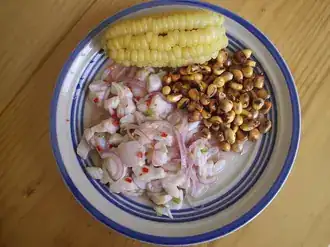
White Fish Ceviche (Cebiche de Pescado)
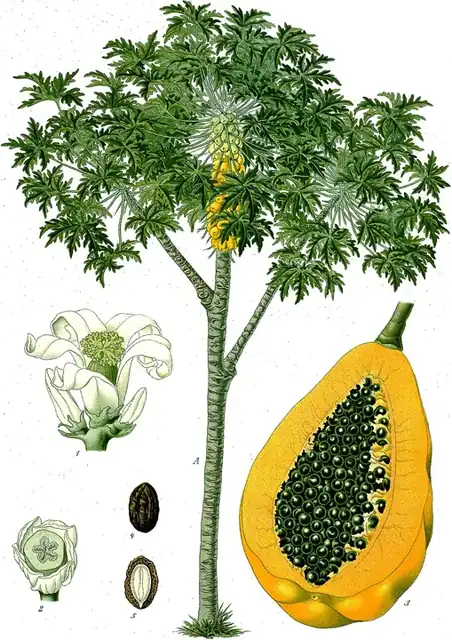
Papaya in the Kitchen: Exploring an Everyday Ingredient