This longer reference provides the background behind the topic. Read it alongside the recipe collection when you want to connect an ingredient or food idea with a dish to prepare.
In this story
OverviewCivilizationsRevolutionTypesProductionLivestock production systemsProduction practicesOverview
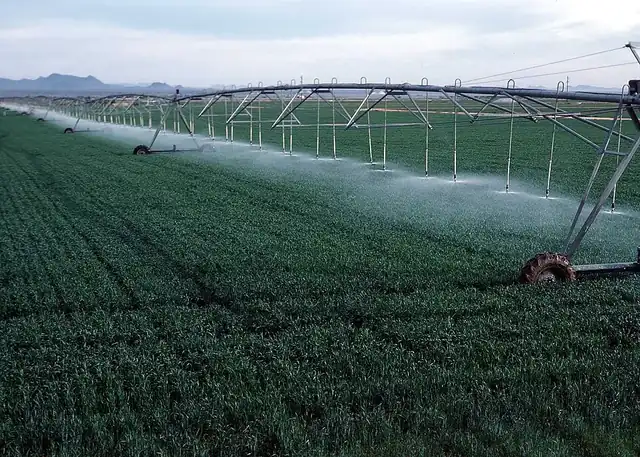
Agriculture is the practice of cultivating the soil, planting, raising, and harvesting both food and non-food crops, as well as livestock production. Broader definitions also include forestry and aquaculture. Agriculture was a key factor in the rise of sedentary human civilization, whereby farming of domesticated plants and animals created food surpluses that enabled people to live in the cities. While humans started gathering grains at least 105,000 years ago, nascent farmers only began planting them around 11,500 years ago. Sheep, goats, pigs, and cattle were domesticated around 10,000 years ago. Plants were independently cultivated in at least 11 regions of the world. In the 20th century, industrial agriculture based on large-scale monocultures came to dominate agricultural output.
As of 2021, small farms, of which the vast majority are one hectare (about 2.5 acres) or smaller, produce about one-third of the world's food. Moreover, five of every six farms in the world consist of fewer than 2 hectare and take up only around 12% of all agricultural land. In terms of total land use, large farms are dominant. While only 1% of all farms globally are greater than 50 hectare, they encompass more than 70% of the world's farmland. Further, nearly 40% of all global agricultural land is found on farms larger than 1,000 hectare.
Farms and farming greatly influence rural economics and greatly shape rural society, affecting both the direct agricultural workforce and broader businesses that support the farms and farming populations.
Civilizations
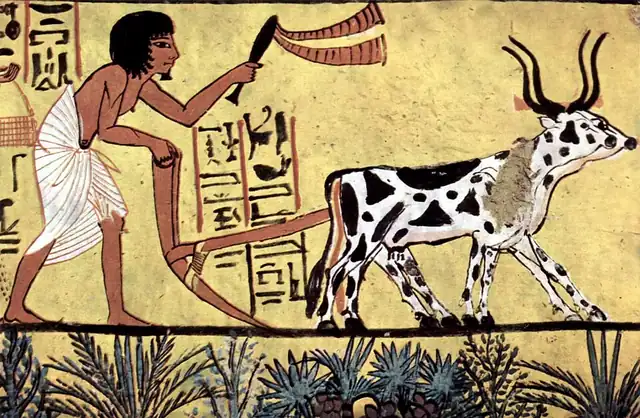
In the Middle East, the Sumerians started to live in villages from about 8000 BC, relying on the Tigris and Euphrates rivers and a canal system for irrigation. Ploughs appear in pictographs around 3000 BC; seed-ploughs around 2300 BC. Farmers grew wheat, barley, vegetables such as lentils and onions, and fruits including dates, grapes, and figs. Ancient Egyptian agriculture relied on the Nile River and its seasonal flooding. Farming started in the predynastic period at the end of the Paleolithic, after 10,000 BC. Staple food crops were grains such as wheat and barley, alongside industrial crops such as flax and papyrus.
In India, wheat, barley and jujube were domesticated by 9000 BC, soon followed by sheep and goats. Cattle, sheep and goats were domesticated in Mehrgarh culture by 8000–6000 BC. Cotton was cultivated by the 5th–4th millennium BC. Archeological evidence indicates an animal-drawn plough from 2500 BC in the Indus Valley civilization.
Revolution
In the Middle Ages, compared to the Roman period, agriculture in Western Europe became more focused on self-sufficiency. The agricultural population under feudalism was typically organized into manors consisting of several hundred or more acres of land presided over by a lord of the manor with a Roman Catholic church and priest.
Thanks to the exchange with the Al-Andalus where the Arab Agricultural Revolution was underway, European agriculture transformed, with improved techniques and the diffusion of crop plants, including the introduction of sugar, rice, cotton and fruit trees (such as the orange).
Types
Pastoralism involves managing domesticated animals. In nomadic pastoralism, herds of livestock are moved from place to place in search of pasture, fodder, and water. This type of farming is practiced in arid and semi-arid regions of Sahara, Central Asia and some parts of India.
In shifting cultivation, a small area of forest is cleared by cutting and burning the trees. The cleared land is used for growing crops for a few years until the soil becomes too infertile, and the area is abandoned. Another patch of land is selected and the process is repeated. This type of farming is practiced mainly in areas with abundant rainfall where the forest regenerates quickly. This practice is used in Northeast India, Southeast Asia, and the Amazon Basin.
Subsistence farming is practiced to satisfy family or local needs alone, with little left over for transport elsewhere. It is intensively practiced in Monsoon Asia and South-East Asia. An estimated 2.5 billion subsistence farmers worked in 2018, cultivating about 60% of the earth's arable land.
Production
Overall production varies by country as listed.
Livestock production systems
Animal husbandry is the breeding and raising of animals for meat, milk, eggs, or wool, and for work and transport. Working animals, including horses, mules, oxen, water buffalo, camels, llamas, alpacas, donkeys, and dogs, have for centuries been used to help cultivate fields, harvest crops, wrangle other animals, and transport farm products to buyers.
Livestock production systems can be defined based on feed source, as grassland-based, mixed, and landless. As of 2010, 30% of Earth's ice- and water-free area was used for producing livestock, with the sector employing approximately 1.3 billion people. Between the 1960s and the 2000s, there was a significant increase in livestock production, both by numbers and by carcass weight, especially among beef, pigs and chickens, the latter of which had production increased by almost a factor of 10. Non-meat animals, such as milk cows and egg-producing chickens, also showed significant production increases. Global cattle, sheep and goat populations are expected to continue to increase sharply through 2050. Aquaculture or fish farming, the production of fish for human consumption in confined operations, is one of the fastest growing sectors of food production, growing at an average of 9% a year between 1975 and 2007.
During the second half of the 20th century, producers using selective breeding focused on creating livestock breeds and crossbreeds that increased production, while mostly disregarding the need to preserve genetic diversity. This trend has led to a significant decrease in genetic diversity and resources among livestock breeds, leading to a corresponding decrease in disease resistance and local adaptations previously found among traditional breeds.
Production practices
Tillage is the practice of breaking up the soil with tools such as the plow or harrow to prepare for planting, for nutrient incorporation, or for pest control. Tillage varies in intensity from conventional to no-till. It can improve productivity by warming the soil, incorporating fertilizer and controlling weeds, but also renders soil more prone to erosion, triggers the decomposition of organic matter releasing CO2, and reduces the abundance and diversity of soil organisms.
Pest control includes the management of weeds, insects, mites, and diseases. Chemical (pesticides), biological (biocontrol), mechanical (tillage), and cultural practices are used. Cultural practices include crop rotation, culling, cover crops, intercropping, composting, avoidance, and resistance. Integrated pest management attempts to use all of these methods to keep pest populations below the number which would cause economic loss, and recommends pesticides as a last resort.
More to savor

Reuben Sandwich

Basic Omelet
History of agriculture: A Closer Look at Food and How We Eat