This longer reference provides the background behind the topic. Read it alongside the recipe collection when you want to connect an ingredient or food idea with a dish to prepare.
Overview
Agriculture began independently in different parts of the globe, and included a diverse range of taxa. At least eleven separate regions of the Old and New World were involved as independent centers of origin.
The development of agriculture about 12,000 years ago changed the way humans lived. They switched from nomadic hunter-gatherer lifestyles to permanent settlements and farming.
Early development
Early people began altering communities of flora and fauna for their own benefit through means such as fire-stick farming and forest gardening very early. Wild grains have been collected and eaten from at least 105,000 years ago, and possibly much longer. Exact dates are hard to determine, as people collected and ate seeds before domesticating them, and plant characteristics may have changed during this period without human selection. An example is the semi-tough rachis and larger seeds of cereals from just after the Younger Dryas (about 9500 BC) in the early Holocene in the Levant region of the Fertile Crescent. Monophyletic characteristics were attained without any human intervention, implying that apparent domestication of the cereal rachis could have occurred quite naturally.
Agriculture began independently in different parts of the globe and included a diverse range of taxa. At least 11 separate regions of the Old and New World were involved as independent centers of origin. Some of the earliest known domestications were of animals. Domestic pigs had multiple centres of origin in Eurasia, including Europe, East Asia and Southwest Asia, where wild boar were first domesticated about 10,500 years ago. Sheep were domesticated in Mesopotamia between 11,000 BC and 9000 BC. Cattle were domesticated from the wild aurochs in the areas of modern Turkey and India around 8500 BC. Camels were domesticated relatively late, perhaps around 3000 BC.
It was not until after 9500 BC that the eight so-called founder crops of agriculture appear: first emmer and einkorn wheat, then hulled barley, peas, lentils, bitter vetch, chick peas and flax. These eight crops occur more or less simultaneously on Pre-Pottery Neolithic B (PPNB) sites in the Levant, although wheat may have been the first to be grown and harvested on a significant scale. At around the same time (9400 BC), parthenocarpic fig trees were domesticated.
Sumer
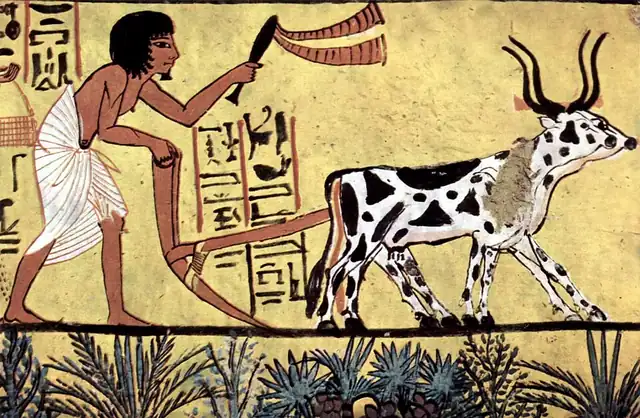
Sumerian farmers grew the cereals barley and wheat, starting to live in villages from about 8000 BC. Given the low rainfall of the region, agriculture relied on the Tigris and Euphrates rivers. Irrigation canals leading from the rivers permitted the growth of cereals in large enough quantities to support cities. The first ploughs appear in pictographs from Uruk around 3000 BC; seed-ploughs that funneled seed into the ploughed furrow appear on seals around 2300 BC. Vegetable crops included chickpeas, lentils, peas, beans, onions, garlic, lettuce, leeks and mustard. They grew fruits including dates, grapes, apples, melons, and figs. Alongside their farming, Sumerians also caught fish and hunted fowl and gazelle. The meat of sheep, goats, cows and poultry was eaten, mainly by the elite. Fish was preserved by drying, salting and smoking.
Indian Subcontinent
Jujube was domesticated in the Indian subcontinent by 9000 BC. Barley and wheat cultivation – along with the domestication of cattle, primarily sheep and goats – followed in Mehrgarh culture by 8000–6000 BC. This period also saw the first domestication of the elephant. Pastoral farming in India included threshing, planting crops in rows – either of two or of six – and storing grain in granaries. Cotton was cultivated by the 5th–4th millennium BC. By the 5th millennium BC, agricultural communities became widespread in Kashmir. Irrigation was developed in the Indus Valley Civilisation by around 4500 BC. The size and prosperity of the Indus civilization grew as a result of this innovation, leading to more thoroughly planned settlements which used drainage and sewers. Archeological evidence of an animal-drawn plough dates back to 2500 BC in the Indus Valley Civilization.
Roman Empire
In the Greco-Roman world of Classical antiquity, Roman agriculture was built on techniques originally pioneered by the Sumerians, transmitted to them by subsequent cultures, with a specific emphasis on the cultivation of crops for trade and export. The Romans laid the groundwork for the manorial economic system, involving serfdom, which flourished in the Middle Ages. The farm sizes in Rome can be divided into three categories. Small farms were from 18 to 88 iugera (one iugerum is equal to about 0.65 acre). Medium-sized farms were from 80 to 500 iugera (singular iugerum). Large estates (called latifundia) were over 500 iugera.
The Romans had four systems of farm management: direct work by the owner and his family; slaves doing work under the supervision of slave managers; tenant farming or sharecropping in which the owner and a tenant divide up a farm's produce; and situations in which a farm was leased to a tenant.
The Americas
Agricultural history took a different path from the Old World as the Americas lacked large-seeded, easily domesticated grains (such as wheat and barley) and large domestic animals that could be used for agricultural labor. Rather than the practice which developed in the Old World of sowing a field with a single crop, pre-historic American agriculture usually consisted of cultivating many crops close to each other utilizing only hand labor. Moreover, agricultural areas in the Americas lacked the uniformity of the east–west area of Mediterranean and semi-arid climates in southern Europe and southwestern Asia, but instead had a north–south pattern with a variety of different climatic zones in close proximity to each other. This fostered the domestication of many different plants.
South America
The earliest known areas of possible agriculture in the Americas dating to about 9000 BC are in Colombia, near present-day Pereira, and by the Las Vegas culture in Ecuador on the Santa Elena peninsula. The plants cultivated (or manipulated by humans) were lerén (Calathea allouia), arrowroot (Maranta arundinacea), squash (Cucurbita species), and bottle gourd (Lagenaria siceraria). All are plants of humid climates and their existence at this time on the semi-arid Santa Elena peninsula may be evidence that they were transplanted there from more humid environments. In another study, this area of South America was identified as one of the four oldest places of origin for agriculture, along with the Fertile Crescent, China, and Mesoamerica, dated between 6200 BC and 10000 BC.
(To facilitate comprehension by readers, Radiocarbon calibrated BP dates in the above sources have been converted to BC.)
More to savor

South Indian Millet Swallow (Mudde)

Reuben Sandwich
Agriculture: A Closer Look at Food and How We Eat