This longer reference provides the background behind the topic. Read it alongside the recipe collection when you want to connect an ingredient or food idea with a dish to prepare.
Overview
The almond (Prunus amygdalus, syn. Prunus dulcis (Mill.) D.A.Webb, nom. illeg. non Prunus dulcis Rouchy) is a species of tree from the genus Prunus. Along with the peach, it is classified in the subgenus Amygdalus, distinguished from the other subgenera by corrugations on the woody shell (endocarp) surrounding the seed.
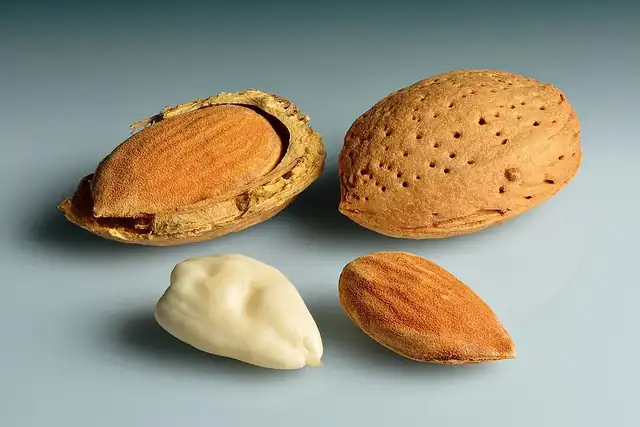
The fruit of the almond is a drupe, consisting of an outer hull and a hard shell with the seed, which is not a true nut. Shelling almonds refers to removing the shell to reveal the seed. Almonds are sold shelled or unshelled. Blanched almonds are unshelled almonds that have been treated with hot water to soften the outer skin, which is then removed to reveal the white embryo. Once almonds are cleaned and processed, they can be stored for around a year if kept refrigerated; at higher temperatures they will become rancid more quickly. Almonds are used in many cuisines, often featuring prominently in desserts, such as marzipan.
The almond tree prospers in a moderate Mediterranean climate with cool winter weather. It is rarely found wild in its original setting. Almonds were one of the earliest domesticated fruit trees, due to the ability to produce quality offspring entirely from seed, without using suckers and cuttings. Evidence of domesticated almonds in the Early Bronze Age has been found in the archeological sites of the Middle East, and subsequently across the Mediterranean region and similar arid climates with cool winters.
Description
The almond is a deciduous tree growing to 3 - 4.5 m in height, with a trunk of up to 30 cm in diameter. The young twigs are green at first, becoming purplish where exposed to sunlight, then grey in their second year. The leaves are 3 - 5 in long, with a serrated margin and a 2.5 cm petiole.
The fragrant flowers are white to pale pink, 3 - 5 cm diameter with five petals, produced singly or in pairs and appearing before the leaves in early spring. Almond trees thrive in Mediterranean climates with warm, dry summers and mild, wet winters. The optimal temperature for their growth is between 15 and 30 C and the tree buds have a chilling requirement of 200 to 700 hours below 7.2 °C to break dormancy.
Scientific name
The almond was named Amygdalus communis by Carl Linnaeus in his Species plantarum in 1753. For the name 'Amygdalus' he referred to Gaspard Bauhin's Pinax (1623). In 1801 the species was for the first time placed in the genus Prunus by August Batsch. In that genus, the name Prunus communis was no longer available because in 1778 William Hudson had already assigned it to a taxon in which he included the plum (Prunus domestica). Batsch thereupon named the species Prunus amygdalus, where 'amygdalus' is the old generic name and should therefore be treated as a noun in apposition. Meanwhile, in 1768, Philip Miller had published the name of what he believed to be a second species of almond: Amygdalus dulcis. He mentioned Linnaeus' Amygdalus communis as the first species.
It was not until 1967 that the combination Prunus dulcis was published for the almond by David Allardice Webb, on the assumption that Amygdalus dulcis was nothing more than a synonym of Amygdalus communis, and thus an available name for that species. The epithet dulcis (1768) is older than amygdalus (1801) and would therefore have priority. Webb noted that it was unfortunate that a species known for 165 years as Prunus amygdalus now had to be renamed under the rules of nomenclature. However, it later turned out that in 1967 the name Prunus dulcis was no longer available for the almond because it had already been used for a cherry in an 1878 publication by L'Abbé Rouchy. The oldest valid combination in Prunus is therefore Prunus amygdalus.
Sweet and bitter almonds
The seeds of Prunus amygdalus var. dulcis are predominantly sweet but some individual trees produce seeds that are somewhat more bitter. The genetic basis for bitterness involves a single gene, the bitter flavour furthermore being recessive, both aspects making this trait easier to domesticate. The fruits from Prunus amygdalus var. amara are always bitter, as are the kernels from other species of genus Prunus, such as apricot, peach and cherry (although to a lesser extent).
The bitter almond is slightly broader and shorter than the sweet almond and contains about 50% of the fixed oil that occurs in sweet almonds. It contains the enzyme emulsin which, in the presence of water, acts on the two soluble glucosides amygdalin and prunasin yielding glucose, cyanide and the essential oil of bitter almonds, which is nearly pure benzaldehyde, the chemical causing the bitter flavour. Bitter almonds may yield 4–9 milligrams of hydrogen cyanide per almond and contain 42 times higher amounts of cyanide than the trace levels found in sweet almonds. The origin of cyanide content in bitter almonds is via the enzymatic hydrolysis of amygdalin. P450 monooxygenases are involved in the amygdalin biosynthetic pathway. A point mutation in a bHLH transcription factor prevents transcription of the two cytochrome P450 genes, resulting in the sweet kernel trait.
Varieties
Almond trees are small to medium-sized but commercial cultivars can be grafted onto a different root-stock to produce smaller trees. Varieties include:
Nonpareil – originates in the 1800s. A large tree that produces large, smooth, thin-shelled almonds with 60–65% edible kernel per nut. Requires pollination from other almond varieties for good nut production.
Production
In 2024, world production of almonds was 3.9 million tonnes, led by the United States with 51% of the total, followed by Australia and Spain as secondary producers (table).
Culinary
While the almond is often eaten on its own, raw or toasted, it is also a component of various dishes. Almonds are available in many forms, such as whole, slivered, and ground into flour. Almond pieces around 2–3 mm in size, called "nibs", are used for special purposes such as decoration. A wide range of classic sweets feature almonds as a central ingredient. Marzipan was developed in the Middle Ages. Since the 19th century almonds have been used to make bread, almond butter, cakes and puddings, candied confections, almond cream-filled pastries, nougat, cookies (macaroons, biscotti and qurabiya), and cakes (financiers, Esterházy torte), and other sweets and desserts. In Saudi Arabia, almonds are a typical embellishment for the rice dish kabsa.
Spanish cookery uses almonds in sweet dishes as well as in savory ones, ground up to thicken sauces and stews.
More to savor

Chicken Vindaloo

Banoffee Pie

Getting to Know Mozzarella: A Food Lover’s Guide