This longer reference provides the background behind the topic. Read it alongside the recipe collection when you want to connect an ingredient or food idea with a dish to prepare.
In this story
OverviewDescriptionHistoryProductionCultivarsCulinary useAlcoholic drinkCultural associationsOverview
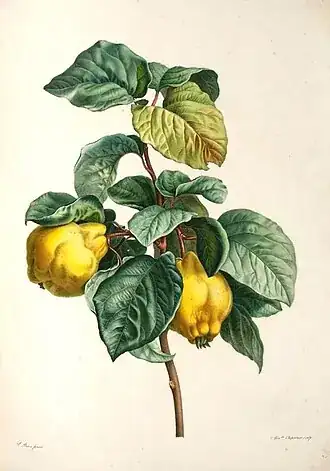
The quince (Cydonia oblonga) is the sole member of the genus Cydonia in the Malinae subtribe (which contains apples, pears, and other fruits) of the Rosaceae family. It is a deciduous tree that bears hard, aromatic bright golden-yellow pome fruit, similar in appearance to a pear. Ripe quince fruits are hard, tart, and astringent. They are eaten raw or processed into jam, quince cheese, or alcoholic drinks.
The quince tree is sometimes grown as an ornamental plant for its attractive pale pink blossoms and as a miniature bonsai plant.
Description
Quinces are shrubs or small trees up to 4 to 6 m tall and 3 to 4.5 m wide. Young twigs are covered in a grey down. The leaves are oval, and are downy on the underside. The solitary flowers, produced in late spring after the leaves, are white or pink.
The ripe fruit is aromatic but remains hard; gritty stone cells are dispersed through the flesh. It is larger than many apples, weighing as much as 1 kg, often pear-shaped but sometimes roughly spherical.
The seeds contain nitriles, common in the seeds of the rose family. In the stomach, enzymes or stomach acid or both cause some of the nitriles to be hydrolysed and produce toxic hydrogen cyanide, which is a volatile gas. The seeds are toxic only if eaten in large quantities.
History
Quince is native to the Hyrcanian forests south of the Caspian Sea in Iran. From that centre of origin it was spread radially by Neolithic farmers, c. 5000 to 3000 BC, to secondary centres including Turkey, Azerbaijan, Turkmenistan, Kashmir, Afghanistan, and Syria. In turn, landraces of quince were then distributed across Europe, Russia, China, India, and North Africa. Charlemagne directed that quinces be planted in well-stocked orchards. Quinces in England are first recorded in about 1275, when Edward I had some planted at the Tower of London. The fruit had acquired its English name by the 14th century. Settlers brought it to North America in the 17th century, and to Central and South America in the 18th century.
In the 18th-century New England colonies, there was always a quince at the lower corner of the vegetable garden, Ann Leighton notes in records of Portsmouth, New Hampshire and Newburyport, Massachusetts.
The fruit was known in the Akkadian language as supurgillu; "quinces" (collective plural), which was borrowed into Aramaic as ספרגלין sparglin; it was known in Judea during the Mishnaic Hebrew as פרישין prishin (a loanword from Jewish Palestinian Aramaic פרישין "the miraculous [fruit]"); quince flourished in the heat of the Mesopotamian plain, where apples did not. It was cultivated from an archaic period around the Mediterranean. Some ancients called the fruit "golden apples".
The Greeks associated it with Kydonia on Crete, as the "Cydonian pome", and Theophrastus, in his Enquiry into Plants, noted that quince was one of many fruiting plants that do not come true from seed.
Production
In 2023, world production of quinces was 687,036 tonnes, with Turkey and China accounting for 44% of the total (table).
Cultivars
Quince cultivars include:
'Champion'
'Cooke's Jumbo' (syn. 'Jumbo')
'Dwarf Orange'
'Gamboa'
'Le Bourgeaut'
'Lescovacz'
'Ludovic'
'Maliformis'
'Meeches Prolific'
'Morava'
'Orange' (syn. 'Apple quince')
'Perfume'
'Pineapple'
'Portugal' (syn. 'Lusitanica')
'Siebosa'
'Smyrna'
'Van Deman'
'Vranja' (syn. 'Bereczki')
The cultivars 'Vranja' Nenadovic and 'Serbian Gold' have gained the Royal Horticultural Society's Award of Garden Merit.
Culinary use
Quinces have intense aroma, flavour, and tartness; most varieties are too hard and tart to be eaten raw. They may be cooked or roasted and used for jams, marmalade, jellies, or pudding. A few varieties, such as 'Aromatnaya' and 'Kuganskaya', can be eaten raw. High in pectin, they are used to make jam, jelly and quince pudding, or they may be peeled, then roasted, baked or stewed; pectin levels diminish as the fruit ripens. Long cooking with sugar turns the flesh of the fruit red due to the presence of pigmented anthocyanins.
The strong flavour means they can be added in small quantities to apple pies and jam. Adding a diced quince to apple sauce enhances the taste of the apple sauce.
Quince cheese or quince jelly originated from the Iberian Peninsula and is a firm, sticky, sweet reddish hard paste made by slowly cooking down the quince fruit with sugar. It is called dulce de membrillo in the Spanish-speaking world, where it is eaten with manchego cheese. Its Portuguese name, "marmelada" (from "''" = "quince", +"ada" analogously as in ""), entered the international lexicon to attain a more general meaning.
Quince is used in the Levant, especially in Syria. It is added to either chicken or kibbeh to create an intense and unique taste such as with kibbeh safarjaliyeh.
Alcoholic drink
In the Balkans, quince eau-de-vie (rakija) is made. Ripe fruits of sweeter varieties are washed and cleared of rot and seeds, then crushed or minced, mixed with cold or boiling sweetened water and yeast, and left for several weeks to ferment. The fermented mash is distilled once, obtaining a 20–30 ABV, or twice, producing an approximately 60% ABV liquor. The two distillates may be mixed or diluted with distilled water to obtain the final product, containing 42–43% ABV.
In Carolina in 1709, the explorer and naturalist John Lawson wrote that he was "not a fair judge of the different sorts of Quinces which they call Brunswick, Portugal and Barbary", but "of this fruit they make a wine or liquor which they call Quince-Drink and which I approve of beyond any drink that their country affords ... The Quince-Drink most commonly purges".
Cultural associations
In Plutarch's Lives, Solon is said to have decreed that "bride and bridegroom shall be shut into a chamber, and eat a quince together." The hero Hercules is associated with golden apples; these are thought by some scholars probably to have been quinces. When a baby is born in the Balkans, a quince tree is planted as a symbol of fertility, love and life. Edward Lear's 1870 nonsense poem The Owl and the Pussycat contains the lines
Kate Young writes in The Guardian'' that the poem may be nonsense, but that slices of quince work well with a meringue and whipped cream dessert.
More to savor

Chicken Vindaloo
Coconut Chicken
Getting to Know Grape: A Food Lover’s Guide