A drink can be an everyday routine, something shared with company, or a way to explore a food tradition. The background below looks more closely at the preparation and story behind the cup or glass.
Overview
Arabic coffee, known in Arabic as qahwa (قهوة), is a family of brewed coffee made from Coffea arabica beans. Most Arab countries throughout the Middle East developed distinct methods for brewing and preparing coffee. Cardamom is an often-added spice, but it can also be served plain or with sugar.
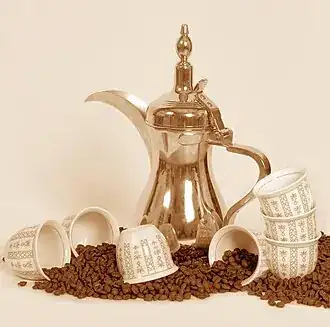
Arabic coffee is bitter and usually served without sugar. It is typically brewed in a dallah or cezve, and served in a small cup decorated with a pattern, known as a finjān. Culturally, Arabic coffee is served during family gatherings or when receiving guests, with its preparation reflecting local customs.
Arabic coffee originated in Greater Yemen, beginning in the port city of Mokha in Yemen and eventually travelling to Mecca in Hejaz, Egypt, the Levant, and then, in the mid-16th century, to Turkey and from there to Europe where coffee eventually became popular as well. Arabic coffee is an Intangible Cultural Heritage of Arab states, confirmed by UNESCO. Every year on 3 March, Yemenis celebrate the "Yemeni Coffee Day," a national festival to encourage coffee cultivation.
Preparation
Arabic coffee is made from lightly to heavily roasted Arabica beans (165 to 210 C) mixed with cardamom, and sometimes flavored with cloves or saffron.
Traditionally, the process begins by roasting green beans in a mihmas (a flat, long-handled iron or bronze roasting pan). Once roasted, the beans are cooled and then crushed in a mihbaj, a large wooden, stone, or brass mortar and pestle. The rhythmic sound of the ''mihbaj'' striking the mortar was historically used as a signal to neighbors that coffee was being prepared and guests were welcome.
The coffee is boiled but not filtered, producing a strong, concentrated drink. It is generally unsweetened (qahwah saada), though sugar may be added during preparation or serving. To balance the bitterness, it is often accompanied by dates, dried or candied fruit, nuts, or other sweets.
Arabic coffee is served in small, handleless cups called finjān.
Arabian Peninsula
In the Arabian Peninsula, Arabic coffee is typically brewed and served from a pot called a "dallah". It is almost always accompanied by dates and offered as a gesture of hospitality. In restaurants, it may be served by waiters called qahwaji.
Light roasting is common in Saudi Arabia, especially in the Najd and Hejaz regions, giving the coffee a golden or blonde color. Spices such as saffron, cardamom, cloves, and cinnamon may be added, with cardamom being the most essential.
In North Arabia, a darker variation known as qahwah shamāliyya (literally "Northern coffee") is prepared by roasting the beans for a longer time.
In the Gulf states, qahwa khaleeji (literally "Gulf coffee") typically has a bright yellow colour due to the heavy use of saffron and cardamom, and very light roasts.
In Yemen, Arabic coffee is often brewed with the addition of local spice blends called hawaij.
Levant
In the Levant, Arabic coffee is similar to Turkish coffee, but is typically spiced with cardamom. The beverage is brewed from finely ground coffee beans, using either a dark roast or a blend of light and dark roasts.' It is traditionally prepared in a long-handled pot known as a "rakwa". In rural regions, among Bedouin communities, and when brewing larger quantities, a larger, long-spouted metal pot known as a "bakraj" is commonly utilized.
The level of sweetness is reflected in the terminology used: unsweetened ("sada"), moderately sweetened ("wasat"), or sweet ("hilwe").
Serving coffee is often ceremonial. The host, or the eldest son, moves clockwise among guests, pouring coffee according to age and status. It is polite to accept three cups, with the last cup traditionally concluded by saying daymen (“always”), wishing the host continued means to serve coffee.
Morocco
The national drink of Morocco is gunpowder green tea brewed with fresh mint. Espresso is very popular, but Arabic coffee is also widely consumed, especially on formal occasions. It is often made with the purpose of conducting a business deal and welcoming someone into one's home for the first time, and frequently served at weddings and on important occasions.
Coffeehouse
Coffeehouse culture began in the Arab world, and eventually spread to other areas of the world and blended with the local culture. Traditional Arab coffeehouses are places where mostly men meet to socialize over games, coffee, and water pipes (shisha or argille). Depending on where the coffeehouse is, its specialty differs. In Maghreb, green tea is served with mint or coffee is served Arab and/or European style. Arabic coffee, or Turkish coffee, is made in Egypt and the Levant countries. Arabic coffee is a very small amount of dark coffee boiled in a pot and presented in a demitasse cup. Particularly in Egypt, coffee is served mazbuuta, which means the amount of sugar will be "just right", about one teaspoon per cup.
However, in the Arabian Peninsula, Arabic coffee is roasted in such a way that the coffee is almost clear. In all of the Arab world, it is traditional for the host to refill the guest's cup until politely signaled that the guest is finished.
Serving
Coffee is part of the hospitality tradition of the inhabitants of the Arabian Peninsula, and guests are often welcomed with the phrase "Come in for coffee," regardless of the actual range of food and drinks served.
Arabic coffee is usually served just a few centiliters at a time. Arabic coffee is served following formal etiquette for the host, the visitor, and the server. The server is required to hold the dallah with the palm of his right hand positioned at the top, while using the left hand to hold the cup. In accordance with guest etiquette, the cup should be received and returned to the server by using the right hand. Priority is given to the oldest or most significant guest. The guest drinks it and if he wishes, he will gesture to the waiter not to pour any more. Otherwise, the host/waiter will continue to serve another few centilitres at a time until the guest indicates he has had enough.
The most common practice is to drink only one cup since serving coffee serves as a ceremonial act of kindness and hospitality. Sometimes people also drink larger volumes during conversations.
More to savor

Paprika Chicken

Loukoumas (Greek Donuts with Honey) II
Oolong: The Tea Between Familiar Categories