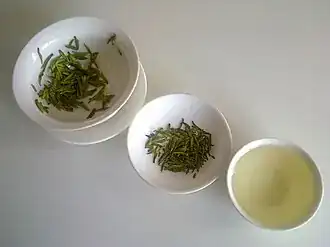
A drink can be an everyday routine, something shared with company, or a way to explore a food tradition. The background below looks more closely at the preparation and story behind the cup or glass.
Overview
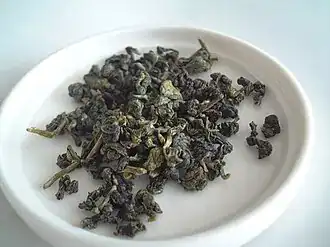
Oolong (;'black dragon' tea) is a traditional semi-oxidized Chinese tea (Camellia sinensis) produced through a process that includes withering the leaves under strong sun and allowing some oxidation to occur before curling and twisting. Most oolong teas, especially those of fine quality, involve unique tea plant cultivars that are exclusively used for particular varieties. The degree of oxidation, which is controlled by the length of time between picking and final drying, can range from 8% to 85% depending on the variety and production style. Oolong is especially popular in southeastern China and among ethnic Chinese in Southeast Asia, as is the Fujian preparation process known as the gongfu tea ceremony.
Different styles of oolong tea can vary widely in flavor. They can be sweet and fruity with honey aromas, woody and thick with roasted aromas, or green and fresh with complex aromas, all depending on the horticulture and style of production. Several types of oolong tea, including those produced in the Wuyi Mountains, Nanping of northern Fujian, such as Da Hong Pao, are among the most famous Chinese teas. Different varieties of oolong are processed differently, but the leaves are usually formed into one of two distinct styles. Some are rolled into long curly leaves, while others are "wrap-curled" into small beads, each with a tail. The former style is the more traditional.
The Chinese term wulong (oolong) was first used to describe a tea in the 1857 text Miscellaneous Notes on Fujian by Shi Hongbao. In Taiwan, oolong teas are also known as qingcha or "dark green teas" since early 2000. The term "blue tea" (thé bleu) in French is used to refer to oolong tea. Oolong teas share some characteristics with both green and black teas – they have light flavour notes but are often more complex in taste than green teas, and not as strong as black teas.
The manufacturing of oolong tea involves repeating stages to achieve the desired amount of bruising and browning of leaves. Withering, rolling, shaping, and firing are similar to the process for black tea, but much more attention to timing and temperature is necessary.
Fujian
Tea production in Fujian is concentrated in two regions: the Wuyi Mountains and Anxi County, Quanzhou. Both are major historical centers of oolong tea production in China.
Wuyi Mountains
The most famous and expensive oolong teas are made here, and the production is still usually accredited as being organic. Some of the better known cliff teas are:
Da Hong Pao ("Big Red Robe"): a highly prized tea and a Si Da Ming Cong tea. This tea is also one of the two oolong varieties classed as a famous Chinese tea.
Shui Jin Gui ("Golden Water Turtle"): a Si Da Ming Cong tea.
Tieluohan ("Iron Arhat"): a Si Da Ming Cong tea.
Bai Jiguan ("White Cockscomb"): a Si Da Ming Cong tea. A light tea with light, yellowish leaves.
Rougui ("Cassia"): a dark tea with a spicy aroma.
Shui Xian ("Narcissus"): a very dark tea. Much of it is grown elsewhere in Fujian.
Anxi
Tieguanyin ("Iron Goddess of Mercy"): one of the Ten Famous Chinese Teas.
Huangjin Gui ("Golden Cassia" or "Golden Osmanthus"): similar to Tieguanyin, with a very fragrant flavor.
Guangdong
Single Bush Dancong (单 枞) ("Phoenix oolong")
Phoenix oolong refers to a family of strip-style oolong teas from Guangdong Province. They are noted for their ability to naturally imitate the flavors and fragrances of various flowers and fruits, such as orange blossom, orchid, grapefruit, almond, ginger flower, etc.
The term dancong originally meant phoenix teas all picked from one tree. In recent times, though, it has become a generic term for all Phoenix Mountain oolongs. True dancongs are still produced, but are not common outside China.
Other varieties
Darjeeling oolong: Darjeeling tea made according to Chinese methods.
Assam smoked oolong: Assam's tea made according to Chinese methods, and smoked over open fire.
Japanese oolongs: Japan has traditionally focused on Green tea, but more recently, there have been new developments in Japanese oolong production, though this remains a minor part of the Japanese tea market.
Vietnamese oolongs: While Vietnam is more known for its green tea, they also produce oolongs.
Apart from varieties based on origin of cultivation, new age specialty tea companies have started offering infused oolong teas.
Preparation
Recommended brewing techniques for oolong tea vary widely. One common method is to use a small steeping vessel, such as a gaiwan or Yixing clay teapot, with a higher than usual leaf to water ratio. Such vessels are used in the gongfu method of tea preparation, which involves multiple short steepings.
For a single infusion, 1- to 5-minute steepings are recommended, depending on personal preference. The recommended water temperature ranges from 180-205 F.
Teaghrelins
Some semi-oxidized oolong teas contain acylated flavonoid tetraglycosides, named teaghrelins due to their ability to bind to ghrelin receptors. Teaghrelins were isolated from Chin-shin oolong tea and Shy‐jih‐chuen oolong tea and recently from other oolong tea varieties.
More to savor
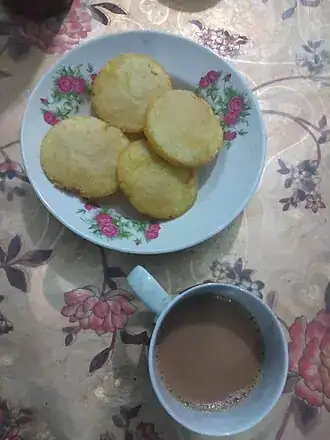
Sylheti Onion and Rice Fritters

English Breakfast
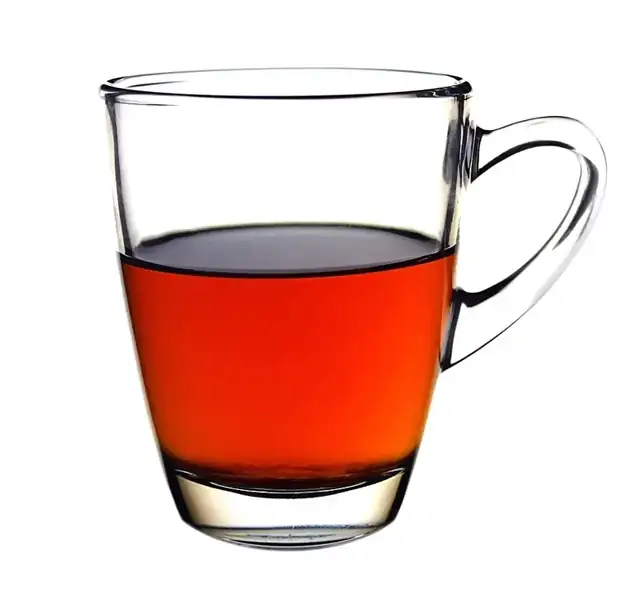
Black Tea: The Leaves Behind a Familiar Daily Cup