This longer reference provides the background behind the topic. Read it alongside the recipe collection when you want to connect an ingredient or food idea with a dish to prepare.
In this story
OverviewProductionPenicillium roqueforti inoculumProduction and fermentationToxins from the production of blue cheeseStructureFlavourOverview
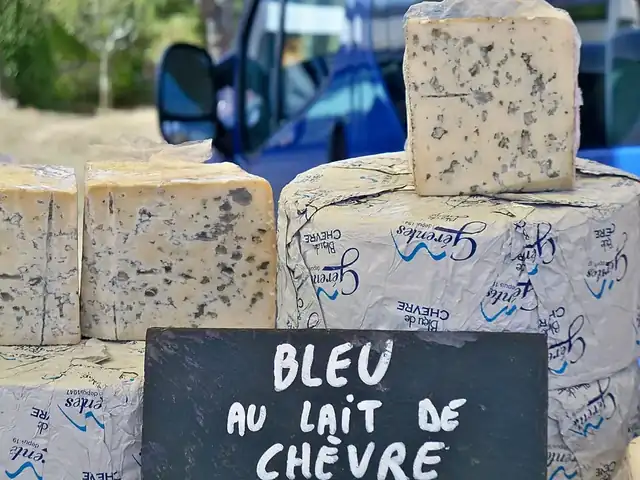
Blue cheese is any cheese made with the addition of cultures of edible molds, which create blue-green spots or veins through the cheese. Blue cheeses vary in flavor from mild to strong and from slightly sweet to salty or sharp; in color from pale to dark; and in consistency from liquid to hard. They may have a distinctive smell, either from the mold or from various specially cultivated bacteria such as Brevibacterium linens.
Some blue cheeses are injected with spores before the curds form, and others have spores mixed in with the curds after they form. Blue cheeses are typically aged in temperature-controlled environments.
Production
Similar to other varieties of cheese, the process of making blue cheese consists of six standard steps. However, additional ingredients and processes are required to give this blue cheese its distinctive properties. To begin with, the commercial-scale production of blue cheese consists of two phases: the culturing of suitable spore-rich inocula and fermentation for maximum, typical flavor.
Penicillium roqueforti inoculum
In the first phase of production, a Penicillium roqueforti inoculum is prepared prior to the actual production of blue cheese. Multiple methods can be used to achieve this. However, all methods involve the use of a freeze-dried Penicillium roqueforti culture. Although Penicillium roqueforti can be found naturally , cheese producers use commercially manufactured Penicillium roqueforti. First, Penicillium roqueforti is washed from a pure culture agar plate which is later frozen. Through the freeze-drying process, water from the frozen state is evaporated without the transition through the liquid state (sublimation). This retains the value of the culture and is activated upon the addition of water.
Salt, sugar or both are added to autoclaved, homogenized milk via a sterile solution. This mixture is then inoculated with Penicillium roqueforti. This solution is first incubated for three to four days at 21-25 C. More salt and/or sugar is added and then aerobic incubation is continued for an additional one to two days. Alternatively, sterilized, homogenized milk and reconstituted non-fat solids or whey solids are mixed with sterile salt to create a fermentation medium. A spore-rich Penicillium roqueforti culture is then added. Next, modified milk fat is added which consists of milk fat with calf pre-gastric esterase. This solution is prepared in advance by an enzyme hydrolysis of a milk fat emulsion.
The addition of modified milk fat stimulates a progressive release of free fatty acids via lipase action which is essential for rapid flavor development in blue cheese. This inoculum produced by either methods is later added to the cheese curds.
Production and fermentation
First, raw milk (either from cattle, goats or sheep) is mixed and pasteurized at 72 C for 15 seconds. Then, acidification occurs: a starter culture, such as Streptococcus lactis, is added in order to change lactose to lactic acid, thus changing the acidity of the milk and turning it from liquid to solid. The next step is coagulation, where rennet, a mixture of rennin and other materials found in the stomach lining of a calf is added to solidify the milk further. Following this, thick curds are cut typically with a knife to encourage the release of liquid or whey. The smaller the curds are cut, the thicker and harder the resulting cheese will become.
After the curds have been ladled into containers in order to be drained and formed into a full wheel of cheese, the Penicillium roqueforti inoculum is sprinkled on top of the curds along with Brevibacterium linens. Then, the curd granules are knit in molds to form cheese loaves with a relatively open texture. Next, whey drainage continues for 10–48 hours in which no pressure is applied, but the molds are inverted frequently to promote this process. Salt is then added to provide flavor as well as to act as a preservative so the cheese does not spoil through the process of brine salting or dry salting for 24–48 hours. The final step is ripening the cheese by aging it. When the cheese is freshly made, there is little to no blue cheese flavor development.
Usually, a fermentation period of 60–90 days is needed before the flavor of the cheese is typical and acceptable for marketing.
Toxins from the production of blue cheese
Penicillium roqueforti, responsible for the greenish blue moldy aspect of blue cheese, produces several mycotoxins. While mycotoxins like roquefortine, isofumigaclavine A, mycophenolic acid and ferrichrome are present at low levels, penicillic acid and PR toxin are unstable in the cheese. Because of the instability of PR toxin and lack of optimal environmental conditions (temperature, aeration) for the production of PR toxin and roquefortine, health hazards due to Penicillium roqueforti metabolites are considerably reduced. Additionally, mycotoxin contamination occurs at low levels and large quantities of cheese are rarely consumed, suggesting that hazard to human health is unlikely.
Structure
The main structure of the blue cheese comes from the aggregation of the casein. In milk, casein does not aggregate because of the outer layer of the particle, called the "hairy layer." The hairy layer consists of κ-casein, which are strings of polypeptides that extend outward from the center of the casein micelle. The entanglement of the hairy layer between casein micelles decreases the entropy of the system because it constrains the micelles, preventing them from spreading out. Curds form, however, due to the function that the enzyme, rennet, plays in removing the hairy layer in the casein micelle. Rennet is an enzyme that cleaves the κ-casein off the casein micelle, thus removing the strain that occurs when the hairy layer entangles.
The casein micelles are then able to aggregate together when they collide with each other, forming the curds that can then be made into blue cheese.
Flavour
A portion of the distinct flavour comes from lipolysis (breakdown of fat). The metabolism of the blue mold further breaks down fatty acids to form ketones to give blue cheese a richer flavour and aroma.
More to savor

Chicken Vindaloo
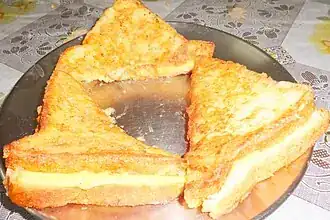
Cheese Egg Toast
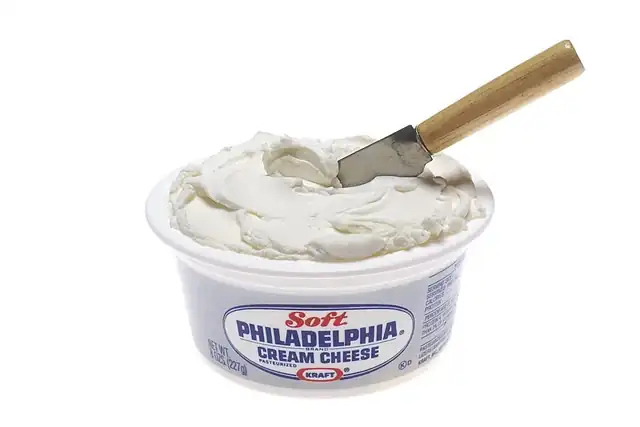
Beyond the Shopping List: The Story of Cream cheese