This longer reference provides the background behind the topic. Read it alongside the recipe collection when you want to connect an ingredient or food idea with a dish to prepare.
Overview
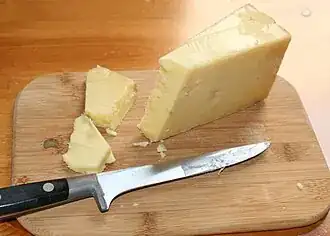
Cheddar cheese (or simply cheddar) is a natural cheese that is relatively hard, off-white (or orange if colourings such as annatto are added), and sometimes sharp-tasting. It originates from the village of Cheddar in Somerset, South West England.
Cheddar is produced all over the world, and cheddar cheese has no Protected Designation of Origin (PDO). In 2007, the name West Country Farmhouse Cheddar was registered in the European Union and (after Brexit) the United Kingdom, defined as cheddar produced from local milk within Somerset, Dorset, Devon and Cornwall and manufactured using traditional methods. Protected Geographical Indication (PGI) was registered for Orkney Scottish Island Cheddar in 2013 in the EU, which also applies under UK law.
Globally, the style and quality of cheeses labelled as cheddar varies greatly, with some processed cheeses packaged as "cheddar". Cheeses similar to Red Leicester are sometimes marketed as "red cheddar".
Cheddar cheese is the most popular cheese in the UK, accounting for 51% of the country's £1.9 billion annual cheese market. It is the second-most popular cheese in the United States behind mozzarella, with an average annual consumption of 10 lb per capita. The United States produced approximately 3000000000 lb of cheddar in 2014, and the UK produced 258000 LT in 2008.
Process
During the manufacture of cheddar, the curds and whey are separated using rennet, an enzyme complex normally produced from the stomachs of newborn calves, while in vegetarian or kosher cheeses, bacterial, yeast or mould-derived chymosin is used.
"Cheddaring" refers to an additional step in the production of cheddar cheese where, after heating, the curd is kneaded with salt, cut into cubes to drain the whey, and then stacked and turned. Strong, extra-mature cheddar, sometimes called vintage, needs to be matured for 15 months or more. The cheese is kept at a constant temperature, often requiring special facilities. As with other hard cheese varieties produced worldwide, caves provide an ideal environment for maturing cheese; still, today, some cheddar is matured in the caves at Wookey Hole and Cheddar Gorge. Additionally, some versions of cheddar are smoked.
Character
The ideal quality of the original Somerset cheddar was described by Joseph Harding in 1864 as "close and firm in texture, yet mellow in character or quality; it is rich with a tendency to melt in the mouth, the flavour full and fine, approaching to that of a hazelnut".
Cheddar made in the classical way tends to have a sharp, pungent flavour, often slightly earthy. The "sharpness" of cheddar is associated with the levels of bitter peptides in the cheese. This bitterness has been found to be significant to the overall perception of the aged cheddar flavour. The texture is firm, with farmhouse traditional cheddar being slightly crumbly; it should also, if mature, contain large cheese crystals consisting of calcium lactate – often precipitated when matured for times longer than six months.
Cheddar can be a deep to pale yellow (off-white) colour, or a yellow-orange colour when certain plant extracts are added, such as beet juice. One commonly used spice is annatto, extracted from seeds of the tropical achiote tree. Originally added to simulate the colour of high-quality milk from grass-fed Jersey and Guernsey cows, annatto may also impart a sweet, nutty flavour. The largest producer of cheddar cheese in the United States, Kraft, uses a combination of annatto and oleoresin paprika, an extract of the lipophilic (oily) portion of paprika.
Cheddar was sometimes (and still can be found) packaged in black wax, but was more commonly packaged in larded cloth, which was impermeable to contaminants, but still allowed the cheese to "breathe".
Australia
As of 2013, cheddar accounts for over 55% of the Australian cheese market, with average annual consumption around 7.5 kg per person. Cheddar is so commonly found that the name is rarely used: instead, cheddar is sold by strength alone as e.g. "mild", "tasty" or "sharp".
Canada
Following a wheat midge outbreak in Canada in the mid-19th century, farmers in Ontario began to convert to dairy farming in large numbers, and cheddar cheese became their main exportable product, even being exported to England. By the turn of the 20th century, 1,242 cheddar factories were in Ontario, and cheddar had become Canada's second-largest export after timber. Cheddar exports totalled 234000000 lbs in 1904, but by 2012, Canada was a net importer of cheese. James L. Kraft grew up on a dairy farm in Ontario, before moving to Chicago.
According to the writer Sarah Champman, "Although we cannot wholly lay the decline of cheese craft in Canada at the feet of James Lewis Kraft, it did correspond with the rise of Kraft’s processed cheese empire." Most Canadian cheddar is produced in the provinces of Québec (40.8%) and Ontario (36%), though other provinces produce some and some smaller artisanal producers exist. The annual production is 120,000 tons.
Canadian cheddar cheese soup is a featured dish at the Canada Pavilion at Epcot in Walt Disney World.
New Zealand
Most of the cheddar produced in New Zealand is factory-made, although some are handmade by artisan cheesemakers. Factory-made cheddar is generally sold relatively young within New Zealand, but the Anchor dairy company ships New Zealand cheddars to the UK, where the blocks mature for another year or so.
United Kingdom
Only one producer of the cheese is now based in the village of Cheddar, the Cheddar Gorge Cheese Co. The name "cheddar" is not protected under European Union or UK law, though the name "West Country Farmhouse Cheddar" has an EU and (following Brexit) a UK protected designation of origin (PDO) registration, and may only be produced in Somerset, Devon, Dorset and Cornwall, using milk sourced from those counties. Cheddar is usually sold as mild, medium, mature, extra mature or vintage. Cheddar produced in Orkney is registered as an EU protected geographical indication under the name "Orkney Scottish Island Cheddar". This protection highlights the use of traditional methods, passed down through generations since 1946 and its uniqueness in comparison to other cheddar cheeses.
"West Country Farmhouse Cheddar" is protected outside the UK and the EU as a Geographical Indication also in China, Georgia, Iceland, Japan, Moldova, Montenegro, Norway, Serbia, Switzerland and Ukraine.
Furthermore, a Protected Geographical Indication (PGI) was registered for Orkney Scottish Island Cheddar in 2013 in the EU, which also applies under UK law. It is protected as a geographical indication in Iceland, Montenegro, Norway and Serbia.
More to savor

Chicken Vindaloo

Cheese Egg Toast

Cottage cheese in the Kitchen: Exploring an Everyday Ingredient