The dish is a starting point for exploring a wider food story. The guide below looks more closely at its background and different forms. When you want to cook, visit the recipe collection for ingredient quantities and step-by-step methods.
In this story
OverviewScientific backgroundVariationsHard-boiled eggsMethods of heatingDishes featuring boiled eggsCooking to eliminate pathogensOverview
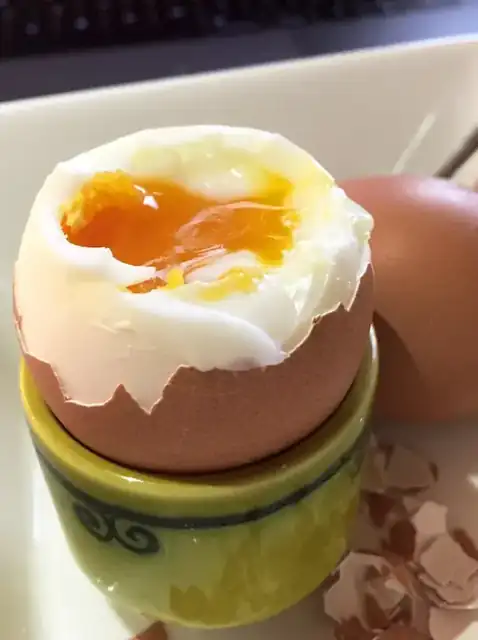
Boiled eggs are a food typically made using chicken eggs. They are cooked with their shells unbroken, usually by immersion in boiling water. Hard-boiled or hard-cooked eggs are cooked so that the egg white and egg yolk both solidify, while soft-boiled eggs may leave the yolk, and sometimes the white, at least partially liquid. Boiled eggs are a popular breakfast food around the world.
Besides boiling water immersion, there are a few different methods to make boiled eggs. Eggs can also be cooked below the boiling temperature, i.e. coddling, or they can be steamed. The egg timer was named for commonly being used to time the boiling of eggs.
Scientific background
The process of cooking an egg causes the proteins within the yolk and albumin to denature and solidify, resulting in a solid egg white and yolk. Coagulation (denaturing) of egg white proteins begins in the 55-60 C temperature range, and egg yolks thicken at the slightly higher temperature of 65 C, solidifying at 70 C. As such, the yolk of an egg will never solidify before the white, though in a boiled egg heat will take longer to reach the yolk through the albumin (compared to a fried egg), making this doubly true. The process may be reversed through breaking the connections between the proteins, which has been demonstrated through the application of either sodium borohydride or vitamin C.
Although the white starts coagulating earlier, it also stops denaturing later, at 85 C when it takes on a tender but solid texture. As a result, it is difficult to produce an egg with both a solid white and a thickened but non-solid yolk. A peeled boiled egg may appear concave or flat on one end due to the presence of an air pocket (or "air cell") that allows a chick from an otherwise fertilized egg to take its first breath before hatching; this occurs more often in older eggs with larger air cells due to a decrease in moisture.
Variations
There are variations both in degree of cooking and in the method of how eggs are boiled, and a variety of kitchen gadgets for making boiled eggs exist.
Hard-boiled eggs
Hard-boiled or hard-cooked eggs are boiled long enough for the yolk to solidify (19 minutes). They can be eaten warm or cold. Hard-boiled eggs are the basis for many dishes, such as egg salad, cobb salad and Scotch eggs, and may be further prepared as deviled eggs.
There are several techniques for hard-boiling an egg. One method is to bring water to a boil and cook for ten minutes. Another method is to bring the water to a boil, but then remove the pan from the heat and allow eggs to cook in the gradually cooling water. Over-cooking eggs will typically result in a thin green iron(II) sulfide coating on the yolk, though the coating has been reported as having little effect on flavor. This reaction occurs more rapidly in older eggs as the whites are more alkaline. Rinsing or immersing the egg in cold water after boiling is a common method of halting the cooking process to prevent this effect, and in commercial operations the discoloration is removed by immersing peeled eggs in a bath of organic acid after cooking.
Hard-boiled eggs are commonly sliced, particularly for use in sandwiches. For this purpose specialized egg slicers exist, to ease slicing and yield even slices. For consistent slice sizes in food service, several eggs may have their yolk and white separated and poured into a cylindrical mold for stepwise hard-boiling, to produce what is known as a "long egg" or an "egg loaf". Commercial long eggs are produced in Denmark by its inventor Danæg and in Japan by Kenko Mayonnaise. The machine for producing long eggs was first introduced in 1974. In addition to being sliced, long eggs can also be used in their entirety in gala pies.
Methods of heating
Steaming Eggs can be taken straight from the refrigerator and placed in the steamer at full steam. Varying the time spent in the steamer results in different degrees of firmness, similar to boiling.
Baked eggs Eggs may be cooked to produce a result similar to boiling via baking in an oven by breaking eggs into a muffin tin or individual ramekins.
Sous vide Boiled eggs can be made by cooking/coddling in their shell "sous vide" in hot water at steady temperatures anywhere from 60 to 85 C. (Recall from the above that the egg white fully cooks at 85 C while the yolk thickens at 65 C.)
Dishes featuring boiled eggs
Boiled eggs often form part of larger, more elaborate dishes. For example, a boiled egg may garnish a bowl of ramen (often first marinated in soy sauce), be baked into a pie such as a torta pasqualina, or be encased in aspic (similar to the French dish œufs en gelée, which features poached eggs). They may also be chopped and mixed with mayonnaise to form egg salad, or be deep-fried and then baked within a serving of lamprais.
Cooking to eliminate pathogens
There are several foodborne illnesses associated with eggs, most if not all of which are caused by pathogenic bacteria. The harmful bacteria associated with eggs are mostly of the genus Salmonella, but other harmful bacteria that can grow at refrigerated temperatures have been found in retail egg products, such as Bacillus cereus and Staphylococcus aureus. Previous studies indicated that "the complete coagulation of [the] whole egg" was sufficient to destroy Salmonella bacteria, but it is now known that the only factor in the inactivation or destruction of pathogenic bacteria in eggs is temperature. Boiling eggs at a temperature of at least 62 C for 30 minutes has been shown to inactivate Salmonella bacteria, though the Food and Drug Administration recommends cooking at the higher temperature of 74 C.
Soft-boiled eggs are not recommended by the Food and Drug Administration for people who may be susceptible to salmonella, such as very young children, the elderly, and those with weakened immune systems. To avoid the issue of salmonella, eggs can be pasteurised in shell at 57 °C for an hour and 15 minutes. The eggs can then be soft-boiled as normal.
More to savor
Koeksisters (Fried Braided Pastry in Syrup)

Chicken Vindaloo
Muffins: The Small Bake with More Than One Identity