A drink can be an everyday routine, something shared with company, or a way to explore a food tradition. The background below looks more closely at the preparation and story behind the cup or glass.
Overview
Tea is an aromatic beverage prepared by infusion of hot or boiling fresh water with fresh or cured leaves of Camellia sinensis, an evergreen shrub native to East Asia that originated in the borderlands of southwestern China, northeast India and northern Myanmar. Tea has a stimulant effect in humans primarily due to its caffeine content.
After plain drinking water, tea is the most widely consumed beverage in the world. There are many varieties of tea according to differences in cultivars, processing and blends; some have a cooling, slightly bitter and astringent flavor, while others have taste profiles that include sweet, nutty, floral or grassy notes.
Traditionally, tea is made by steeping loose tea leaves in hot water (usually in a teapot or teacup) for a period of time, or in the case of compressed and fermented tea, via decoction (simmering) in a kettle. Convenient preparations, such as tea bag, infuser and press as well as powdered instant tea such as matcha, konacha and chai latte, are also common. Tea is most commonly consumed as a hot beverage in a plain hot water infusion, although it can also be in mixed drink forms, such as milk tea and butter tea, sometimes sweetened with added sugar or sugar substitutes, or alternatively flavored with salt and spices.
In modern times, tea can also be served as a cold beverage in the form of iced tea or in soft drink mixtures such as bubble tea.
Early tea drinking
People in ancient East Asia ate tea for centuries, perhaps even millennia, before ever consuming it as a beverage. They would nibble on the leaves raw, add them to soups or greens, or ferment them and chew them as areca nut is chewed.
Tea drinking may have begun in the region of Yunnan, where it was used for medicinal purposes. It is believed that in Sichuan, "people began to boil tea leaves for consumption into a concentrated liquid without the addition of other leaves or herbs, thereby using tea as a bitter yet stimulating drink, rather than as a medicinal concoction."
Chinese legends attribute the invention of tea to the mythical Shennong (in central and northern China) in 2737 BC, although evidence suggests that tea drinking may have been introduced from southwest China. The earliest written records of tea come from China. The word tú appears in the Shijing and other ancient texts to signify a kind of "bitter vegetable" (苦菜), and it is possible that it referred to many different plants such as sow thistle, chicory, or smartweed, as well as tea. In the Chronicles of Huayang, it was recorded that the Ba people in Sichuan presented tu to the Zhou king.
Production
Tea is mainly grown in Asia and Africa, with smaller areas in South America and around the Black and Caspian Seas. The four biggest tea-producing countries are China, India, Kenya and Sri Lanka, together representing 81% of world tea production. Smaller hubs of production include such places as São Miguel Island, Azores, in Portugal, and Guria, in Georgia. In 2022, global production of tea was 29.8 million tonnes, led by China with 49% and India with 20% of the world total. Kenya, Sri Lanka, and Turkey were secondary producers.
Tea bags
In 1907, American tea merchant Thomas Sullivan began distributing samples of his tea in small bags of silk with a drawstring. Consumers noticed they could simply leave the tea in the bag and reuse it with fresh tea. However, the potential of this distribution and packaging method would not be fully realised until later. During World War II, tea was rationed in the United Kingdom. In 1953, after rationing in the UK ended, Yorkshire-based tea manufacturer Tetley launched the tea bag in the UK, and it was an immediate success.
The "pyramid tea bag" (or sachet), introduced by Lipton and PG Tips/Scottish Blend in 1996, attempts to address one of the connoisseurs' arguments against paper tea bags by way of its three-dimensional tetrahedron shape, which allows more room for tea leaves to expand while steeping. However, some types of pyramid tea bags have been criticised as being environmentally unfriendly, since their synthetic material is not as biodegradable as loose tea leaves and paper tea bags.
Loose tea
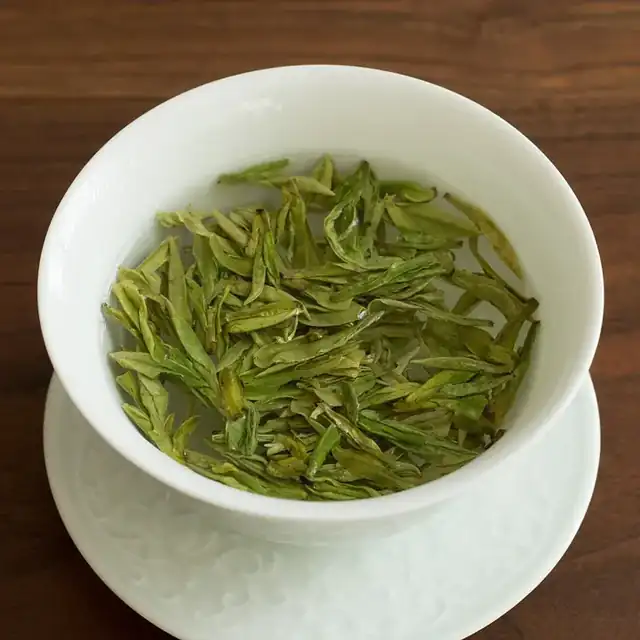
The tea leaves are packaged loosely in a canister, paper bag, or other container such as a tea chest. Some whole teas, such as rolled gunpowder tea leaves, which resist crumbling, are vacuum-packed for freshness in aluminised packaging for storage and retail. The loose tea is individually measured for use, allowing for flexibility and flavour control at the expense of convenience. Strainers, tea balls, tea presses, filtered teapots, and infusion bags prevent loose leaves from floating in the tea and over-brewing. A traditional method uses a three-piece lidded teacup called a gaiwan, the lid of which is tilted to decant the tea into a different cup for consumption.
Compressed tea
Tea bricks or compressed tea are produced for convenience in transport, storage, and ageing. It can usually be stored longer without spoilage than loose leaf tea. Compressed tea is prepared by loosening leaves from the cake using a small knife, and steeping the extracted pieces in water. During the Tang dynasty, as described by Lu Yu, compressed tea was ground into a powder, combined with hot water, and ladled into bowls, resulting in a "frothy" mixture. In the Song dynasty, the tea powder would instead be whisked with hot water in the bowl. Although no longer practiced in China today, the whisking method of preparing powdered tea was transmitted to Japan by Zen Buddhist monks, and is still used to prepare matcha in the Japanese tea ceremony.
Chinese pu-erh is often distributed in the form, as other teas may sometimes be.
Instant tea
"Instant tea", similar to freeze-dried instant coffee and an alternative to brewed tea, can be consumed either hot or cold. Instant tea was developed in the 1930s, with Nestlé introducing the first commercial product in 1946, while Redi-Tea debuted instant iced tea in 1953. Additives, such as chai, vanilla, honey, fruit or powdered milk, are commonly used.
During the Second World War, British and Canadian soldiers were issued instant tea in their composite ration ("compo") packs. These blocks of instant tea, powdered milk, and sugar were not always well received. As Royal Canadian Artillery Gunner, George C Blackburn observed:
More to savor

Algerian Mint Tea

English Breakfast
Green Tea: A Different Path from Leaf to Cup