This longer reference provides the background behind the topic. Read it alongside the recipe collection when you want to connect an ingredient or food idea with a dish to prepare.
In this story
OverviewFree convectionNucleateCritical heat fluxTransitionPool boilingFlow boilingIn cookingOverview
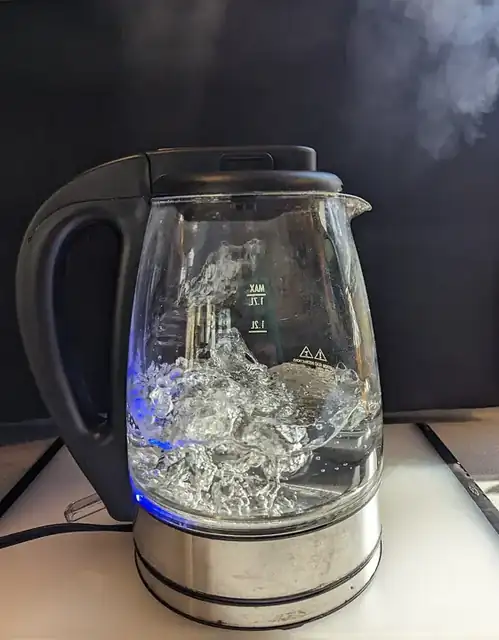
Boiling or ebullition is the rapid phase transition from liquid to gas or vapour; the reverse of boiling is condensation. Boiling occurs when a liquid is heated to its boiling point, so that the vapour pressure of the liquid is equal to the pressure exerted on the liquid by the surrounding atmosphere. Boiling and evaporation are the two main forms of liquid vapourization.
There are two main types of boiling: nucleate boiling, where small bubbles of vapour form at discrete points; and critical heat flux boiling, where the boiling surface is heated above a certain critical temperature and a film of vapour forms on the surface. Transition boiling is an intermediate, unstable form of boiling with elements of both types. The boiling point of water is 100 °C or 212 °F, but is lower with the decreased atmospheric pressure found at higher altitudes.
Boiling water is used as a method of making it potable by killing microbes and viruses that may be present. The sensitivity of different micro-organisms to heat varies, but if water is held at 100 C for one minute, most micro-organisms and viruses are inactivated. Ten minutes at a temperature of 70 °C (158 °F) is also sufficient to inactivate most bacteria.
Boiling water is also used in several cooking methods including boiling, parboiling, blanching, steaming, and poaching.
Free convection
The lowest heat flux seen in boiling is only sufficient to cause natural convection, where the warmer fluid rises due to its slightly lower density. This condition occurs only when the superheat is very low, meaning that the hot surface near the fluid is nearly the same temperature as the boiling point.
Nucleate
Nucleate boiling is characterised by the growth of bubbles or pops on a heated surface (heterogeneous nucleation), which rises from discrete points on a surface, whose temperature is only slightly above the temperature of the liquid. In general, the number of nucleation sites is increased by an increasing surface temperature.
An irregular surface of the boiling vessel (i.e., increased surface roughness) or additives to the fluid (i.e., surfactants and/or nanoparticles) facilitate nucleate boiling over a broader temperature range, while an exceptionally smooth surface, such as plastic, lends itself to superheating. Under these conditions, a heated liquid may show boiling delay and the temperature may go somewhat above the boiling point without boiling.
Homogeneous nucleation, where the bubbles form from the surrounding liquid instead of on a surface, can occur if the liquid is warmer in its center, and cooler at the surfaces of the container. This can be done, for instance, in a microwave oven, which heats the water and not the container.
Critical heat flux
Critical heat flux (CHF) describes the thermal limit of a phenomenon where a phase change occurs during heating (such as bubbles forming on a metal surface used to heat water), which suddenly decreases the efficiency of heat transfer, thus causing localised overheating of the heating surface. As the boiling surface is heated above a critical temperature, a film of vapour forms on the surface. Since this vapour film is much less capable of carrying heat away from the surface, the temperature rises very rapidly beyond this point into the transition boiling regime. The point at which this occurs is dependent on the characteristics of boiling fluid and the heating surface in question.
Transition
Transition boiling may be defined as the unstable boiling, which occurs at surface temperatures between the maximum attainable in nucleate and the minimum attainable in film boiling.
The formation of bubbles in a heated liquid is a complex physical process which often involves cavitation and acoustic effects, such as the broad-spectrum hiss one hears in a kettle not yet heated to the point where bubbles boil to the surface.
Pool boiling
"Pool boiling" refers to boiling where there is no forced convective flow. Instead, the flow occurs due to density gradients. It can experience any of the regimes mentioned above.
Flow boiling
"Flow boiling" occurs when the boiling fluid circulates, typically through pipes. Its movement can be powered by pumps, such as in power plants, or by density gradients, such as in a thermosiphon or a heat pipe. Flows in flow boiling are often characterised by a void fraction parameter, which indicates the fraction of the volume in the system that is vapor. One can use this fraction and the densities to calculate the vapor quality, which refers to the mass fraction that is in the gas phase. Flow boiling can be very complex, with heavy influences of density, flow rates, and heat flux, as well as surface tension. The same system may have regions that are liquid, gas, and two-phase flow.
Such two phase regimes can lead to some of the best heat transfer coefficients of any system.
In cooking
Boiling is the method of cooking food in boiling water or other water-based liquids such as stock or milk. Simmering is gentle boiling, while in poaching the cooking liquid moves but scarcely bubbles.
The boiling point of water is typically considered to be 100 °C, especially at sea level. Pressure and a change in the composition of the liquid may alter the boiling point of the liquid. High elevation cooking generally takes longer since boiling point is a function of atmospheric pressure. At an elevation of about 1 mile, water boils at approximately 95 °C. Depending on the type of food and the elevation, the boiling water may not be hot enough to cook the food properly. Similarly, increasing the pressure as in a pressure cooker raises the temperature of the contents above the open air boiling point.
More to savor

Chicken Vindaloo

Popcorn
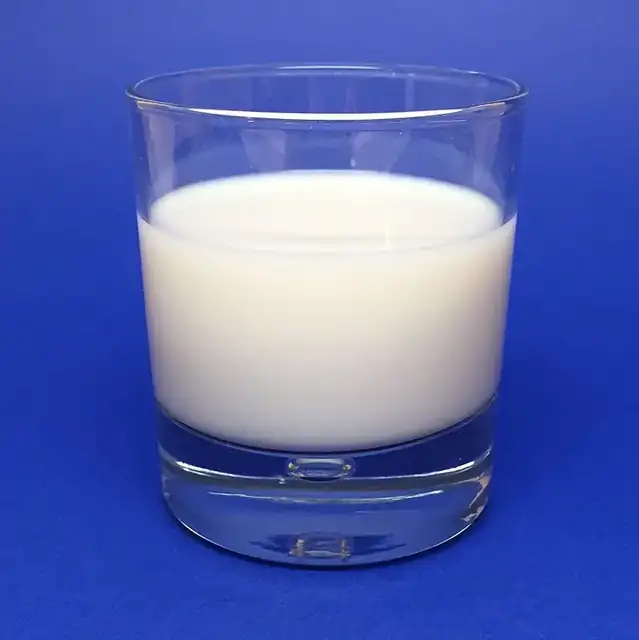
Beyond the Shopping List: The Story of Milk