This longer reference provides the background behind the topic. Read it alongside the recipe collection when you want to connect an ingredient or food idea with a dish to prepare.
Overview
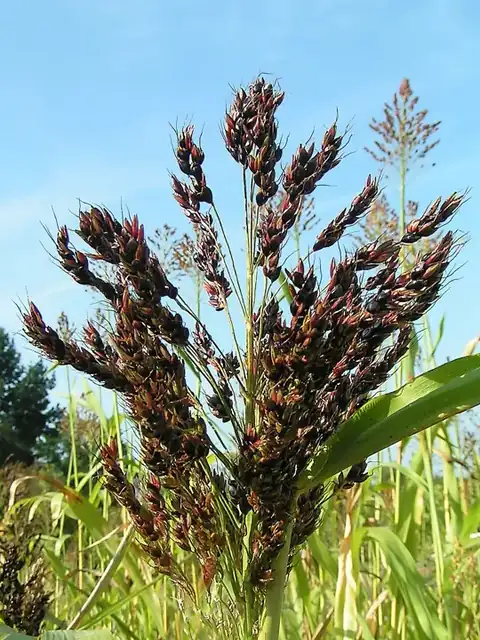
Sorghum bicolor, commonly called sorghum and also known as broomcorn, great millet, Indian millet, Guinea corn, jowar, or milo, is a species in the grass genus Sorghum. It is typically an annual, but some cultivars are perennial. It grows in clumps that may reach over 4 m high. The grain is 2 to 4 mm in diameter.
The species originated and was domesticated in Sudan. Native to Africa and the Indian subcontinent, it is cultivated in tropical and subtropical regions for its grain. It is the world's fifth-most important cereal crop. The grain is used as food by humans, while the plant is used for animal feed and ethanol production.
Description
Sorghum is a large stout grass that grows up to 2.4 m tall. It has large bushy flowerheads or panicles that provide an edible starchy grain with up to 3,000 seeds in each flowerhead. It grows in warm climates worldwide for food and forage. Sorghum is native to Africa and to the Indian Subcontinent, with many cultivated forms. Most production uses annual cultivars, but some wild species of Sorghum are perennial; the Land Institute is attempting to develop a perennial cultivar for "repeated, sufficient grain harvests without resowing". The name sorghum derives from Italian sorgo, which in turn most likely comes from 12th century Medieval Latin surgum or suricum. This in turn may be from Latin syricum, meaning "[grass] of Syria".
Types include milo, durra, imphee, hegari, kaffir, feterita, shallu, and kaoliang.
Phylogeny
Sorghum is closely related to maize and the millets within the PACMAD clade of grasses, and more distantly to the cereals of the BOP clade such as wheat and barley.
Domestication
S. bicolor was domesticated from its wild ancestor more than 5,000 years ago in Eastern Sudan in the area of the Rivers Atbara and Gash. It has been found at an archaeological site near Kassala in eastern Sudan, dating from 3500 to 3000 BCE, and is associated with the Neolithic Butana Group culture. Sorghum bread from graves in Predynastic Egypt, some 5,100 years ago, is displayed in the Egyptian Museum, Turin, Italy.
The first species to be domesticated was bicolor; it had tight husks that had to be removed forcibly. Around 4,000 years ago, this spread to the Indian subcontinent; around 3,000 years ago it reached West Africa. Four other species evolved through cultivation to have larger grains and to become free-threshing, making harvests easier and more productive. These were caudatum in the Sahel; durra, most likely in India; guinea in West Africa (later reaching India), and from that race magentiferum that gave rise to the varieties of Southern Africa. Wetter conditions in parts of the Horn of Africa between about 2,500 and 1,000 years ago supported the expansion of sorghum cultivation and contributed to the development of complex agricultural societies such as Aksum.
Spread
In the Middle Ages, the Arab Agricultural Revolution spread sorghum and other crops from Africa and Asia across the Arab world as far as Al-Andalus in Spain. Sorghum remained the staple food of the medieval kingdom of Alodia and most Sub-Saharan cultures prior to European colonialism.
Tall varieties of sorghum with a high sugar content are called sweet sorghum; these are useful for producing a sugar-rich syrup and as forage. Sweet sorghum was important to the sugar trade in the 19th century. The price of sugar was rising because of decreased production in the British West Indies and more demand for confectionery and fruit preserves, and the United States was actively searching for a sugar plant that could be produced in northern states. The "Chinese sugar-cane", sweet sorghum, was viewed as a plant that would be productive in the West Indies.
Production
In 2023, world production of sorghum was 57 million tonnes, led by the United States with 14% of the total (table). Mexico, Ethiopia, and India were secondary producers.
It is the world's fifth-most important cereal crop after rice, wheat, maize, and barley.
Food and drink
Sorghum is widely used for food and animal fodder. It is also used to make alcoholic beverages. It can be made into couscous, porridge, or flatbreads such as Indian jōḷada roṭṭi or tortillas; and it can be burst in hot oil to make a popcorn smaller than that of maize. Since it does not contain gluten, it can be used in gluten-free diets.
In South Africa, characteristically sour malwa beer is made from sorghum or millet. The process involves souring the mashed grain with lactic acid bacteria, followed by fermenting by the wild yeasts that were on the grain. In China and Taiwan, sorghum is one of the main materials of Kaoliang liquor, a type of the colourless distilled alcoholic drink baijiu. In Uganda, sorghum is an ingredient used in angodic, which is a traditional food of the Karamojong people.
In countries including the US, the stalks of sweet sorghum varieties are crushed in a cane juicer to extract the sweet molasses-like juice. The juice is sold as syrup, and used as a feedstock to make biofuel.
More to savor

Chicken Vindaloo

Spaghetti alla Carbonara
A Closer Look at Fenugreek: From Ingredient to Meal