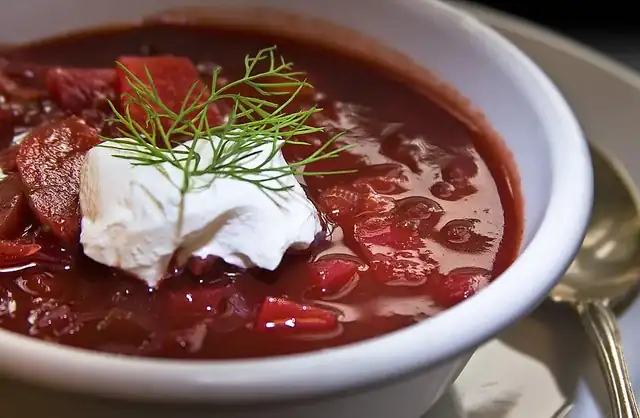
The dish is a starting point for exploring a wider food story. The guide below looks more closely at its background and different forms. When you want to cook, visit the recipe collection for ingredient quantities and step-by-step methods.
In this story
OverviewIngredients and preparationGarnishes and side dishesNovel ingredients: beets, tomatoes and potatoesHaute cuisineAs a ritual dishAs an ethnic dishOverview
Borscht is a sour soup, made with meat stock, vegetables and seasonings, common in Eastern Europe, Central Europe and Northern Asia. In English, the word borscht, borrowed via Yiddish, is most often associated with the variant of the soup originating in Ukraine, made with red beetroots as one of the main ingredients, which give the dish its distinctive red color. The same name, however, is also used for a wide selection of sour-tasting soups without beetroots, such as sorrel-based green borscht, rye-based white borscht, and cabbage borscht.
Borscht derives from an ancient soup originally cooked from pickled stems, leaves and umbels of common hogweed (Heracleum sphondylium), an herbaceous plant growing in damp meadows, which lent the dish its Slavic name. With time, it evolved into a diverse array of tart soups, among which the Ukrainian beet-based red borscht has become the most popular. It is typically made by combining meat or bone stock with sautéed vegetables, which—as well as beetroots—usually include cabbage, carrots, onions, potatoes, and tomatoes. Depending on the recipe, borscht may include meat or fish, or be purely vegetarian; it may be served either hot or cold, and it may range from a hearty one-pot meal to a clear broth or a smooth drink.
It is often served with smetana or sour cream, hard-boiled eggs or potatoes, but there exists an ample choice of more involved garnishes and side dishes, such as uszka or pampushky, that can be served with the soup.
Ingredients and preparation
The stock is typically made by boiling meat, bones, or both. Beef, pork or a combination of both are most commonly used, with brisket, ribs, shank and chuck considered to give the most flavorful results, especially if cooked on a high flame. Marrow bones are considered best for the bone stock. Meat stock is usually cooked for about two hours, whereas bone stock takes four to six hours to prepare. Meat and bones are usually removed afterwards and the meat is only added back into the soup about 10–15 minutes before the borscht is done. Some recipes call for smoked meats, resulting in a distinctively smoky borscht, while others use poultry or mutton stock.
Fasting varieties are typically made with fish stock to avoid the use of meat, while purely vegetarian recipes often substitute forest mushroom broth for the stock.
Garnishes and side dishes
The diversity of borscht styles is matched by the wide choice of garnishes and side dishes with which various types of borscht may be served. Most often, borscht is served with smetana, a soured dairy product similar to the French crème fraîche. The smetana may be served in a separate pitcher for the diners to add the desired amount themselves or the borscht may come already "whitened" with the smetana already added. The cream can also be thickened with flour before being added to the soup. Yogurt and a mixture of milk and yolks are possible substitutes.
Chopped herbs are often sprinkled on the surface of the soup; dill is most common, but parsley, chives or scallion are often added as well. Individual helpings may be spiced up with minced hot peppers or garlic. Many types of borscht are served over halves or quarters of hard-boiled chicken or quail eggs. Navy beans, broad beans or string beans are also a common addition.
Novel ingredients: beets, tomatoes and potatoes
Beet (Beta vulgaris), a plant native to the Mediterranean Basin, was already grown in antiquity. Only the leaves were of culinary use, as the tapered, tough, whitish and bitter-tasting root was considered unfit for human consumption. It is probably that beet greens were used in variants of green borscht long before the invention of the beetroot-based red borscht. Beet varieties with round, red, sweet taproots, known as beetroots, were not reliably reported until the 12th century and did not spread to Eastern Europe before the 16th century.
Mikołaj Rej, a Polish Renaissance poet and moralist, included the earliest known Polish recipe for pickled beetroots in his 1568 book, Life of an Honest Man. It would later evolve into ćwikła, or chrain mit burik, a beet-and-horseradish relish popular in Polish and Jewish cuisines. Rej also recommended the "very tasty brine" left over from beetroot pickling, which was an early version of beet sour. The sour found some applications in Polish folk medicine as a cure for hangover and—mixed with honey—as a sore throat remedy.
Haute cuisine
In Ukraine borshch was popularized as a national dish by the 19th century, when many recipes for cooking borshch had become known, some of which would contain more than 20 ingredients. Among the rich it was not unusual to have several varieties of the dish during one meal. One recipe preserved from that time includes ingredients such as cardamom, eggs, mushrooms and cherry.
As a ritual dish
Borscht is often associated with its role in religious traditions of various denominations (Eastern Orthodox, Greek and Roman Catholic, and Jewish) that are common in Eastern Europe. In East Slavic countries, "memorial borscht" is served as the first course at a post-funeral wake. According to a traditional belief, the soul of the departed either feeds on or is carried up to heaven by puffs of steam rising from bowls of borscht and other hot dishes, such as blini, porridge, boiled potatoes or freshly baked bread. In the region of Polesye, straddling the Belarusian-Ukrainian border, the same steaming-hot dishes, including borscht, are given as an offering to the souls of deceased ancestors during the annual semi-pagan remembrance ceremony known as Dzyady or Forefathers' Night.
As an ethnic dish
In its currently most popular, beet-based version, borscht most probably originated in what is now Ukraine. Borscht's role as a staple of everyday Ukrainian diet is reflected in the Ukrainian saying, "borscht and porridge are our food" (compare the equivalent Russian saying, where borscht is replaced with shchi). The hearty soup in which the beetroot is just one of sundry vegetables, as opposed to the typically Polish clear beet broth, is still known in Poland as "Ukrainian borscht".
More to savor

Koko da Kosai (Fermented Corn Porridge and Bean Fritters)

Apple Crisp I

Tom Yum: The Hot-and-Sour Character of a Thai Soup