The dish is a starting point for exploring a wider food story. The guide below looks more closely at its background and different forms. When you want to cook, visit the recipe collection for ingredient quantities and step-by-step methods.
In this story
OverviewHistorical sourcesAnalysisIngredientsPakki and kacchi biryaniDifference between biryani and pilauIn the Indian subcontinentOverview
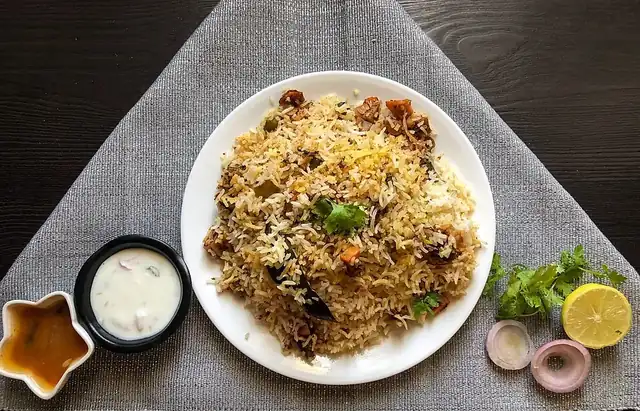
Biryani is a mixed rice dish traditionally made with spiced meat, seafood, or vegetables. It was present in Mughal-era India, though whether it was created there is debated. It is thought to derive from a Persian rice dish, either pilau or birinj biryan. The dish makes use of slow-cooking as in Persian pilau, combined with Persian-style yoghurt-marinated meat and a spicy Indian style of cooking; it was likely developed in the Mughal court kitchens. It is also possible that biryani was brought to South India before the Mughal era, or that pilau was brought to India and biryani was developed from it before being adopted by the Mughals.
Biryani is one of the most popular dishes in South Asia and among the South Asian diaspora. The dish is often associated with the region's Muslim population in particular, but is nevertheless a mainstream culinary staple embraced by every demographic. Similar dishes are prepared in many other countries, often with local variations, and often brought there by South Asian diaspora populations. Biryani is the most-ordered dish on Indian online food ordering and delivery services, is used in weddings and celebrations throughout the region, and has been described as the most popular dish in India.
Historical sources
The Mughal text Ain-i-Akbari (written 1589–1596), from the time of the emperor Akbar, mentions two rice dishes, pilau and biryani, listing ingredients with required quantities for each:
The Ain-i-Akbari further names a dish of spiced mutton as a biryani, this time without mentioning rice:
The Portuguese priest Sebastien Manrique described rice dishes on sale in the tent-city of the next Mughal emperor Shah Jahan as he travelled to Lahore in 1641. Manrique distinguished "Persian" pilau from "Mogol" biryani:
Analysis
The historian of food Lizzie Collingham writes that the modern biryani developed in India (Hindustan) in the royal kitchens of the Mughal Empire, specifically during the rule of the emperor Akbar (1556–1605), and is a mix of the native spicy rice dishes of South Asia, Persian yoghurt-marinated meat, and the Persian pilau style of garnished rice. Collingham writes that "in the kitchens [of the Mughal court]... the delicately flavoured Persian pilau met the pungent and spicy rice dishes of Hindustan to create the classic Mughlai dish, biryani".
The cookery writer Pratibha Karan states that biryani is of Indian origin, derived from pilau which Muslim traders and invaders brought with them. She speculates that pilau was an army dish in medieval India. Armies would prepare a one-pot dish of rice with any available red meat. Over time, the dish became biryani due to different methods of cooking.
In the view of the historian of Islamic cuisine Salma Hussein and others, biryani came to South Asia from Persia before the Mughal era, most probably arriving in South India's Deccan region, brought by travelling soldier-statesmen and pilgrims. It has also been suggested that the dish was introduced from Persia by the Mughals. Another variant theory, that biryani came to India with Timur's invasion, appears to be incorrect because there is no record of biryani having existed in his native region of Central Asia during that period.
Ingredients
Ingredients for biryani vary according to the region and the type of meat and vegetables used. Meat (chicken, goat, beef) is the prime ingredient with rice. Seafood (fish, prawns) and vegetables are sometimes added. Navratan biryani tends to use sweeter, richer ingredients such as cashews, sultanas (kishmish), and fruits such as apple and pineapple.
The spices and condiments used in biryani may include fennel seeds, ghee (clarified butter), nutmeg, mace,black pepper, cloves, green cardamom, black cardamom, cinnamon, bay leaves, coriander, mint, ginger, onions, tomatoes, red chillies, star anise, turmeric, coriander, cumin, milk, yoghurt and garlic. The premium varieties include saffron. Some commercial recipes for biryani include aromatic essences such as mitha attar, kewra and rose water. Dried sour prunes (alu bukhara) may be added. In nasi briyani and other variants made in Southeast Asian countries such as Malaysia, Singapore, and Indonesia, local spices and aromatics such as pandan leaf may be added.
Biryani may be served with side dishes such as raita (yoghurt with cucumber, tomato, etc), fried or curried aubergine (brinjal), salad, or a curried side such as ande ka salan (with boiled eggs) or mirchi ka salan (with chili peppers).
Pakki and kacchi biryani
Biryani can be cooked using one of two techniques, pakki ("cooked") and kacchi ("raw"). In a pakki biryani, the ingredients are cooked separately (at least in part) and then arranged in layers. The different layers can be individually coloured and flavoured with a brightly-coloured spice such as turmeric or saffron. In a kacchi biryani, layers are arranged in a pot which is then sealed and cooked slowly (Dum cooking) for the food to steam in its own liquid.
Difference between biryani and pilau
Pilau is a mixed rice dish popular in the South Asian, Central Asian, and Middle Eastern cuisine. Opinions differ on the differences between the dishes, if any.
The British-era author Abdul Halim Sharar mentions that biryani has a stronger curried taste due to a greater amount of spices. According to Delhi-based historian Sohail Hashmi, pilau tends to be plainer than biryani, and consists of meat or vegetables cooked with rice with the bottom layered with potatoes or onions. Biryani contains more gravy, and is often cooked longer, leaving the meat (and vegetables, if present) more tender, and the rice more flavoured. Biryani is cooked with additional dressings and often has a light layer of scorched rice at the bottom.
In the Indian subcontinent
There are many types of biryani in the Indian subcontinent. Biryani is the single most-ordered dish in Indian online food ordering and delivery services, and has been described as the most popular dish in India. The names of variants are often based on their region or city of origin. Some have taken the name of the shop that sells it, as in Fakhruddin Biriyani in Dhaka, Students biryani in Karachi, Lucky biryani in Bandra, Mumbai and Baghdadi biryani in Colaba, Mumbai. Biryanis are often specific to the Muslim communities where they originate; they are usually the defining dishes of those communities. In 2009, the Deccani Biryani Makers Association submitted 'Hyderabadi Biryani' for a geographical indication, but the attempt failed as they were unable to provide documentary evidence of its historical origin.
More to savor
Boeuf Bourguignon
Papadam (Black Gram Flatbread)
Curry: Why One Word Covers So Many Different Dishes