This longer reference provides the background behind the topic. Read it alongside the recipe collection when you want to connect an ingredient or food idea with a dish to prepare.
In this story
OverviewManufacturing and compositionTypesClarified butterWhey butterProductionIn cooking and gastronomyOverview
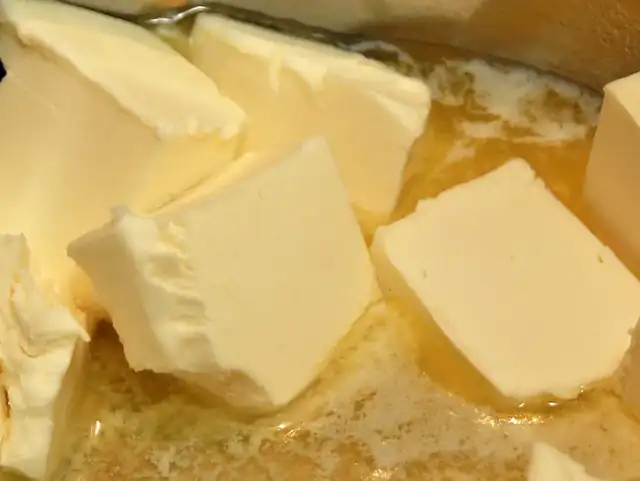
Butter is a dairy product made from the fat and protein components of churned cream. It is a semi-solid emulsion at room temperature, consisting of approximately 81% butterfat. It is used at room temperature as a spread, melted as a condiment, and used as a fat in baking, sauce-making, pan frying, and other cooking procedures.
Most frequently made from cow's milk, butter can also be manufactured from the milk of other mammals, including sheep, goats, buffalo, and yaks. It is made by churning milk or cream to separate the fat globules from the buttermilk. Salt has been added to butter since antiquity to help preserve it, particularly when being transported; salt may still play a preservation role but is less important today as the entire supply chain is usually refrigerated. In modern times, salt may be added for taste and food coloring for color. Rendering butter, removing the water and milk solids, produces clarified butter (including ghee), which is almost entirely butterfat.
Butter is a gel.
Manufacturing and composition
Unhomogenized milk and cream contain butterfat in microscopic globules. These globules are surrounded by membranes made of phospholipids (fatty acid emulsifiers) and proteins, which prevent the fat in milk from pooling together into a single mass. Butter is produced by agitating cream, which damages these membranes and allows the milk fats to conjoin, separating from the other parts of the cream. Variations in the production method will create butters with different consistencies, mostly due to the butterfat composition in the finished product. Butter contains fat in three separate forms: free butterfat, butterfat crystals, and undamaged fat globules. In the finished product, different proportions of these forms result in different consistencies within the butter; butters with many crystals are harder than butters dominated by free fats.
Churning produces small butter grains floating in the water-based portion of the cream. This watery liquid was traditionally called buttermilk (although modern commercial buttermilk is instead directly fermented skimmed milk.) The buttermilk is drained off; sometimes more buttermilk is removed by rinsing the grains with water. Then the grains are "worked": pressed and kneaded together. When prepared manually, this is done using wooden boards called scotch hands. This consolidates the butter into a solid mass and breaks up embedded pockets of buttermilk or water into tiny droplets.
Types
Before modern factory butter making, cream was usually collected from several milkings and was therefore several days old and somewhat fermented by the time it was made into butter. Butter made in this traditional way (from a fermented cream) is known as cultured butter. During fermentation, the cream naturally sours as bacteria convert milk sugars into lactic acid. The fermentation process produces additional aroma compounds, including diacetyl, which makes for a fuller-flavored and more "buttery" tasting product.
Butter made from fresh cream is called sweet cream butter. Production of sweet cream butter first became common in the 19th century, when the development of refrigeration and the mechanical milk separator made sweet cream butter faster and cheaper to produce at scale (sweet cream butter can be made in 6 hours, whereas cultured butter can take up to 72 hours to make).
Cultured butter is preferred throughout continental Europe, while sweet cream butter dominates in the United States and the United Kingdom. Chef Jansen Chan, the director of pastry operations at the International Culinary Center in Manhattan, says, "It's no secret that dairy in France and most of Europe is higher quality than most of the U.S." The combination of butter culturing, the 82% butterfat minimum (as opposed to the 80% minimum in the U.S.), and the fact that French butter is grass-fed, accounts for why French pastry (and French food in general) has a reputation for being richer-tasting and flakier. Cultured butter is sometimes labeled "European-style" butter in the United States, although cultured butter is made and sold by some, especially Amish, dairies.
Clarified butter
Clarified butter has almost all of its water and milk solids removed, leaving almost-pure butterfat. Clarified butter is made by heating butter to its melting point and then allowing it to cool; after settling, the remaining components separate by density. At the top, whey proteins form a skin, which is removed. The resulting butterfat is then poured off from the mixture of water and casein proteins that settle to the bottom.
Ghee is clarified butter that has been heated to around 120 °C (250 °F) after the water evaporated, turning the milk solids brown. This process flavors the ghee, and also produces antioxidants that help protect it from rancidity. Because of this, ghee can be kept for six to eight months under normal conditions.
Whey butter
Cream may be separated (usually by a centrifuge or a sedimentation) from whey instead of milk, as a byproduct of cheese-making. Whey butter may be made from whey cream. Whey cream and butter have a lower fat content and taste more salty, tangy and "cheesy". They are also cheaper to make than "sweet" cream and butter. The fat content of whey is low, so a thousand units mass of whey will typically yield only three units of butter.
Production
In 2023, world production of butter made from cow milk was six million tonnes, led by the United States with 16% of the total, and Germany, New Zealand, and France as secondary producers (table).
In cooking and gastronomy
Butter has been considered indispensable in French cuisine since the 17th century. Chefs and cooks have extolled its importance: Fernand Point said "Donnez-moi du beurre, encore du beurre, toujours du beurre!" ('Give me butter, more butter, still more butter!'). Julia Child said, "With enough butter, anything is good."
Melted butter plays an important role in the preparation of sauces, notably in French cuisine. Beurre noisette (hazelnut butter) and Beurre noir (black butter) are sauces of melted butter cooked until the milk solids and sugars have turned golden or dark brown; they are often finished with an addition of vinegar or lemon juice. Hollandaise and béarnaise sauces are emulsions of egg yolk and melted butter. Hollandaise and béarnaise sauces are stabilized with the powerful emulsifiers in the egg yolks, but butter itself contains enough emulsifiers—mostly remnants of the fat globule membranes—to form a stable emulsion on its own.
More to savor

Chicken Vindaloo
Spritzgeback (German Spritz Butter Cookies)
Cooking in the Kitchen: Exploring an Everyday Ingredient