This longer reference provides the background behind the topic. Read it alongside the recipe collection when you want to connect an ingredient or food idea with a dish to prepare.
In this story
OverviewDescriptionGenomeHarvestingProductionFood and drinkPreparation of bitter cassavaOverview
Manihot esculenta, commonly called cassava, manioc, or yuca (among numerous regional names), is a woody shrub of the spurge family, Euphorbiaceae, native to South America, from Brazil, Paraguay and parts of the Andes. Although a perennial plant, cassava is extensively cultivated in tropical and subtropical regions as an annual crop for its edible starchy tuberous root. Cassava is predominantly consumed in boiled form, but substantial quantities are processed to extract cassava starch, called tapioca, which is used for food, animal feed, and industrial purposes. The Brazilian farofa, and the related garri of West Africa, is an edible coarse flour obtained by grating cassava roots, pressing moisture off the obtained grated pulp, and finally drying and roasting it.
Cassava is the third-largest source of carbohydrates in food in the tropics, after rice and maize, making it an important staple; more than 500 million people depend on it. It offers the advantage of being exceptionally drought-tolerant, and able to grow productively on poor soil. The largest producer is Nigeria, while Thailand is the largest exporter of cassava starch.
Description
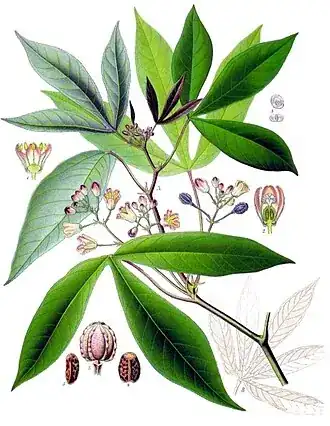
The cassava plant has alternately arranged, palmately lobed leaves each with three to seven lobes. The plant's sap is milky. Cassava is monoecious, with separate male and female flowers on the same plant, arranged in inflorescences. These develop at the apex of the growing stem; buds can sprout to form new branches below the inflorescence, enabling continued vegetative growth. Farmers prefer a non-branching (erect) plant because it is easier to collect, transport, and store. However, the erect form complicates plant breeding as flowers are scarce or absent; breeders make use of photoperiod extension, pruning, and plant growth regulators to encourage flowering.
Cassava is a perennial species that is usually harvested within one year after planting. The harvested part is the storage root, which is long and tapered, with an easily detached rough brown rind. The white or yellowish flesh is firm and even in texture. Commercial cultivars can be 5 to 10 cm wide at the top, and some 15 to 30 cm long, with a woody vascular bundle running down the middle. The tuberous roots are largely starch, with small amounts of calcium (16 milligrams per 100 grams), phosphorus (27 mg/100 g), and vitamin C (20.6 mg/100 g). Content of total pro-vitamin A carotenoids has been increased through conventional breeding from a maximum of 10.3 to 24.3 υg/g FW basis. Cassava roots contain little protein, whereas the leaves are rich in it, except for being low in methionine, an essential amino acid.
Genome
The complete and haplotype-resolved African cassava (TME204) genome has been reconstructed and made available using the Hi-C technology. The genome shows abundant novel gene loci with enriched functionality related to chromatin organization, meristem development, and cell responses. Differentially expressed transcripts of different haplotype origins were enriched for different functionality during tissue development. In each tissue, 20–30% of transcripts showed allele-specific expression differences with <2% of direction-shifting. Despite high gene synteny, the HiFi genome assembly revealed extensive chromosome rearrangements and abundant intra-genomic and inter-genomic divergent sequences, with significant structural variations mostly related to long terminal repeat retrotransposons.
Although smallholders are otherwise economically inefficient producers, they are vital to productivity at particular times. Small cassava farmers are no exception. Genetic diversity is vital when productivity has declined due to pests and diseases, and smallholders tend to retain less productive but more diverse gene pools.
The molecular genetics of starchy root development in cassava have been analyzed and compared to other root and tuber crops, including possible (unproven) roles for
(FT) orthologs.
Harvesting
Before harvest, the leafy stems are removed. The harvest is gathered by pulling up the base of the stem and cutting off the tuberous roots.
Production
In 2022, world production of cassava root was 330 million tonnes, led by Nigeria with 18% of the total (table). Other major growers were Democratic Republic of the Congo and Thailand.
Cassava is the third-largest source of carbohydrates in food in the tropics, after rice and maize. making it an important staple; more than 500 million people depend on it. It offers the advantage of being exceptionally drought-tolerant, and able to grow productively on poor soil. Cassava grows well within 30° of the equator, where it can be produced at up to 2000 m above sea level, and with 50 to 5000 mm of rain per year. These environmental tolerances suit it to conditions across much of South America and Africa.
Cassava yields a large amount of food energy per unit area of land per day – 250,000 kcal/ha, as compared with 156,000 kcal/ha for rice, 110,000 kcal/ha for wheat and 200,000 kcal/ha for maize.
Food and drink
There are many ways of cooking cassava. It has to be prepared correctly to remove its toxicity. The root of the sweet variety is mild to the taste, like potatoes; In Brazil, farofa, a dry meal made from cooked powdered cassava, is roasted in butter, eaten as a side dish, or sprinkled on other food. Jewish households sometimes use it in cholent. It can be made into a flour that is used in breads, cakes and cookies. In Taiwanese culture, later spread to the United States, cassava "juices" are dried to a fine powder and used to make tapioca, a popular starch used to make bubbles (tapioca pearl), a chewy topping in bubble tea. Haitian bambouri and Jamaican bammy are blended Caribbean food traditions, combining Indigenous Caribbean cassava-based cooking with African cultural practices.
Alcoholic beverages made from cassava include cauim (Brazil), kasiri (Venezuela, Guyana, Suriname), parakari or kari (Venezuela, Guyana, Surinam), and nihamanchi (South America),
Preparation of bitter cassava
An ancestral method used by the indigenous people of the Caribbean to detoxify cassava is by peeling, grinding, and mashing; filtering the mash through a basket tube (sebucan or tipiti) to remove the hydrogen cyanide; and drying and sieving the mash for flour. The poisonous filtrate water was boiled to release the hydrogen cyanide, and used as a base for stews.
A safe processing method known as the "wetting method" is to mix the cassava flour with water into a thick paste, spread it in a thin layer over a basket and then let it stand for five hours at 30 °C in the shade. In that time, about 83% of the cyanogenic glycosides are broken down by linamarase; the resulting hydrogen cyanide escapes to the atmosphere, making the flour safe for consumption the same evening.
More to savor

Chicken Vindaloo
Puff Pastry with Nuts and Whipped Cream (Om Ali)

Curry tree at the Table: The Food Behind the Name