This longer reference provides the background behind the topic. Read it alongside the recipe collection when you want to connect an ingredient or food idea with a dish to prepare.
Overview
Cashew is the common name of a tropical evergreen tree Anacardium occidentale, in the family Anacardiaceae. It is the source of the cashew nut and the cashew apple. The tree can grow as tall as 14 m.
Cashews are native to tropical South America. Portuguese explorers encountered them in the 16th century and spread them to India and other tropical regions of the world. The dwarf cultivars, growing up to 6 m, are the most profitable, maturing sooner and producing greater yields. In 2023, 3.9 million tons of cashew nuts were harvested globally, led by the Ivory Coast and India.
The nut shell and raw seed are toxic, but the nut is edible once shelled and roasted or steamed. Treated cashews are eaten on their own as a snack, used in recipes, or processed into cashew cheese or cashew butter. The cashew apple, an accessory fruit, is a light reddish to yellow fruit, the pulp and juice of which can be processed into a sweet, astringent fruit drink or fermented and distilled into liquor. Additionally, derivatives from the shell are used in products such as varnishes, lubricant, and paints.
Description
The cashew tree is large and evergreen, growing to 14 m tall, with a short, often irregularly shaped trunk. The leaves are spirally arranged, leathery textured, elliptic to obovate, 4-22 cm long and 2-15 cm broad, with smooth margins. The flowers are produced in a panicle or corymb up to 26 cm long; each flower is small, pale green at first, then turning reddish, with five slender, acute petals 7-15 mm long. The largest cashew tree in the world covers an area around 7500 m2 and is located in Parnamirim, Brazil.
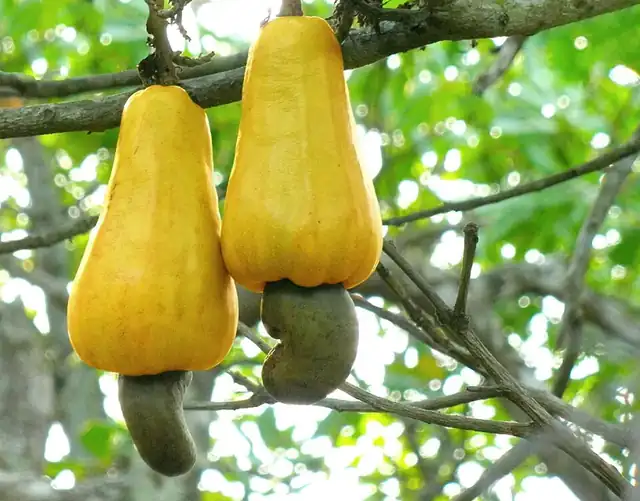
The fruit of the cashew tree is an accessory fruit (sometimes called a pseudocarp or false fruit). What appears to be the fruit is an oval or pear-shaped structure, a hypocarpium, that develops from the pedicel and the receptacle of the cashew flower. Called the cashew apple, better known in Central America as marañón, it ripens into a yellow or red structure about 5–11 cm long.
The true fruit of the cashew tree is a kidney-shaped or boxing glove-shaped drupe that grows at the end of the cashew apple. The drupe first develops on the tree and then the pedicel expands to become the cashew apple. The drupe becomes the true fruit, a single shell-encased seed, which is often considered a nut in the culinary sense. The seed is surrounded by a double-shell that contains an allergenic phenolic resin, anacardic acid - which is a potent skin irritant chemically related to the better-known and also toxic allergenic oil urushiol, which is found in the related poison ivy and lacquer tree.
Distribution and habitat
The species is native to tropical South America and later was distributed around the world in the 1500s by Portuguese explorers. Portuguese colonists in Brazil began exporting cashew nuts as early as the 1550s. The Portuguese took it to Goa, formerly Estado da Índia Portuguesa in India, between 1560 and 1565. From there, it spread throughout Southeast Asia and eventually Africa.
Production
In 2024, world production of cashews (in shell) was 4.2 million tonnes, led by Ivory Coast and India, having 41% of the total when combined (table).
Trade
Almost all cashews produced in Africa between 2000 and 2019 were exported as raw nuts, which are much less profitable than shelled nuts. One of the goals of the African Cashew Alliance is to promote Africa's cashew processing capabilities to improve the profitability of Africa's cashew industry. Half of the world's cashews were sold by American retailer Costco, as of 2025.
Toxicity
Some people are allergic to cashews, but they are a less frequent allergen than other tree nuts or peanuts. For up to 6% of children and 3% of adults, consuming cashews may cause allergic reactions, ranging from mild discomfort to life-threatening anaphylaxis. These allergies are triggered by the proteins found in tree nuts, and cooking often does not remove or change these proteins. Reactions to cashew and tree nuts can also occur as a consequence of hidden nut ingredients or traces of nuts that may inadvertently be introduced during food processing, handling, or manufacturing.
The shell of the cashew nut contains oil compounds that can cause contact dermatitis similar to poison ivy, primarily resulting from the phenolic lipids, anacardic acids, and cardanol. Because it can cause dermatitis, cashews are typically not sold in the shell to consumers. Cardanol, which can be readily and inexpensively extracted from the waste shells, is under research for its potential applications in nanomaterials and biotechnology.
Nut and shell
Culinary uses for cashew seeds in snacking and cooking are similar to those for all tree seeds called nuts.
Cashews are commonly used in Indian cuisine, whole for garnishing sweets or curries, or ground into a paste that forms a base of sauces for curries (e.g., korma), or some sweets (e.g., kaju barfi). It is also used in powdered form in the preparation of several Indian sweets and desserts. In Goan cuisine, both roasted and raw kernels of Goa Kaju are used whole for making curries and sweets. Cashews are also used in Thai and Chinese cuisines, generally in whole form. In the Philippines, cashew is a known product of Antipolo and is eaten with suman. The province of Pampanga also has a sweet dessert called turrones de casuy, which is cashew marzipan wrapped in white wafers.
In Indonesia, roasted and salted cashews are called kacang mete or kacang mede, while the cashew apple is called jambu monyet ( 'monkey rose apple').
In the 21st century, cashew cultivation increased in several African countries to meet the manufacturing demands for cashew milk, a plant milk alternative to dairy milk. In Mozambique, bolo polana is a cake prepared using powdered cashews and mashed potatoes as the main ingredients. This dessert is common in South Africa.
More to savor

Chicken Vindaloo
Stuffed Squash
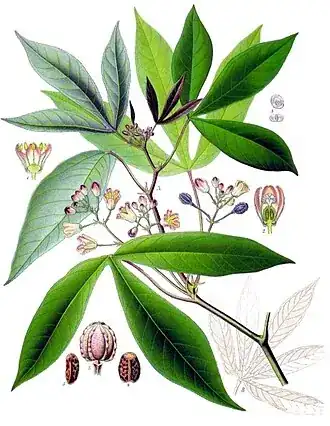
Cassava at the Table: The Food Behind the Name