This longer reference provides the background behind the topic. Read it alongside the recipe collection when you want to connect an ingredient or food idea with a dish to prepare.
In this story
OverviewDescriptionFlowersFruitDistribution and habitatVirusesProductionCulinary useTraditional medicineOverview
The papaya is the plant species Carica papaya, one of the 3 accepted species in the genus Carica of the family Caricaceae.
It was first domesticated in Mesoamerica, within modern-day southern Mexico and Central America. It is grown in several countries in regions with a tropical climate. In 2024, India was the leading producer, accounting for 36% of the world total.
Description
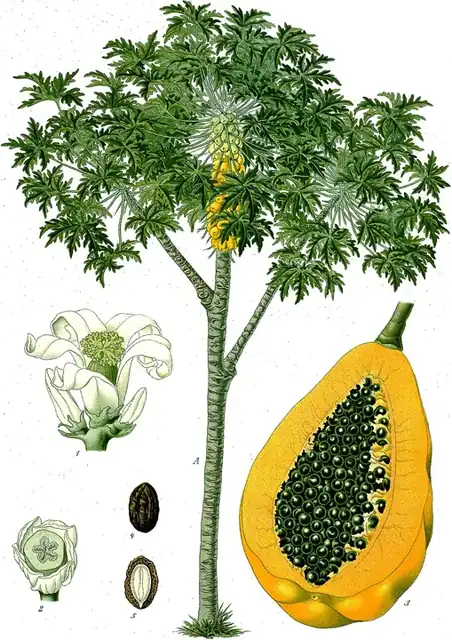
The papaya is a large herbaceous plant, usually with a single stem growing from 5 to 10 m tall, with spirally arranged leaves confined to the top of the trunk. The lower trunk is conspicuously scarred where leaves and fruit were borne. The leaves are large, 50 - 70 cm in diameter, deeply palmately lobed, with seven lobes. All plant parts contain latex in articulated laticifers.
Flowers
Papayas are dioecious. The flowers are five-parted and highly dimorphic; the male flowers have the stamens fused to the petals. There are two different types of papaya flowers. The female flowers have a superior ovary and five contorted petals loosely connected at the base.
Male and female flowers are borne in the leaf axils; the male flowers are in multiflowered dichasia, and the female ones are in few-flowered dichasia. The pollen grains are elongated and approximately 35 microns in length. The flowers are sweet-scented, open at night, and are wind- or insect-pollinated.
Fruit
The fruit is a large berry about 15 - 45 cm long and 10 - 30 cm in diameter. It is ripe when it feels soft (as soft as a ripe avocado or softer) and its skin has attained an amber to orange hue. Along the walls of the large central cavity are attached numerous black seeds.
Distribution and habitat
Native to tropical regions in the Americas, papaya originates from southern Mexico and Central America. Papaya is also considered native to southern Florida, introduced by predecessors of the Calusa no later than AD 300. Spaniards introduced papaya to the Old World in the 16th century. Papaya cultivation is now nearly pantropical, spanning Hawaii, Central Africa, India, and Australia.
Wild populations of papaya are generally confined to naturally disturbed tropical forests. Papaya is found in abundance on Everglades hammocks following major hurricanes, but is otherwise infrequent. In the rain forests of southern Mexico, papaya thrives and reproduces quickly in canopy gaps while dying off in the mature closed-canopy forests.
Viruses
Papaya ringspot virus is a well-known virus within plants in Florida. The first signs of the virus are yellowing and vein-clearing of younger leaves and mottling yellow leaves. Infected leaves may obtain blisters, roughen, or narrow, with blades sticking upwards from the middle of the leaves. The petioles and stems may develop dark green greasy streaks and, in time, become shorter. The ringspots are circular, C-shaped markings that are a darker green than the fruit. In the later stages of the virus, the markings may become gray and crusty. Viral infections impact growth and reduce the fruit's quality. One of the biggest effects that viral infections have on papaya is taste. As of 2010, the only way to protect papaya from this virus is genetic modification.
The papaya mosaic virus destroys the plant until only a small tuft of leaves is left. The virus affects both the leaves of the plant and the fruit. Leaves show thin, irregular, dark-green lines around the borders and clear areas around the veins. The more severely affected leaves are irregular and linear in shape. The virus can infect the fruit at any stage of its maturity. Fruits as young as two weeks old have been spotted with dark-green ringspots about 1 inch (25 mm) in diameter. Rings on the fruit are most likely seen on either the stem end or the blossom end. In the early stages of the ringspots, the rings tend to be many closed circles, but as the disease develops, the rings increase in diameter consisting of one large ring.
The difference between the ringspot and the mosaic viruses is the ripe fruit in the ringspot has a mottling of colors, and the mosaic does not.
Production
In 2024, world production of papayas was 15 million tonnes, led by India with 36% of the total (table).
Global papaya production grew significantly over the early 21st century, mainly as a result of increased production in India and demand by the United States. The United States is the largest importer of papayas worldwide.
In South Africa, papaya orchards yield up to 100 tonnes of fruit per hectare.
Culinary use
The ripe fruit of the papaya is usually eaten raw, without skin or seeds. The black seeds are edible and have a sharp, spicy taste. The unripe green fruit is usually cooked due to its latex content.
Both green papaya fruit and its latex are rich in papain, a cysteine protease used for tenderizing meat and other proteins, as practiced currently by indigenous Americans, people of the Caribbean region, Pacific Islands, and the Philippines. It is included as a component in some powdered meat tenderizers. Papaya is not suitable for foods which set due to gelatin (such as jelly or aspic) because the enzymatic properties of papain prevent gelatin from setting.
Traditional medicine
In traditional medicine, papaya leaves are thought to be useful for treating malaria, as an abortifacient, purgative, smoked to relieve asthma, or as a decoction in Caribbean regions during the 20th century.
More to savor

Chicken Vindaloo
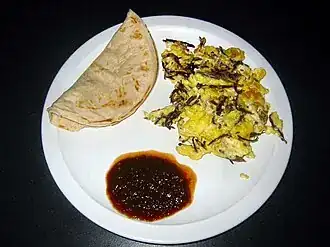
Machacado con Huevo (Eggs with Shredded Beef)
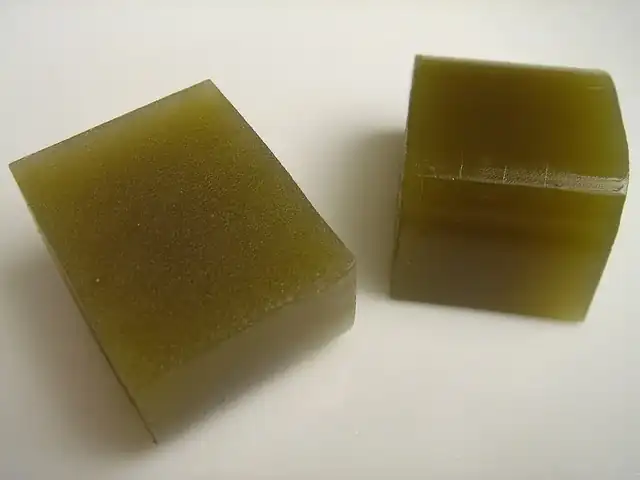
Agar in the Kitchen: Exploring an Everyday Ingredient