The dish is a starting point for exploring a wider food story. The guide below looks more closely at its background and different forms. When you want to cook, visit the recipe collection for ingredient quantities and step-by-step methods.
In this story
OverviewProto-CevicheColonial and modern cevichePreparation and variantsSouth AmericaNorth and Central America and the CaribbeanUNESCO Intangible Cultural Heritage of HumanityOverview
Ceviche, cebiche, sebiche, or seviche is a traditional cold dish consisting of raw fish or shellfish marinated in citrus and seasonings. Different versions of ceviche are part of the culinary cultures of various Latin American countries along the Pacific Ocean where each iteration is considered native, including Chile, Colombia, Costa Rica, Ecuador, El Salvador, Guatemala, Honduras, Mexico, Puerto Rico, Nicaragua, Panama, and Peru. Most notably, ceviche is considered the national dish of Peru and is recognized by UNESCO as an expression of Peruvian traditional cuisine and an Intangible Cultural Heritage of Humanity.
Unlike Japanese sashimi, which is served completely unaltered, the seafood in ceviche is marinated in fresh citrus juice—typically lemon or lime. The citric acid denatures the protein molecules in the fish, altering their structure, causing the flesh to turn opaque and firm. While this process mimics the look and texture of heat-cooked fish, the seafood remains structurally raw, as acid marination does not preserve the fish or kill pathogens the way true heat-cooking or curing does. While the fish is typically marinated in lemon or sour lime juice in contemporary preparation, ancient Andean coastal inhabitants used juices from native plants like the banana passionfruit (known locally as tumbo) before the introduction of citrus fruits to the Andean region during 16th century.
Proto-Ceviche
Before the arrival of Europeans, the ancient civilizations along the Pacific coast of South America practiced a form of "Proto-Ceviche". The term "Proto-Ceviche" refers to the historical predecessor of the modern version of the dish. These early versions of the dish relied on varying types of local acids and preservatives that were used long before the introduction of limes to the Andean region. Various explanations of the dish's origins exist, with Peruvian researchers and archaeological evidence strongly favoring a pre-Hispanic origin within coastal civilizations. According to some historic sources from Peru, the Caral civilization that developed in central Peru between 3500 BC to 1800 BC has left evidence of the use and consumption of raw Peruvian anchovy with chili and sea salt, according to the investigations of archaeologist Ruth Shady.
Colonial and modern ceviche
The modern style of ceviche recognized globally is a direct result of a culinary fusion that occurred during the Spanish colonial era in the 16th century. This period saw the combination of New World ingredients with Old World cooking techniques. Historians concur that the modern iteration of ceviche originated during colonial times in present-day Peru, specifically through the introduction of limes, onions, and vinegar. The technique of macerating (softening or breaking down a food by leaving it in liquid, in this case citrus) raw fish and meat in vinegar, citrus, and spices (escabeche) was brought to the Americas from Spain and is linked to the Moorish (Muslim) heritage in Spanish cuisine.
Preparation and variants
Ceviche is marinated in a citrus-based mixture, with lemons and limes most commonly used. In addition to adding flavor, the citric acid causes the proteins in the seafood to become denatured, resulting in the dish appearing to be cooked without the application of heat. Because the dish is eaten raw and not cooked with heat, it must be prepared fresh and consumed immediately to minimize the risk of food poisoning. Acid marinades will not kill bacteria or parasitic worms, unlike the heat of cooking. Traditional-style ceviche was marinated for about three hours. Modern-style ceviche, popularized in the 1970s, usually has a very short marinating period. The appropriate fish can marinate in the time it takes to mix the ingredients, serve, and carry the ceviche to the table.
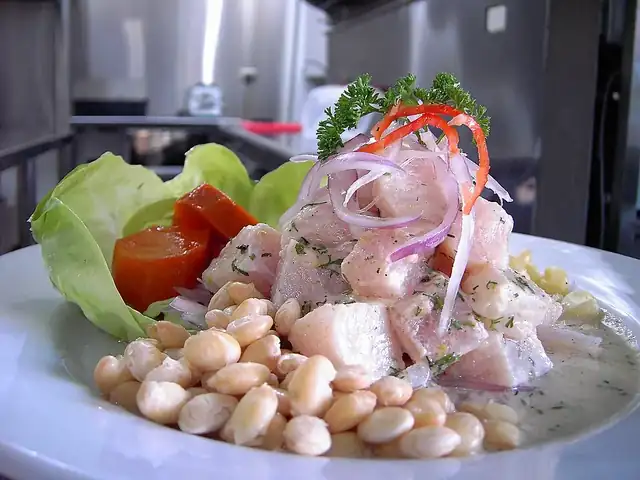
Accompaniments to ceviche vary greatly by region: in Ecuador, ceviche is served with fried plantains, popcorn, or tostones; in Colombia, Panama, and Guatemala, it is served with saltine crackers, though in the north cookies or toast are used as a garnish; in Mexico, it is served with corn tostadas or crackers; in Panama, the spicy chombo chili pepper is sometimes added to taste; and in Peru, it is served with boiled root vegetables (such as sweet potatoes, cassava, or rarely potatoes), grains or seeds such as boiled or roasted corn, legumes, fried plantains, seaweed, or lettuce; sometimes it can also be accompanied by chilcano (broth made from fish heads).
Most Latin American countries have given ceviche its own touch of individuality by adding their own particular garnishes.
South America
In Peru, ceviche has been declared part of the country's national heritage and has even had a holiday declared in its honor. The classic Peruvian ceviche is composed of chunks of raw fish, marinated in freshly squeezed key lime, with sliced onions, chili peppers, salt and pepper. Corvina or cebo (sea bass) was the fish traditionally used. The mixture was traditionally marinated for several hours and served at room temperature, with chunks of corn on the cob and slices of cooked sweet potato. Earlier preparation methods likely involved longer curing times, closer to pickling, before the adoption of citrus introduced after Spanish contact. Regional or contemporary variations include garlic, fish bone broth, minced Peruvian ají limo, or the Andean chili rocoto, toasted corn or cancha and yuyo (seaweed).
North and Central America and the Caribbean
In Mexico, the U.S., and some parts of Central America, it is served either in cocktail cups with tostadas or as a tostada topping and taco filling. In Mexico, when served in a cup with tomato sauce, it is called a ceviche cocktail. Shrimp, octopus, squid, tuna, and mackerel are also popular bases for Mexican ceviche. The marinade ingredients include salt, lime, onion, chili peppers, avocado, and cilantro (coriander). Cut olives and tomatoes are often added to the preparation.
UNESCO Intangible Cultural Heritage of Humanity
In December 2023, the UNESCO Intergovernmental Committee for the Safeguarding of the Intangible Cultural Heritage of Humanity, met in Kasane, Botswana. During this meeting they made the decision to put the "practices and meanings associated with the preparation and consumption of ceviche", on the List of the Intangible Cultural Heritage of Humanity as a traditional dish of Peru. As a basis for its decision, it was considered that the preparation and consumption of ceviche in Peru, "entail specific practices, knowledge and meanings at each stage, from fishing to cultivating the ingredients and preparing the dish. As recipes vary from one region to the next, the dish also strengthens regional cultural identity".
More to savor
Sinigang (Philippine Sour Soup)
Ají de Gallina (Peruvian Chili Chicken)

Hot Dogs: A Sausage, a Bun, and a Food Story