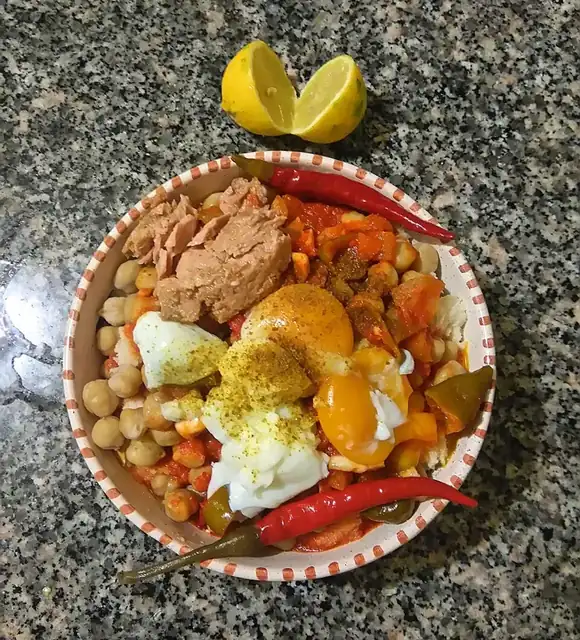
Use the regional background below as a starting point for exploring the food, rather than expecting one dish to represent every household. Food traditions differ within a country and continue to change through travel, migration, and everyday cooking.
Overview
Tunisian cuisine, the cuisine of Tunisia, consists of the cooking traditions, ingredients, recipes and techniques developed in Tunisia since antiquity. It is mainly a blend of Arab, Mediterranean, Punic, and Berber cuisine. Historically, Tunisian cuisine witnessed influence and exchanges with many cultures and nations like Italians, Andalusians, French and Arabs.
Like many countries in the Mediterranean basin, the Tunisian cuisine is heavily based on olive oil, spices, tomatoes, seafood and meat. Yet, it has a distinctive spiciness that differs it from surrounding cuisines.
Ingredients
Unlike other North African cuisines, Tunisian food is quite spicy. A popular condiment and ingredient which is used extensively in Tunisian cooking, harissa, is a mix of ground chili peppers, garlic, and caraway or spices commonly sold together as a paste. It is usually the most important ingredient in different sauces and gravies. Westernised harissa mostly contains red chilies to replace black cumin, which is different from standard cumin. Other common spices include cumin or cumin seeds, garlic, caraway seeds, coriander seeds and paprika. A recipe for the sauce includes red chili peppers and garlic, flavored with coriander, cumin, olive oil and often tomatoes. Harissa has been recognized on UNESCO's list of Intangible Heritage since 2022.
Like harissa or chili peppers, tomato paste is also an ingredient integral to the cuisine of Tunisia. Tuna, eggs, olives and various varieties of pasta, cereals, herbs and spices are also ingredients which are prominently used in Tunisian cooking.
Potatoes were introduced by European settlers in the early 20th century and have become a common ingredient in traditional salads, sauces and couscous. By 1990 one of the most common homemade foods with potatoes was French fries.
Tunisian culinary ingredients include the following typical elements:
Condiments and flavorings: harissa, rose water, orange blossom water, jasmine water and geranium water.
Eggs.
Farm animals: lamb, veal, beef, camel and chicken.
Fish and seafood: tuna, squid (calamari), octopus, anchovies, eel, sardines, mackerel, red snapper, sea bream, sea snails and sea bass.
Fruits: lemons, oranges, figs, dates, olives, apricots, pomegranates and quince.
Regional cuisines
Tunisia has different regional aspects. Tunisian cuisine varies from north to south, from the coast to the Atlas Mountains, from urban areas to the countryside, and along religious affiliations.
For instance, the original inhabitants of Tunis (the Beldiya), do not use harissa much; they prefer milder food, and have also developed their own breads and desserts.
Closer to the Atlas mountain range, game is favoured. A diet may be composed of quail, pigeons, squab, partridge, rabbits and hare. In the Cap Bon, people enjoy tuna, anchovies, sardines, sea bass and mackerels. On the island of Djerba, where there is a dense Jewish presence, kosher food is consumed.
Despite the strong presence of fast-food and restaurants in Sfax, people from the city enjoy their traditional dishes more than anything else. Sfaxians tend to add their own touch to the Tunisian cuisine. They have staple regional dishes such as marka which is a fish soup to which Sfaxians usually add vermicelli or couscous. The soup can also be eaten with barley bread or croutons. Charmoula is a dish made of baked raisins, onions and spices, traditionally eaten with salted fish on the first day of Eid al-Fitr. Sfax is also famed for its pastries. There are two kinds of Sfaxian pastries: daily pastry (locally called hlou Arbi) like makrouth, doria, and ghraiba, and high-range pastry for weddings and special ceremonies (like baklawa, mlabbes and ka'ak warka''').
The region of Gabes is famous for using hrous seasoning instead of harissa (hrous Gabsi is a paste whose main ingredients are 50% salt pickled onions, 50% dried red chili, unlike harissa which does not contain onions).
In Djerba, kosher cuisine is available as well as a myriad of restaurants offering a wide range of regional dishes like rouz djerbi and mainly seafood-based meals.
Meats
Preferred meats include lamb (kosksi bil ghalmi) or chicken (kosksi bil djaj), but regional substitutes include red snapper, grouper (kousksi bil mannani), sea bass (kosksi bil marqua), hare (kosksi bil arnab) or quail (kosksi bil hjall).
Tunisians also love a salted form of bacon made with mutton meat in their dishes(kosksi bil qadid)
Pork consumption is forbidden to Muslims in Tunisia, in accordance with Islamic dietary laws.
Seafood
A popular seafood specialty is poisson complet or the whole fish. The entire fish, excluding internal organs, is prepared and fire-grilled, but it can also be fried, grilled or sautéed. It is accompanied with potato chips and either mild or spicy tastira, made by frying green peppers, tomatoes, onion and a little garlic, all of which is finely chopped and sometimes served with an egg poached or sunny side up. Finely chopped fresh parsley is sprinkled on top; a drizzle of lemon juice and a pinch of sea salt complete the recipe.
In medieval Tunisia oases, a holiday dish called barkukishto was prepared with dried octopus and small fish in a vegetable broth.
Sauces
Tunisian sauces, which are closer to spicy broths, are an integral part of dishes. Otherwise olive oils are often used as sauces.Harissa or hrissa is often said to be a Tunisian sauce, but it is better described as an ingredient of Tunisian cooking or a seasoning. Harissa is made of red chili, garlic, salt, cumin, coriander, olive oil, and sometimes also caraway or mint.Kerkennaise and mloukhia are other frequently used sauces. Kerkennaise is made of capers, olive oil, tomato, scallions, coriander, caraway, cumin, parsley, garlic, white vinegar and paprika. Mloukhia is a dark green sauce served with shredded lamb or beef.
Dishes
Asida—a sweet gruel pudding.
Assidat zgougou—an Aleppo pine pudding.
Baklawa—layers of thin pastry interspersed with ground pine nuts, almonds, hazelnuts and pistachios, brushed in golden butter, baked and dipped in a honey syrup.
Bambalouni—fried sweet donut-like cake served with sugar.
Berber-style lamb stew—A simple stew of lamb cooked with vegetables, such as potatoes and carrots, in a traditional clay pot.
Borzgane–A sweet and savory couscous that mixes crunchy dried fruits and tender meat. It is a festive couscous prepared to welcome spring.
Bouza—rich and sticky sorghum puree.
Brik—tiny parcels of minced lamb, beef, or vegetables and an egg wrapped in thin pastry and deep-fried.
Bsisa—barley pudding
Caponata- a sweet and sour stew of eggplant and other vegetables
More to savor

Austrian Napkin Dumpling (Serviettenknödel)
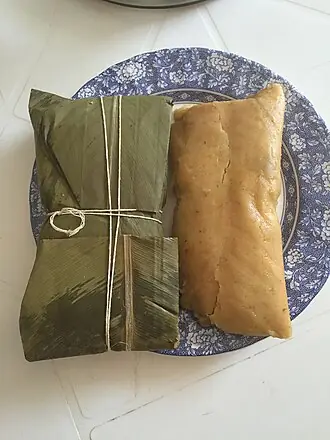
Hallaca (Venezuelan Stuffed Corn Dough)
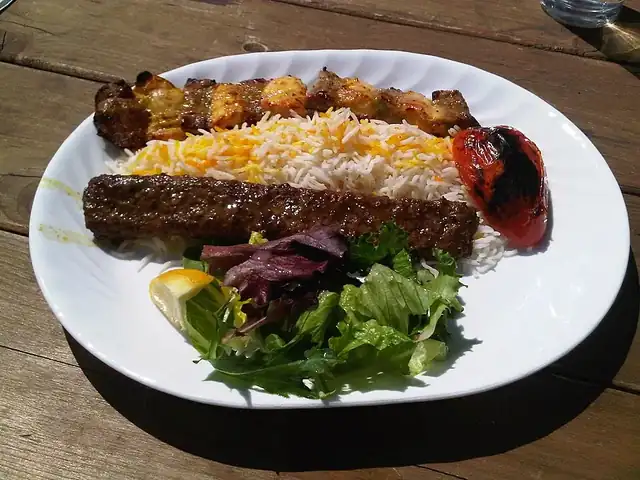
A Taste of Iran: Exploring a Varied Culinary Tradition