The dish is a starting point for exploring a wider food story. The guide below looks more closely at its background and different forms. When you want to cook, visit the recipe collection for ingredient quantities and step-by-step methods.
In this story
OverviewCompositionMughal ancestryCreated in GlasgowInvented in BritainAdapted from an Indian dishPopularityOverview
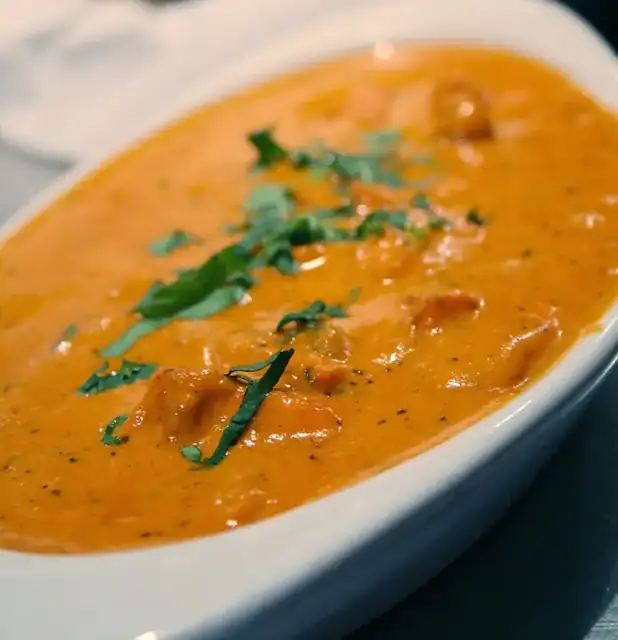
Chicken tikka masala is a curry consisting of roasted marinated chicken pieces (chicken tikka) in a creamy spiced sauce (masala). It is thought to have been created in Britain, possibly by Ali Ahmed Aslam in Glasgow. It is offered at restaurants around the world and in some of its forms is similar to butter chicken.
It is one of the most popular dishes in Britain, and in 2001 was described by the British Foreign Secretary Robin Cook as "a true British national dish". The dish has been called inauthentic both by white Britons and by South Asians. Scholars and critics have debated the status of the dish, concluding variously that it has undergone an elaborate process of cultural interchange, and serves as symbol of Britain's multicultural society. Lizzie Collingham states that it feels quintessentially South Asian despite its British origins.
Composition
Chicken tikka masala is a brightly coloured curry composed of chicken tikka, boneless chunks of chicken marinated in spices (masala) and yoghurt, roasted in an oven, and served in a creamy sauce. A tomato and coriander leaf sauce is common, but there is no standard recipe: a 1998 survey in Britain found that among 48 recipes, the only common ingredient was chicken. It is served as a main course, often with rice or flatbread. Some forms of chicken tikka masala are similar to butter chicken, both in the method of creation and appearance. A vegetarian alternative is to use paneer tikka, Indian cheese replacing the meat.
Mughal ancestry
The English word "tikka" is borrowed from Hindi-Urdu टिक्का/تکہ tikkā "small pieces of meat", itself a borrowing from Classical Persian تکه tikka, "pieces". Chicken tikka (without a sauce) was created in the reign of the Mughal Emperor Babur (r. 1526–1530) by marinating pieces of chicken meat in yoghurt and spices, and then grilling them in a tandoor oven.
Created in Glasgow
It has been suggested that chicken tikka masala originated in a restaurant in Glasgow, Scotland. This version recounts how a British Pakistani chef, Ali Ahmed Aslam, proprietor of the Shish Mahal restaurant in Glasgow from the 1960s, invented the dish by improvising a sauce made from a tin of condensed tomato soup, and spices, to please a customer who wanted a sauce to accompany the dry chicken tikka meat.
The historian of ethnic food Peter Grove challenges the claim that Aslam had created the dish, on the grounds that the dish existed several years before his restaurant opened. Specifically, Sultan Ahmed Ansari, owner of Glasgow's Taj Mahal restaurant, stated that he had created the dish in the 1950s.
The London restaurant owner Iqbal Wahhab claims that he and Peter Grove fabricated the story of a chef using Campbell's tomato soup to create chicken tikka masala "to entertain journalists", and that in particular the use of the soup was "completely made up".
Invented in Britain
Many sources attribute the creation of chicken tikka masala to the South Asian community in Great Britain. The British Indian businessman Gulam Noon is among the people who helped to popularise the dish, though he was not its inventor; he ran food product companies in Southall, in the west of London.
The Multicultural Handbook of Food, Nutrition and Dietetics credits its creation to Bangladeshi migrant chefs in Britain in the 1960s, who at that time ran most of Britain's Indian restaurants. They developed several new British Indian dishes.
Peter and Colleen Grove conclude that the dish "was most certainly invented in Britain, probably by a Bangladeshi chef." They suggest that "the shape of things to come may have been a recipe for Shahi Chicken Masala in Mrs Balbir Singh's Indian Cookery published in 1961." Mrs Balbir Singh's recipe calls for onions fried in oil, with garlic, ginger, masala spices and tomatoes for the frying mixture for the chicken; cream, ground almonds, and yoghurt are added later in the cooking.
Adapted from an Indian dish
It has been suggested that the dish is derived from butter chicken, a popular dish in the northern Indian subcontinent. Rahul Verma, a food critic for The Hindu, claimed that the dish has its origins in the Punjab region.
Popularity
Chicken tikka masala is served in restaurants around the world. By 2010, it was the most popular dish in British curry houses. According to a 2012 survey of 2,000 people in Britain, it was the country's second-most popular foreign dish to cook, after Chinese stir fry. The Oxford Companion to Food traces this popularity to 1983, when supermarkets began selling the dish as a chilled meal; and as of 2016 it was the third most popular ready meal sold in UK supermarkets. In 2025, the scholars of Indian food Bhaskar Sailesh and K. Karthikeyan called it "the world's best-recognized dish". In 2009, efforts by Scottish parliamentarian Mohammed Sarwar to gain the Glasgow dish protected designation of origin status were however unsuccessful.
In the United States, chicken tikka masala has in addition been sold as a taco filling by food trucks and as a pizza topping. In India, chicken tikka masala has been seen as a novelty dish in its own right, and alongside that it has been used as a pizza topping by an Indian fast food chain. BBC Good Food has proposed chicken tikka masala pizzas, using naan flatbreads topped with the curry mix, yoghurt, and mango chutney.
More to savor
Chicken Tikka Masala

Chicken Vindaloo
Masala Chai: The Spiced Tea That Makes a Cup a Ritual