The dish is a starting point for exploring a wider food story. The guide below looks more closely at its background and different forms. When you want to cook, visit the recipe collection for ingredient quantities and step-by-step methods.
In this story
OverviewBezzera's inventionAchieving higher pressuresCharacteristicsProcessRoastsEspresso-based drinksOverview
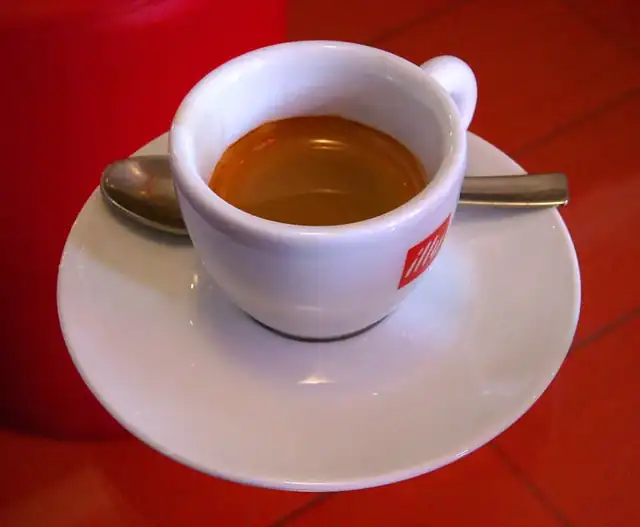
Espresso is a concentrated form of coffee produced by forcing hot water under high pressure through finely ground coffee beans. Originating in Italy, espresso has become one of the most popular coffee-brewing methods worldwide. It is characterized by its small serving size, typically 25–30 ml, and its distinctive layers: a dark body topped with a lighter-colored foam called "crema".
Espresso machines use pressure to extract a highly concentrated coffee with a complex flavor profile in a short time, usually 25–30 seconds. The result is a beverage with a higher concentration of suspended and dissolved solids than regular drip coffee, giving espresso its characteristic body and intensity. While espresso contains more caffeine per unit volume than most coffee beverages, its typical serving size results in less caffeine per serving compared to larger drinks such as drip coffee.
Espresso serves as the base for other coffee drinks, including cappuccino, caffè latte, and americano. It can be made with various types of coffee beans and roast levels, allowing for a wide range of flavors and strengths, despite the widespread myth that it is made with dark-roast coffee beans. The quality of an espresso is influenced by factors such as the grind size, water temperature, pressure, and the barista's skill in tamping (packing and leveling) the coffee grounds.
Bezzera's invention
A machine that could brew individual servings came in the new century. In 1901, the inventor Luigi Bezzera of Milan filed a patent for his coffee maker. This machine contained a boiler, which when heated generated steam that would direct water through one of several heads, cooled on its path to a temperature considered more suitable for brewing. To the heads, a portafilter containing compressed coffee could be attached, producing coffee in individual portions, that is, 'expressly' for the customer.
In 1903, another Milanese man, Desiderio Pavoni, purchased Bezzera's patents. He modified the design by adding a mechanism to release pressure and in 1905 began to sell machines. These are generally held to be the first commercial espresso machines. Although early espresso machines could produce coffee at a rate of 1,000 an hour, the steam and high temperatures gave the drinks a black appearance and a burnt, bitter taste. The pressure they generated was around 1.5 bar, too little to produce a drink that would be considered espresso today, and they lacked the foam "crema". Espressos were longer and took more time to pull—almost a minute, around twice that of the modern espresso.
Achieving higher pressures
For decades, manufacturers endeavored to produce a machine that could use higher pressures without the resulting coffee tasting burned. Arduino tried, unsuccessfully, to incorporate air pumps and screw pistons. In 1935 in Trieste, Italy, Francesco Illy registered a patent for the Illetta, a machine that used compressed air rather than steam. Three years later in Milan, Achille Gaggia registered a patent to do the same, employing a hand-pulled, rotating piston.
In 1947, Gaggia further developed the piston mechanism. The new machines contained much smaller boilers, which generated steam to push water into a receptacle. These were a standardized size, producing a coffee of a standardized size. In the receptacle, a lever-operated piston containing gears and a spring further pressurized the water up to 12 atmospheres. This water was shot through a coffee puck, producing a foam ("crema") out of essential oils and colloids. Gaggia began selling these the following year, using advertising to emphasize the lack of steam and the presence of crema. For the latter, the drink was marketed under the name crema caffè. These are typically seen as the first modern espresso machines.
Characteristics
Espresso is generally thicker than coffee brewed by other methods. This is due to the higher concentration of suspended and dissolved solids and the crema on top (a foam with a creamy consistency). As a result of the pressurized brewing process, the flavors and chemicals in a typical cup of espresso are very concentrated.
Espresso contains more caffeine per unit volume than most coffee beverages, but as its usual serving size of 25–30 ml (1 US oz) is much smaller than other coffee drinks, the overall caffeine content of a single "serving" of espresso is generally lower than that of other coffees. While the exact caffeine content of any coffee drink will vary, a typical 30 ml serving of espresso contains approximately 65 milligrams of caffeine, but a typical 240 ml serving of drip coffee contains approximately 95 mg of caffeine.
Unlike other coffee drinks, an espresso contains three phases: an emulsion of oil droplets, suspended solids, and a layer of gas bubbles or foam. In the mouth, the dispersed oil droplets are perceived as creamy, and they contribute to what is known as the drink's "body". These droplets preserve some aromatic compounds that are lost to the air in other brewing methods.
Process
Espresso is made by forcing very hot water under high pressure through finely ground compacted coffee. There is no universal standard defining the process of extracting espresso, but several institutions have published definitions that restrict the amount and type of ground coffee used, the temperature and pressure of the water, and the rate of extraction. Typically, an espresso is made using an espresso machine.
The act of producing an espresso is often called "pulling" an espresso, originating from lever espresso machines, with which a barista pulls down a handle attached to a spring-loaded piston, which forces hot water through the coffee at high pressure. However, it is more common for an electric pump to generate the pressure.
Tamping down the coffee promotes the water's even penetration through the grounds. This process produces a thicker beverage by extracting both solid and dissolved components.
The technical parameters outlined by the Italian Espresso National Institute for making a "certified Italian espresso" are:
Roasts
Any bean or roasting level can be used to produce authentic espresso. For example, in southern Italy, a darker roast is generally preferred. Farther north, the trend moves toward slightly lighter roasts, while outside Italy a wide range is popular.
Espresso-based drinks
When it is not served by itself, espresso is frequently blended, often with milk—steamed (without significant foam), wet foamed (microfoam), and dry foamed—or hot water. Several are listed below; for reference, espresso typically has a volume between 25 - 30 ml.
Other variants include:
Caffè crema: "long" espresso from more water and coarser ground coffee, approximately 120–180 ml
Espresso con panna: espresso with cream
More to savor
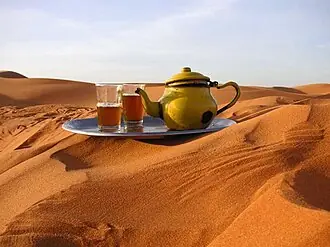
Algerian Mint Tea
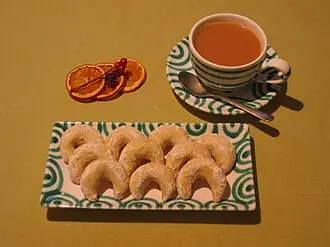
Vanillekipferl (Almond Crescent Cookies)

Chicken Tikka Masala: A Creamy Curry with a Wider Story