This longer reference provides the background behind the topic. Read it alongside the recipe collection when you want to connect an ingredient or food idea with a dish to prepare.
In this story
OverviewDistribution to EuropeDistribution to the rest of the worldPreparationProductionCookingRegional cuisinesOverview
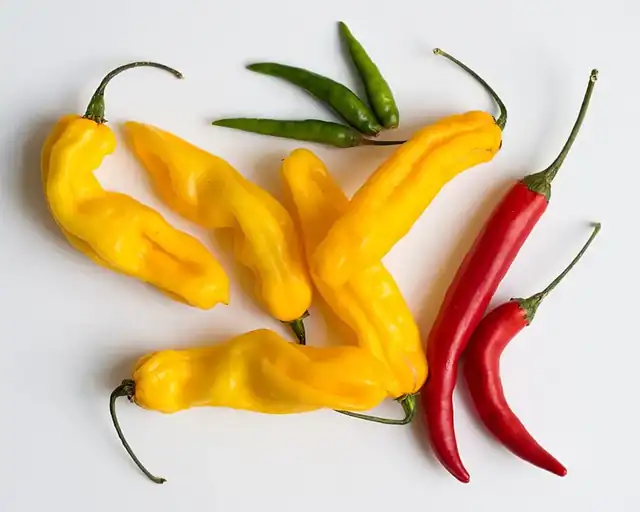
Chili peppers, also spelled chile or chilli , are varieties of berry-fruit plants from the genus Capsicum, which are members of the nightshade family Solanaceae, cultivated for their pungency (spicy heat). They are used as a spice to add pungency in many cuisines. Capsaicin and the related capsaicinoids give chili peppers their intensity when ingested or applied topically. Chili peppers exhibit a range of heat and flavors. This diversity is the reason behind the availability of different types of chili powder, each offering its own taste and heat level.
Chili peppers originated in Central or South America and were first cultivated in Mexico. European explorers brought chili peppers back to the Old World in the late 15th century as part of the Columbian exchange, which led to the cultivation of multiple varieties across the world for food and traditional medicine. Five Capsicum species have been widely cultivated: annuum, baccatum, chinense, frutescens, and pubescens.
Distribution to Europe
In 1493, Diego Álvarez Chanca accompanied Christopher Columbus on his second voyage to the West Indies. Upon returning to Spain with chili peppers, Chanca became the first European to document their medicinal uses in the Old World, publishing his observations in 1494. Columbus and his crew called the Capsicum fruits "peppers" (pimientos in Spanish) because they were pungent like black pepper (Piper nigrum). The introduction of chilies to Europe formed part of the wider interchange of plants, animals, and cultures between the New World and the Old World known as the Columbian exchange. Unlike Piper vines, which grow naturally only in the tropics, chilies could be grown in temperate climates. By the mid-1500s, they had become a common garden plant in Spain and were incorporated into numerous dishes.
By 1526, they had appeared in Italy, in 1543 in Germany, and by 1569 in the Balkans, where they came to be processed into paprika.
Distribution to the rest of the world
The rapid introduction of chilies to Africa and Asia was likely through Portuguese and Spanish traders in the 16th century, though the details are unrecorded. The Portuguese introduced them first to Africa and Arabia, and then to their colonies and trading posts in Asia, including Goa, Sri Lanka, and Malacca. From there, chilies spread to neighboring regions in South Asia and western Southeast Asia via local trade and natural dispersal. Around the same time, the Spanish also introduced chilies to the Philippines, where they spread to Melanesia, Micronesia, and other Pacific Islands via their monopoly of the Manila galleons. Their spread to East Asia in the late 16th century is less clear, but was likely also through local trade or through Portuguese and Spanish trading ports in Canton, China, and Nagasaki, Japan.
The earliest known mention of the chili pepper in Chinese writing dates to 1591, though the pepper is thought to have entered the country in the 1570s.
Preparation
Harvested chilies may be used fresh, or dried, typically on the ground in hot countries, to make a variety of products. Drying enables chilies grown in temperate regions to be used in winter. For home use, chilies can be dried by threading them with cotton and hanging them up in a warm dry place to dry.
Products include whole dried chilies, chili flakes, and chili powder, Fresh or dried chilies are used to make hot sauce, a liquid condiment—usually bottled for commercial use—that adds spice to other dishes. Dried chilies are used to make chili oil, cooking oil infused with chili.
Production
In 2024, world production of green chillies and peppers (as any Capsicum or Pimenta fruits) was 45 million tonnes, with China accounting for 39% of the total and India with 12% (table). Global production of dry chillies and peppers in 2024 was 5.5 million tonnes, led by China, Thailand, and Bangladesh, each accounting for over 300,000 tonnes.
Cooking
Chilies with a low capsaicin content can be cooked like bell peppers, for example stuffing and roasting them. Hotter varieties need to be handled with care to avoid contact with skin or eyes; washing does not efficiently remove capsaicin from skin. Chilies can be roasted over very hot coals or grilled for a short time, as they break up if overcooked.
The leaves of every species of Capsicum are edible, being mildly bitter and nowhere near as hot as the fruits. They are cooked as greens in Filipino cuisine, where they are called dahon ng sili (literally "chili leaves"). They are used in the chicken soup tinola. In Korean cuisine, the leaves may be used in kimchi.
Regional cuisines
Chilies are present in many cuisines, including curries. In Peru, Papa a la huancaina is a dish of potatoes in a sauce of fresh cheese and aji amarillo chilies. In Thailand, kaeng tai pla fish curry is flavoured with a tai pla sauce made with garlic, shallots, galangal, kaffir lime, turmeric, fish paste, and bird's eye chilies. In Jamaica, jerk chicken is spiced with powerful habanero chilies and allspice. Goan vindaloo curry uses the extremely hot ghost pepper or bhut jolokia to create "perhaps [India's] hottest dish". In Bhutan, ema datshi, entirely made of chili mixed with local cheese, is the national dish. Many Mexican dishes use chilies of different types, including the jalapeño, poblano, habanero, serrano, chipotle, ancho, pasilla, guajillo, de árbol, cascabel and mulato.
These offer a wide range of flavours including citrus, earthy, fruity, and grassy. They are used in many dishes and the spicy mole sauce and Mexican salsa sauces. In Yoruba cuisine, chillies are well used in many dishes including Ewa Agoyin and Obe ata.
More to savor

Chicken Vindaloo

Koko da Kosai (Fermented Corn Porridge and Bean Fritters)
Getting to Know Okra: A Food Lover’s Guide