This longer reference provides the background behind the topic. Read it alongside the recipe collection when you want to connect an ingredient or food idea with a dish to prepare.
In this story
OverviewDescriptionTaxonomyEtymologyOrigin and distributionCulinaryPodsLeaves and seedsFolk medicineIndustrialOverview
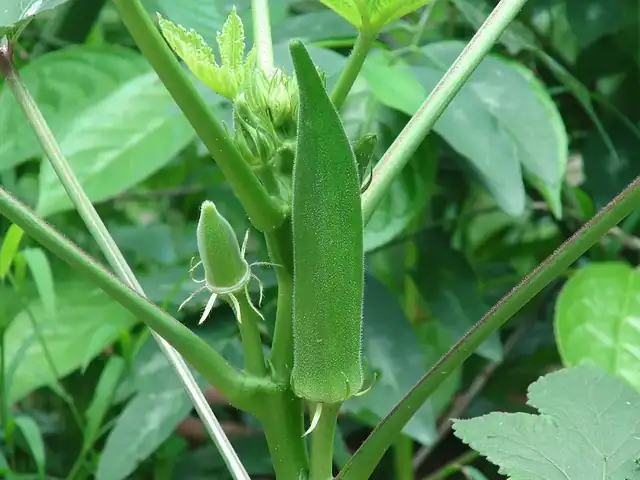
Okra , Abelmoschus esculentus, known in some English-speaking countries as lady's fingers, is a flowering plant in the mallow family native to West Africa. Cultivated in tropical, subtropical, and warm temperate regions around the world for its edible green (red in some cultivars) seed pods, okra is used in the cuisines of many countries.
Description
Abelmoschus esculentus is a perennial, often cultivated as an annual in temperate climates, often growing to around 2 m tall. As a member of the Malvaceae, it is related to such species as cotton, cocoa, and hibiscus. The leaves are 10–20 cm long and broad, palmately lobed with 5–7 lobes. The flowers are 4–8 cm in diameter, with five white to yellow petals, often with a red or purple spot at the base. The pollen grains are spherical and approximately 188 microns in diameter. The fruit is a capsule up to 18 cm long with pentagonal cross-section, containing numerous seeds.
Taxonomy
Abelmoschus esculentus was first described as Hibiscus esculentus by the Swedish botanist Carl Linnaeus in 1753. Linnaeus based his diagnosis on a specimen collected in India. The German botanist Conrad Moench placed the species in genus Abelmoschus in 1794.
Etymology
The word okra derives from a West African language, probably ọ́kwụ̀rụ̀, appearing first in English in 1679 in the Colony of Virginia.
The scientific name can be broken down and translated: Abelmoschus is Neo-Latin from the Arabic (أبو المسك), which was likely derived from the plant's seeds displaying a sweet, musky aroma when crushed; esculentus is Latin for 'edible' or 'being fit for human consumption'.
Origin and distribution
Okra is an allopolyploid of uncertain parentage. However, proposed parents include Abelmoschus ficulneus, A. tuberculatus and a reported diploid form of okra. Truly wild (as opposed to naturalised) populations are not known with certainty, and the West African variety has been described as a cultigen.
Okra originated in East Africa in Ethiopia, Eritrea and eastern Sudan. From Arabia, the plant spread around the shores of the Mediterranean Sea and eastward. Okra was introduced to Europe by the Umayyad conquest of Hispania. One of the earliest accounts is by Abu al-Abbas al-Nabati, who visited Ayyubid Egypt in 1216 and described the plant under cultivation by the locals who ate the tender young pods with meal.
The plant was introduced to the Americas by ships plying the Atlantic slave trade by 1658, when its presence was recorded in Brazil. It was further documented in Suriname in 1686. Okra may have been introduced to southeastern North America from Africa in the early 18th century. By 1748 it was being grown as far north as Philadelphia. Thomas Jefferson noted it was well established in Virginia by 1781. It was commonplace throughout the Southern United States by 1800, and the first mention of different cultivars was in 1806.
Culinary
Okra is one of three thickeners that may be used in gumbo soup from Louisiana. Fried okra is a dish from the Cuisine of the Southern United States. In Cuba and Puerto Rico, the vegetable is referred to as quimbombó, and is used in dishes such as quimbombó guisado (stewed okra), a dish similar to gumbo. It is also used in traditional dishes in the Dominican Republic, where it is called molondrón. In Brazil, it is an important component of several regional dishes, such as caruru, made with shrimp, in the Northeastern region, and frango com quiabo (chicken with okra) and carne refogada com quiabo (stewed meat with okra) in Minas Gerais.
In South Asia, the pods are used in many spicy vegetable preparations as well as cooked with beef, mutton, lamb and chicken.
Pods
The pods of the plant are mucilaginous, resulting in the characteristic "goo" or slime when the seed pods are cooked; the mucilage contains soluble fiber. One possible way to de-slime okra is to cook it with an acidic food, such as tomatoes, to minimize the mucilage. Pods are cooked, pickled, eaten raw, or included in salads. Okra may be used in developing countries to mitigate malnutrition and alleviate food insecurity.
Leaves and seeds
Young okra leaves may be cooked similarly to the greens of beets or dandelions, or used in salads. Okra seeds may be roasted and ground to form a caffeine-free substitute for coffee. When importation of coffee was disrupted by the American Civil War in 1861, the Austin State Gazette said, "An acre of okra will produce seed enough to furnish a plantation with coffee in every way equal to that imported from Rio."
Greenish-yellow edible okra oil is pressed from okra seeds; it has a pleasant taste and odor, and is high in unsaturated fats such as oleic acid and linoleic acid. The oil content of some varieties of the seed is about 40%. At 794 kg/ha, the yield was exceeded only by that of sunflower oil in one trial.
Folk medicine
An infusion of the immature pods or leaves may be used with intent as folk medicine to treat various illnesses.
Industrial
Bast fibre from the stem of the plant has industrial uses such as the reinforcement of polymer composites. The mucilage produced by the okra plant can be used for the removal of turbidity from wastewater by virtue of its flocculant properties. Having composition similar to a thick polysaccharide film, okra mucilage is under development as a biodegradable food packaging, as of 2018. A 2009 study found okra oil suitable for use as a biofuel. A 2025 study suggests that okra polymers, along with fenugreek, may be successful as treatments for removing microplastics from water.
More to savor

Chicken Vindaloo

Coconut Rice (Nasi Lemak)
Getting to Know Chili pepper: A Food Lover’s Guide