This longer reference provides the background behind the topic. Read it alongside the recipe collection when you want to connect an ingredient or food idea with a dish to prepare.
In this story
OverviewDescriptionSimilar speciesDistribution and habitatEcologyCulinary artsIn cultureOverview
Chives, scientific name Allium schoenoprasum, is a species of flowering plant in the family Amaryllidaceae.
A perennial plant, A. schoenoprasum is widespread in nature across much of Eurasia and North America. It is the only species of Allium native to both the New World and Old World.
The leaves and flowers are edible. Chives are a commonly used herb and vegetable with a variety of culinary uses. They are also used to repel insects.
Description
Chives are a bulb-forming herbaceous perennial plant, growing to 25 cm tall. The bulbs are slender, conical, 2–3 cm long and 1 cm broad, and grow in dense clusters from the roots. The scapes (or stems) are hollow and tubular, up to 50 cm long and 2–3 mm across, with a soft texture, although, prior to the emergence of a flower, they may appear stiffer than usual. The grass-like leaves, which are shorter than the scapes, are also hollow and tubular, or terete (round in cross-section).
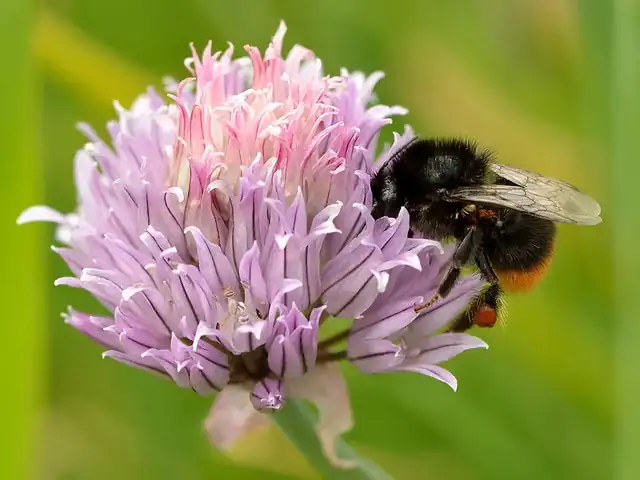
The flowers are pale purple, and star-shaped with six petals, 1–2 cm wide, and produced in a dense inflorescence of 10–30 together; before opening, the inflorescence is surrounded by a papery bract. The seeds are produced in a small, three-valved capsule, maturing in summer. The herb flowers from April to May in the southern parts of its habitat zones and in June in the northern parts.
Sometimes, the plants found in North America are classified as A. schoenoprasum var. sibiricum, although this is disputed. Differences between specimens are significant. One example was found in northern Maine growing solitary, instead of in clumps, also exhibiting dingy grey flowers.
Similar species
Close relatives of chives include common onions, garlic, shallot, leek, scallion, and Chinese onion.
The terete hollow leaves distinguish the plant from Allium tuberosum (garlic chives), which has the leaves flattened and strap-like.
Distribution and habitat
Native to temperate areas of Europe, Asia and North America. chives are the only species of Allium native to both the New and the Old Worlds.
It has a wide natural range across much of the Northern Hemisphere.
In Asia it is native from the Ural Mountains in Russia to Kamchatka in the far east. It grows natively in the Korean peninsula, but only the islands of Hokkaido and Honshu in Japan. Likewise its natural range in China only extends to Xinjiang and Inner Mongolia, though it is also found in adjacent Mongolia. It is native to all the nations of the Caucasus. However, in Central Asia it is only found in Kazakhstan and Kyrgyzstan. To the south its range also extends to Afghanistan, Iran, Iraq, Pakistan, and the Western Himalayas in India.
It is native to all parts of Europe with the exception of Sicily, Sardinia, the island of Cyprus, Iceland, Crimea, and Hungary and other offshore islands. It also is not native to Belgium and Ireland, but it grows there as an introduced plant.
In North America it is native to Alaska and almost every province of Canada, but has been introduced to the island of Newfoundland. In the United States the certain native range in the lower 48 is in two separated areas. In the west its range is in Washington, Oregon, Idaho, Montana, Wyoming, and Colorado. In the east it extends from Minnesota, eastward through Wisconsin, Michigan, Ohio, Pennsylvania, and New Jersey. Then northward into New York and all of New England. The Plants of the World Online database lists it as introduced to Illinois and Maryland and the USDA Natural Resources Conservation Service PLANTS database additionally lists it as growing in Nevada, Utah, Missouri, and Virginia without information on if it is native or introduced to those states.
In other areas of the Americas chives grow as an introduced plant in Mexico, Honduras, Costa Rica, Cuba, Jamaica, Hispaniola, Trinidad, Colombia, Bolivia, and the southern part of Argentina in Tierra del Fuego.
Ecology
Chives are repulsive to most insects due to their sulfur compounds, but their flowers attract bees, and they are at times kept to increase desired insect life.
The plant provides a great deal of nectar for pollinators. It was rated in the top 10 for most nectar production (nectar per unit cover per year) in a United Kingdom plants survey conducted by the AgriLand project which is supported by the UK Insect Pollinators Initiative.
Culinary arts
Chives are grown for their scapes and leaves, which are used for culinary purposes as a flavoring herb, and provide a somewhat milder onion-like flavor than those of other Allium species. The edible flowers are used in salads, or used to make blossom vinegars. Both the scapes and the unopened, immature flower buds are diced and used as an ingredient for omelettes, fish, potatoes, soups, and many other dishes. The scapes are often paired with cream cheese.
Chives have a wide variety of culinary uses, such as in traditional dishes in France, Sweden, and elsewhere. In his 1806 book Attempt at a Flora (Försök til en flora), Anders Jahan Retzius describes how chives are used with pancakes, soups, fish, and sandwiches. They are also an ingredient of the gräddfil sauce with the traditional herring dish served at Swedish midsummer celebrations. The flowers and scapes may also be used to garnish dishes.
In Poland and Germany, chives are served with quark. Chives are one of the fines herbes of French cuisine, the others being tarragon, chervil and parsley. Chives can be found fresh at most markets year-round, making them readily available; they can also be dry-frozen without much impairment to the taste, giving home growers the opportunity to store large quantities harvested from their own gardens.
In culture
In Europe, chives were sometimes referred to as "rush leeks".
It was mentioned in 80 A.D. by Marcus Valerius Martialis in his "Epigrams" (13.18 porri sectivi):
The Romans believed chives could relieve the pain from sunburn or a sore throat. They believed eating chives could increase blood pressure and act as a diuretic.
Romani have used chives in fortune telling. Bunches of dried chives hung around a house were believed to ward off disease and evil.
In the 19th century, Dutch farmers fed cattle on the herb to give a different taste to their milk.
More to savor

Chicken Vindaloo

Greek Salad
Oyster Mushrooms at the Table: The Food Behind the Name