What we eat is only part of the story of a meal. The setting, the way food is served, and the habits around the table can be just as revealing. The guide below follows the subject in more detail.
In this story
OverviewAs cooking utensilsAs cooking thermometersAs eating utensilsPropagation throughout the worldCommon characteristicsChopstick customs, manners and etiquetteOverview
Chopsticks are shaped pairs of equal-length sticks that have been used as kitchen and eating utensils in most countries of the Sinosphere for over three millennia. They are held in the dominant hand, secured by fingers, and wielded as extensions of the hand, to pick up food.
Originating in China, chopsticks later spread to other parts of the Sinosphere such as Korea, Japan and Vietnam. Chopsticks have become more accepted in connection with East Asian food in the West, especially in cities with significant East Asian diaspora communities.
Chopsticks are smoothed, and frequently tapered. They are traditionally made of wood, bamboo, metal, ivory, and ceramics, and in modern days, increasingly available in non-traditional materials such as plastic, stainless steel, and even titanium. Chopsticks are often seen as requiring practice and skill to master to be used as an eating utensil. In some countries, failing to follow etiquette in their use is frowned upon, though such feelings are generally lesser than they once were.
As cooking utensils
The first chopsticks were used for cooking, stirring the fire, serving or seizing bits of food, and not as eating utensils. One reason was that before the Han dynasty, millet was predominant in North China, Korea and parts of Japan. While chopsticks were used for cooking, millet porridge was eaten with spoons at that time. The use of chopsticks in the kitchen continues to this day.
Ryōribashi are Japanese kitchen chopsticks used in Japanese cuisine. They are used in the preparation of Japanese food, and are not designed for eating. These chopsticks allow handling of hot food with one hand, and are used like regular chopsticks. These chopsticks have a length of 30 cm or more, and may be looped together with a string at the top. They are usually made from bamboo. For deep frying, however, metal chopsticks with bamboo handles are preferred, as tips of regular bamboo chopsticks become discolored and greasy after repeated use in hot oil. The bamboo handles protect against heat.
Similarly, Vietnamese cooks use Đũa cả or "grand chopsticks" in cooking, and for serving rice from the pot.
As cooking thermometers
When a wetted end of a wooden chopstick is dipped into cooking oil, a sizzling sound due to bubbles bursting indicates that the temperature is suitable for deep-frying. Instead, loud popping or crackling implies that the temperature is too high, whereas silence implies that it is too low.
As eating utensils
Chopsticks began to be used as eating utensils during the Han dynasty, as rice consumption increased. During this period, spoons continued to be used alongside chopsticks as eating utensils at meals. It was not until the Ming dynasty that chopsticks came into exclusive use for both serving and eating. They then acquired the name kuaizi and the present shape.
Propagation throughout the world
The use of chopsticks as both cooking and eating utensils spread throughout East and Southeast Asia over time. Scholars such as Isshiki Hachiro and Lynn White have noted how the world was split among three dining customs, or food cultural spheres. There are those that eat with their fingers, those that use forks and knives, and then there is the "chopsticks cultural sphere", consisting of China, Japan, Korea, and Vietnam.
As Han Chinese emigration percolated, they spread the usage of chopsticks as eating utensils to South and Southeast Asian countries including Brunei, Cambodia, Laos, Nepal, Malaysia, Myanmar, Singapore and Thailand. In Singapore and Malaysia, the Han Chinese traditionally consume all food with chopsticks, while ethnic Indians and Malays (especially in Singapore) use chopsticks primarily to consume noodle dishes. Overall, the use of either chopsticks, a spoon, or a fork, is interchangeable in these regions. In Laos, Myanmar, Thailand and Nepal chopsticks are generally used only to consume noodles.
Similarly, chopsticks have become more accepted in connection with East Asian cuisine around the world, in Hawaii, the West Coast of North America, and cities with Overseas Asian communities all around the globe.
Common characteristics
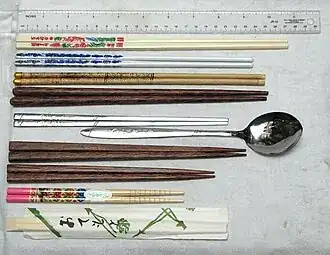
Chopsticks come in a wide variety of styles, with differences in geometry and material. Depending on the country and the region some chopstick styles are more common than others.
Length: Chopsticks range from 23 to(-) long, tapering to one end. Very long, large chopsticks, usually about 30 to(-), are used for cooking, especially for deep frying foods.
Cross-section: Chopsticks may have round, square, hexagonal, or other polygonal cross-sections. Usually the edges are rounded off so there are no sharp 90° surface angles in square chopsticks. Korean chopsticks are notable for having flat handles, instead of regular full bodies as in Chinese, Vietnamese and Japanese chopsticks.
Taper: Chopsticks are usually tapered in the end used for picking up food. Chinese and Vietnamese chopsticks are more commonly blunt, while Japanese ones tend to be sharp and pointed in style. Korean chopsticks typically have sharp tapers.
Tips: Some chopsticks have a rough surface for the tip end, to provide better friction for gripping food. The gripping surfaces may be carved as circumferential grooves, or provided as a rough texture.
Chopstick customs, manners and etiquette
Chopsticks are used in many parts of Asia and principles of etiquette are similar, but finer points can differ from region to region. Chopstick manners were gradually shaped to work with a culture's particular dietary varieties and habit. Etiquette developed for primarily individual servings eaten on the floor (or tatami in the case of Japan) could be different from communal meals eaten around a table while seated on chairs. The need for serving or communal chopsticks similarly differ. In some cultures it is customary to lift a bowl to the mouth, when the only eating utensil used is chopsticks. In other cultures, lifting a bowl closer to the mouth is frowned upon as equivalent to begging, as the local custom is to use chopsticks for chunky food, and a spoon for liquid food.
In chopstick-using countries, holding chopsticks incorrectly reflects negatively on a child's parents and home environment. There are frequent news articles on the alarming decline of children's abilities to use chopsticks correctly. Similarly, stabbing food due to one's inability to wield chopsticks with dexterity is also frowned upon.
In general, chopsticks should not be left vertically stuck into a bowl of rice because it resembles the ritual of incense-burning that symbolizes "feeding" the dead.
More to savor
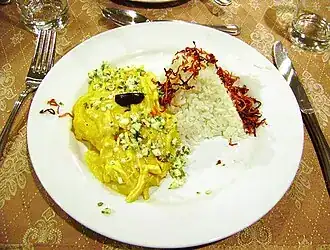
Ají de Gallina (Peruvian Chili Chicken)

Chicken Vindaloo
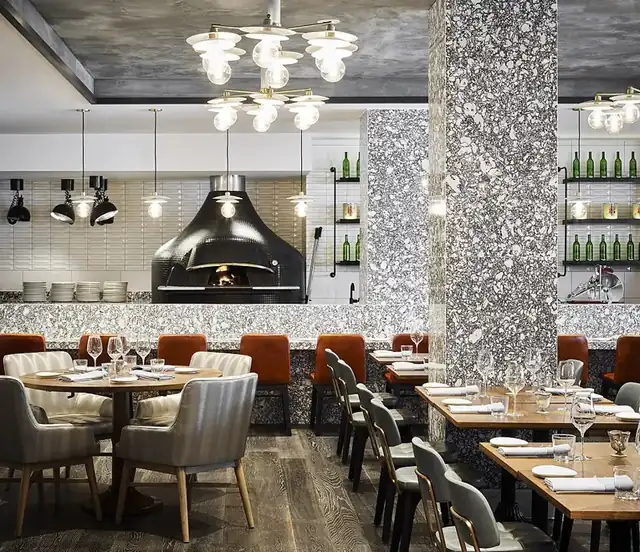
Restaurants: How Eating Out Became Its Own Food Story