This longer reference provides the background behind the topic. Read it alongside the recipe collection when you want to connect an ingredient or food idea with a dish to prepare.
Overview
The cocoa bean, also known as cocoa or cacao , is the dried and fully fermented seed of Theobroma cacao, the cacao tree. Due to its high fat content, the bean can be ground into a liquor, from which cocoa butter and cocoa powder are extracted. Cacao trees are native to the Amazon rainforest. They are the basis of chocolate and Mesoamerican foods including tejate, an indigenous Mexican drink.
The cacao tree was first domesticated at least 5,300 years ago by the Mayo-Chinchipe culture in South America before it was introduced in Mesoamerica. Cacao was consumed by pre-Hispanic cultures in spiritual ceremonies, and its beans were a common currency in Mesoamerica. The cacao tree grows in a limited geographical zone; today, West Africa produces nearly 81% of the world's crop. The three main varieties of cocoa plants are Forastero, Criollo, and Trinitario, with Forastero being the most widely used.
Varieties
Cocoa beans are traditionally classified into three main varieties: Forastero, Criollo and Trinitario. Use of these terms has changed across different contexts and times, and recent genetic research has found that the categories of Forastero and Trinitario are better understood as geohistorical inventions rather than as having a botanical basis. They are still used frequently in marketing material. Criollo has traditionally been the most prized variety. Believed to have been native to South America, by the time of the Spanish conquest they were grown in Mesoamerica. After European colonization, disease and population decrease led to the Spanish and Portuguese using different cacao varieties from South America. Different from the Criollo beans, these new beans were named Forastero, which can be translated as strange or foreign.
They are generally of the Amelonado type and are associated with West Africa. Trinitario refers to any hybrid between Criollo and Forastero.
Harvesting
Cacao trees grow in hot, rainy tropical areas within 20° of latitude from the Equator. Cocoa harvest is not restricted to one period per year and a harvest typically occurs over several months. In fact, in many countries, cocoa can be harvested at any time of the year. Pesticides are often applied to the trees to combat capsid bugs, and fungicides to fight black pod disease.
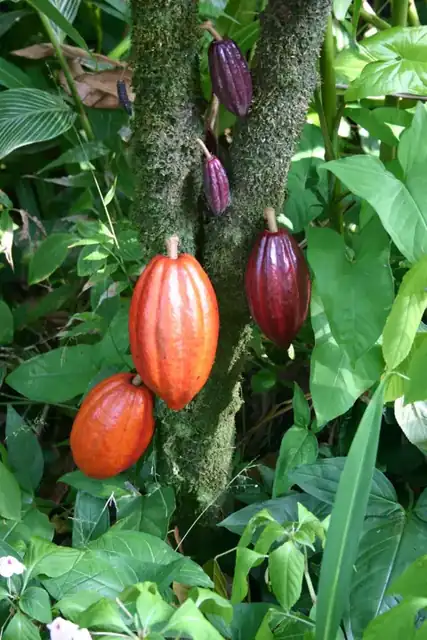
Immature cocoa pods have a variety of colours, but most often are green, red, or purple, and as they mature, their colour tends towards yellow or orange, particularly in the creases. Unlike most fruiting trees, the cacao pod grows directly from the trunk or large branch of a tree rather than from the end of a branch, similar to jackfruit. This makes harvesting by hand easier as most of the pods will not be up in the higher branches. The pods on a tree do not ripen together; harvesting needs to be done periodically through the year. Harvesting occurs between three and four times weekly during the harvest season.
Harvest processing
The harvested pods are opened, typically with a machete or a knife, to expose the beans. The pulp and cocoa seeds are removed and the rind is discarded. The pulp and seeds are then piled in heaps, placed in bins, or laid out on grates for several days. During this time, the seeds and pulp undergo "sweating", where the thick pulp liquefies as it ferments. The fermented pulp trickles away, leaving cocoa seeds behind to be collected. At the end of this process, the seeds change color from pale yellow or violet to brown. Sweating is important for the quality of the beans, which originally have a strong, bitter taste.
If sweating is interrupted, the resulting cocoa may be ruined; if underdone, the cocoa seed maintains a flavor similar to raw potatoes and becomes susceptible to mildew. Some cocoa-producing countries distill alcoholic spirits using the liquefied pulp.
Production
In 2022, world production of cocoa beans was 5.87 million tonnes, led by Ivory Coast with 38% of the total, while secondary producers were Ghana and Indonesia (table).
Consumption
People around the world consume cocoa in many different forms, consuming more than 3 million tons of cocoa beans yearly. Once the cocoa beans have been harvested, fermented, dried and transported they are processed in several components. Processor grindings serve as the main metric for market analysis. Processing is the last phase in which consumption of the cocoa bean can be equitably compared to supply. After this step all the different components are sold across industries to many manufacturers of different types of products.
Global market share for processing has remained stable, even as grindings increase to meet demand. One of the largest processing countries by volume is the Netherlands, handling around 13% of global grindings. Europe and Russia as a whole handle about 38% of the processing market. Average year after year demand growth has been just over 3% since 2008. While Europe and North America are relatively stable markets, increasing household income in developing countries is the main reason of the stable demand growth. As demand is awaited to keep growing, supply growth may slow down due to changing weather conditions in the largest cocoa production areas.
Chocolate production
To produce 1 kg of chocolate, around 300 to 600 cocoa beans are processed. The beans are roasted, cracked, and deshelled, resulting in pieces called nibs (the cotyledons, of which beans generally contain two), which are ground into a thick paste known as chocolate liquor or cocoa paste. The liquor is processed into chocolate by adding cocoa butter, sugar, and sometimes vanilla and lecithin. Alternatively, cocoa powder and cocoa butter can be separated using a hydraulic press or the Broma process. Treating cocoa with an alkali produces Dutch process cocoa, which has a different flavor profile than untreated cocoa. Roasting can also be done on the whole bean or nib, affecting the final flavor.
Cocoa powder may have a fat content of about 12%, but this varies significantly. Cocoa butter is used in chocolate bar manufacture, other confectionery, soaps, and cosmetics.
Treating with an alkali produces Dutch process cocoa, which is less acidic, darker, and more mellow in flavor than untreated cocoa. Regular (non-alkalized) cocoa is acidic, so when cocoa is treated with an alkaline ingredient, generally potassium carbonate, the pH increases. This can be done at various stages during manufacturing, including during nib treatment, liquor treatment, or press cake treatment.
More to savor

Chicken Vindaloo

Koko da Kosai (Fermented Corn Porridge and Bean Fritters)
Getting to Know Chili pepper: A Food Lover’s Guide