This longer reference provides the background behind the topic. Read it alongside the recipe collection when you want to connect an ingredient or food idea with a dish to prepare.
Overview
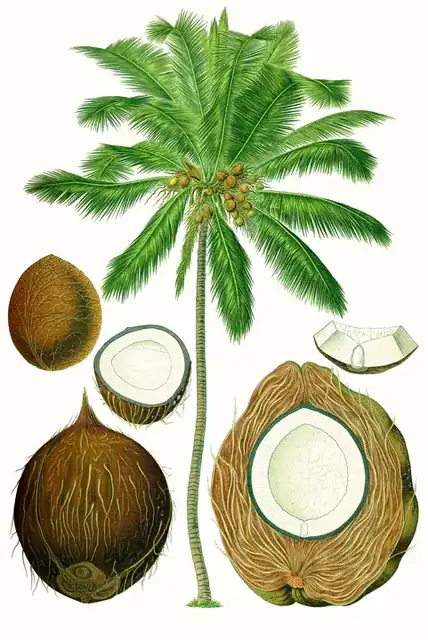
The coconut (Cocos nucifera) is a member of the palm family (Arecaceae) and the only living species of the genus Cocos. The term "coconut" (or the archaic "cocoanut") can denote the whole coconut palm tree or the large hard fruit. Originally native to the Southeast Asia, New Guinea, and the Southwestern Pacific, they are ubiquitous in coastal tropical regions.
The coconut tree provides food, fuel, cosmetics, folk medicine, and building materials. The inner flesh of the mature fruit forms a regular part of the diets of many people in the tropics and subtropics. Coconut endosperm contains a large quantity of a liquid, "coconut water". Mature coconuts can be processed for oil and coconut milk from the flesh, charcoal from the hard shell, and coir from the fibrous husk. Dried coconut flesh is called copra, and the oil and milk derived from it are commonly used in cooking and in soaps and cosmetics. Sweet coconut sap can be made into drinks or fermented into palm wine or coconut vinegar. The hard shells, fibrous husks and long pinnate leaves are used to make products for furnishing and decoration.
Description
Cocos nucifera is a large palm, growing up to 30 meter tall, with pinnate leaves 4 - 6 m long, and pinnae 60 - 90 cm long; old leaves break away cleanly, leaving the trunk smooth. On fertile soil, a tall coconut palm tree produces around 80 fruits per year; new varieties may be able to yield as many as 150 per year. In India, average production is over 8,000 nuts per hectare per year. Tall varieties produce their first fruit in 6 to 10 years, and live for 60 to 100 years; dwarf varieties become productive more quickly, but have a shorter lifespan.
Inflorescence
The coconut is monoecious, meaning that both male and female flowers grow on the same tree, in its case in the same inflorescence. It is possible that the species in addition occasionally has bisexual flowers. The female flower is much larger than the male flower. Mature trees grow continuously, producing leaves, flowers, and fruit all year round. It takes some 14 months for each flower primordium to develop into an inflorescence, botanically a spadix inside a sheathing spathe. A healthy tree can produce up to 15 inflorescences per year, staggered so that there is always a mature one with others in different stages of development. It takes 11 months from the opening of the female flowers to the time of harvest. Coconut palms are largely cross-pollinated, although most dwarf varieties are self-pollinating.
Fruit
Botanically, the coconut fruit is a drupe, not a true nut. Like other fruits, it has three layers: the exocarp, mesocarp, and endocarp. The exocarp is the glossy outer skin, usually yellow-green to yellow-brown in color. The mesocarp is composed of a fiber, called coir, which has many traditional and commercial uses. The exocarp and the mesocarp make up the "husk" of the coconut, while the endocarp makes up the hard coconut "shell". The endocarp is around 4 mm thick and has three distinctive germination pores (micropyles) on the distal end. Two of the pores are plugged (the "eyes"), while one is functional.
The interior of the endocarp is hollow and is lined with a thin brown seed coat, some 0.2 mm thick. The endocarp is initially filled with a liquid endosperm (the coconut water). The liquid contains many free cell nuclei (it is multinucleate) dividing by mitosis, without cell boundaries. As development continues, cellular layers of endosperm deposit along the walls of the endocarp up to 11 mm thick, starting at the far end. They eventually form the edible solid endosperm ("coconut meat") which hardens over time. The small cylindrical embryo is embedded in the solid endosperm directly below the functional pore. During germination, the embryo pushes out of the functional pore and forms a haustorium inside the central cavity. This absorbs the solid endosperm to nourish the seedling.
Production
In 2024, world production of coconuts in shells was 65.5 million tonnes, led by Indonesia, India, and the Philippines, together having 72% of the total (table).
In India, four southern states account for most of India's total production: Tamil Nadu, Karnataka, Kerala, and Andhra Pradesh. Though Kerala has the largest number of coconut trees, Tamil Nadu is the most productive per hectare. The coconut is the official state tree of Kerala, whose name in the local language Malayalam means "coconut land".
Culinary
The many culinary uses of coconuts are largely based on the edible white, fleshy part of the seed (the endosperm), known as "coconut meat". The meat of immature coconuts can be eaten as it is or cooked in pastries. Mature coconut meat is tough and is processed before consumption, being made into products like coconut milk, "coconut chips" or grated and dehydrated as "desiccated coconut".
Coconut milk, used for cooking many dishes, is pressed from coconut meat. It can be diluted to create coconut milk beverages such as milk substitutes. Coconut milk powder, a protein-rich powder, can be processed from coconut milk. Coconut milk and coconut cream extracted from grated coconut can be added to desserts and savory dishes, or used in curries and stews. Products made from thickened coconut milk with sugar and eggs, like coconut jam and coconut custard, are widespread in Southeast Asia. Coconut oil is used for frying and cooking.
Non-food uses
Among the many non-food uses of coconut palms, the husk and shells can be used for fuel or made into charcoal. The husks can serve as flotation devices or as an abrasive. The shell, freed from the husk, and heated on warm ashes, exudes an oily material that is used to soothe dental pains in traditional medicine of Cambodia. Coir fiber from husks is used in ropes, mats, brushes, and sacks, as caulking for boats, and as stuffing for mattresses. It is used in horticulture in potting compost, especially in orchid mix, and to make brooms in Cambodia. Coconut cups were frequently carved with scenes in relief and mounted with precious metals. The leaves provide material for baskets and for roofing thatch; they can be woven into mats, cooking skewers, and kindling arrows.
Leaves are woven into small pouches that are filled with rice and cooked to make pusô and ketupat.
More to savor

Chicken Vindaloo

Koko da Kosai (Fermented Corn Porridge and Bean Fritters)
A Closer Look at Ricotta: From Ingredient to Meal