This longer reference provides the background behind the topic. Read it alongside the recipe collection when you want to connect an ingredient or food idea with a dish to prepare.
Overview
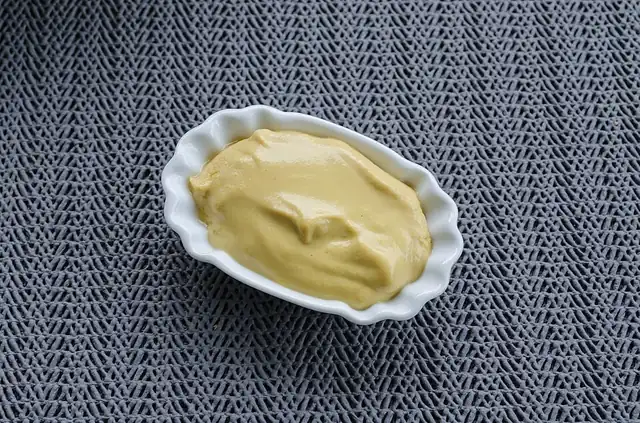
Mustard is a condiment made from the seeds of a mustard plant, which may be the white/yellow mustard (Sinapis alba), brown mustard (Brassica juncea), or black mustard (Rhamphospermum nigrum).
The whole, ground, cracked, or bruised mustard seeds are mixed with water, vinegar, lemon juice, wine, or other liquids, salt, and often other flavourings and spices, to create a paste or sauce ranging in colour from bright yellow to dark brown. The seed itself has a strong, pungent, and somewhat bitter taste. The taste of mustard condiments ranges from sweet to spicy.
Mustard is commonly paired with meats, vegetables, and cheeses, especially as a condiment for sandwiches, hamburgers, and hot dogs. It is also used as an ingredient in many dressings, glazes, sauces, soups, relishes, and marinades. As a paste or as individual seeds, mustard is used as a condiment in the cuisine of India and Bangladesh, the Mediterranean, northern and southeastern Europe, Asia, the Americas, and Africa, making it one of the most popular and widely used spices and condiments in the world.
Culinary uses
Mustard is most often used at the table as a condiment on cold and hot meats. It is also used as an ingredient in mayonnaise, vinaigrette, marinades, and barbecue sauce. It is also a popular accompaniment to hot dogs, pretzels, and bratwurst. In the Netherlands and Belgium, mustard is mainly used as a seasoning of croquettes, bitterballen, and cheese, and commonly used to make mustard soup, which includes mustard, cream, parsley, garlic, and pieces of salted bacon.
Mustard as an emulsifier can stabilize a mixture of two or more immiscible liquids, such as oil and water. Added to Hollandaise sauce, mustard can inhibit curdling.
Mustard can be added to dishes as a primary spice, which is popular in East Indian cuisine. Added to mixed vegetables or fish curries, it can impart a unique flavour to some of the Indian recipes.
Preparation
The many varieties of prepared mustards have a wide range of strengths and flavours, depending on the variety of mustard seed and the preparation method. The basic taste and "heat" of the mustard are determined largely by seed type, preparation, and ingredients. Preparations from the white mustard plant (Sinapis alba) have a less pungent flavour than preparations of black mustard (Brassica nigra) or brown mustard (Brassica juncea). The temperature of the water and concentration of acids, such as vinegar, also determine the strength of a prepared mustard; hotter liquids and stronger acids denature the enzymes that give mustard its strong flavour. Thus, "hot" mustard is made with cold water, whereas using hot water produces a milder condiment, all else being equal.
Mustard oil can be extracted from the chaff and meal of the seed.
Hot table mustard can be prepared at home by mixing ground mustard powder to the desired consistency with water or an acidic liquid such as wine, vinegar, milk or beer, and letting it stand for ten minutes. It is usually prepared immediately before a meal; mustard prepared with water, in particular, is more pungent, but deteriorates rapidly.
Flavours
The mustard plant itself has a sharp, hot, pungent flavour.
Mixing ground mustard seeds with water causes a chemical reaction between two compounds in the seed: the enzyme myrosinase and various glucosinolates such as sinigrin and sinalbin. The myrosinase enzyme turns the glucosinolates into various isothiocyanate compounds known generally as mustard oil. The concentrations of different glucosinolates in mustard plant varieties, and the different isothiocyanates that are produced, make different flavours and intensities.
Allyl isothiocyanate and 4-hydroxybenzyl isothiocyanate are responsible for the sharp, hot, pungent sensation in mustards and in horseradish, wasabi, and garlic, because they stimulate the heat- and acidity-sensing TRPV ion channel TRPV1 on nociceptors (pain-sensing nerve cell) in the mouth and nasal passages. The heat of prepared mustard can dissipate with time. This is due to gradual chemical break-up of 4-hydroxybenzyl isothiocyanate.
Sulforaphane, phenethyl isothiocyanate, and benzyl isothiocyanate create milder and less pungent intensities and flavours as when found in broccoli, brussels sprouts, watercress, and cabbages.
The sulfoxide unit in sulforaphane is structurally similar to a thiol, which yields onion or garlic-like odours.
Storage and shelf life
Prepared mustard is typically sold in glass jars, plastic bottles, or metal squeeze tubes. Because of its antibacterial properties and acidity, mustard does not require refrigeration for safety; it will not grow mould, mildew, or harmful bacteria. Mustard can last indefinitely without becoming inedible or harmful, though it may dry out, lose flavour, or brown from oxidation. Mixing in a small amount of wine or vinegar may improve dried-out mustard. Some types of prepared mustard stored for a long time may separate, which can be corrected by stirring or shaking. If stored unrefrigerated for a long time, mustard can acquire a bitter taste.
When whole mustard seeds are crushed and mixed with a liquid, an enzyme is activated that releases pungent sulfurous compounds, but they quickly evaporate. An acidic liquid, such as wine or vinegar, produces longer-lasting flavour by slowing the reaction. However prepared mustard loses its pungency over time; the loss can be slowed by keeping a sealed container (opaque or in the dark) in a cool place or refrigerator.
Varieties
Mustards come in a wide variety of preparations which vary in the preparation of the mustard seeds and which other ingredients are included. The mustard seed husks may be ground with the seeds, or winnowed away after the initial crushing.
Locations renowned for their mustard include Dijon and Meaux in France; Norwich and (historically) Tewkesbury in England; and Düsseldorf, Bautzen, and Bavaria in Germany.
Fruit mustards
Fruit and mustard have been combined since the Lombard creation of mostarda di frutta in the 14th century. Large chunks of fruit preserved in a sweet, hot mustard syrup were served with meat and game, and were said to be a favourite of the Dukes of Milan. Traditional variations of fruit mustards include apple mustard (traditional in Mantua and very hot), quince mostarda (or mostarda vicentina, mild and with a jam-like appearance), and cherry mustard. In various areas of Italy, the term mostarda refers to sweet condiments made with fruit, vegetables, and mosto, grape juice that gets simmered until syrupy.
More to savor

Chicken Vindaloo

Koko da Kosai (Fermented Corn Porridge and Bean Fritters)
A Closer Look at Cauliflower: From Ingredient to Meal