The dish is a starting point for exploring a wider food story. The guide below looks more closely at its background and different forms. When you want to cook, visit the recipe collection for ingredient quantities and step-by-step methods.
In this story
OverviewPreparationRecognitionLocal variationsAlgeriaSimilar foodsDishes with similar namesOverview
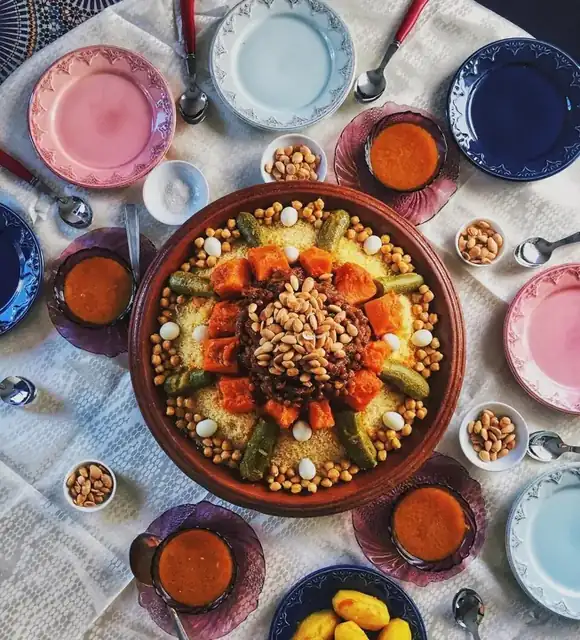
Couscous (Tamazight: ⵙⴽⵙⵓ seksu or ⴽⵙⴽⵙⵓ keskesu), is a traditional North African dish of small steamed granules of rolled semolina that is often served with a stew spooned on top. Pearl millet, sorghum, bulgur, and other cereals are often cooked in much the same way in West Africa, and the resulting dishes are sometimes called couscous in English, French, and Hassaniya Arabic.
Couscous is a staple food throughout the Maghrebi cuisines of Algeria, Tunisia, Mauritania, Morocco, and Libya. It was integrated into French and European cuisine at the beginning of the twentieth century, through the French colonial empire and the Pieds-Noirs of Algeria.
In 2020, couscous was added to UNESCO's Intangible Cultural Heritage list.
Preparation
Couscous is traditionally made from semolina, the hardest part of the grain of durum wheat (the hardest of all forms of wheat), which resists the grinding of the millstone. The semolina is sprinkled with water and rolled with the hands to form small pellets, sprinkled with dry flour to keep them separate, and then sieved. Any pellets that are too small to be finished granules of couscous fall through the sieve and are again rolled and sprinkled with dry semolina and rolled into pellets. This labor-intensive process continues until all the semolina has been formed into tiny couscous granules. In the traditional method of preparing couscous, groups of people come together to make large batches over several days, which are then dried in the sun and used for several months.
Handmade couscous may need to be rehydrated as it is prepared; this is achieved by a process of moistening and steaming over stew until the couscous reaches the desired light and fluffy consistency.
In some regions, couscous is made from farina or coarsely ground barley or pearl millet.
In modern times, couscous production is largely mechanized, and the product is sold worldwide. This couscous can be sauteed before it is cooked in water or another liquid. Properly cooked couscous is light and fluffy, not gummy or gritty.
Traditionally, North Africans use a food steamer (called a taseksut in the Berber language, a كِسْكَاس kiskas in Arabic or a couscoussier in French). The base is a tall metal pot shaped like an oil jar, where the meat and vegetables are cooked as a stew. On top of the base, a steamer sits where the couscous is cooked, absorbing the flavours from the stew. The steamer's lid has holes around its edge so steam can escape. It is also possible to use a pot with a steamer insert. If the holes are too big, the steamer can be lined with damp cheesecloth.
The couscous that is sold in most Western grocery stores is usually pre-steamed and dried. It is typically prepared by adding 1.5 measures of boiling water or stock to each measure of couscous and then leaving it covered tightly for about five minutes. Pre-steamed couscous takes less time to prepare than regular couscous, most dried pasta, or dried grains (such as rice). Packaged sets of quick-preparation couscous and canned vegetables, and generally meat, are routinely sold in European grocery stores and supermarkets. Couscous is widely consumed in France, where it was introduced by Maghreb immigrants and voted the third most popular dish in a 2011 survey.
Recognition
In December 2020, Algeria, Mauritania, Morocco, and Tunisia obtained official recognition for the knowledge, know-how, and practices pertaining to the production and consumption of couscous on the Representative List of the Intangible Cultural Heritage of Humanity by UNESCO. The joint submission by the four countries was hailed as an "example of international cooperation."
Local variations
Couscous proper is about 2 mm in diameter, but there also exists a larger variety (3 mm more) known as berkoukes, as well as an ultra-fine version (around 1 mm). In Morocco, Algeria, Tunisia, and Libya, it is generally served with vegetables (carrots, potatoes, and turnips) cooked in a spicy or mild broth or stew, usually with some meat (generally, chicken, lamb, or mutton).
Algeria
Algerian couscous is a traditional staple food in Algeria, and it plays an important role in Algerian cuisine. It is commonly served with vegetables, meat, or fish. In Algeria, there are various types of couscous dishes.
Similar foods
Couscous is made from crushed wheat flour rolled into its constituent granules or pearls, making it distinct from pasta, even pasta such as orzo and risoni of similar size, which is made from ground wheat and either molded or extruded. Couscous and pasta have similar nutritional value, although pasta is usually more refined.
Several dishes worldwide are also made from granules, like those of couscous rolled from flour from grains or other milled or grated starchy crops.
Attiéké, a staple food in Côte d'Ivoire and surrounding regions of West Africa, is made from granulated grated cassava.
Dambou is a couscous-like dish from Niger. It may be made from semolina for special occasions but is often made with rice, millet, or other grain. Moringa leaves are traditionally included in the dish. In France, this Nigerien dish has been adapted as a specific variant (called couscous aux épinards) of the Maghreb-syle couscous commonly found there, often using spinach in place of the moringa.
Fregula is a type of pasta from Sardinia. It is similar to North African Berkoukes and Middle Eastern Moghrabieh. Fregula comes in varying sizes but typically consists of semolina dough rolled into balls 2–3 mm in diameter and toasted in an oven.
Kouskousaki (Κουσκουσάκι (in Greek) or kuskus (in Turkish) is a pasta from Greece and Turkey, that is boiled and served with cheese and walnuts.
Wusu-Wusu is a couscous that is prepared out of fonio in the Hausa region of Nigeria, Benin, Togo and Ghana.
Dishes with similar names
Israeli couscous is an extruded and toasted pasta and does not share main ingredients or method of production with couscous.
More to savor
Dambun Masara
Gambian Yassa Poulet

Xiaolongbao: The Small Steamed Buns with a Soup-Filled Surprise