The dish is a starting point for exploring a wider food story. The guide below looks more closely at its background and different forms. When you want to cook, visit the recipe collection for ingredient quantities and step-by-step methods.
Overview
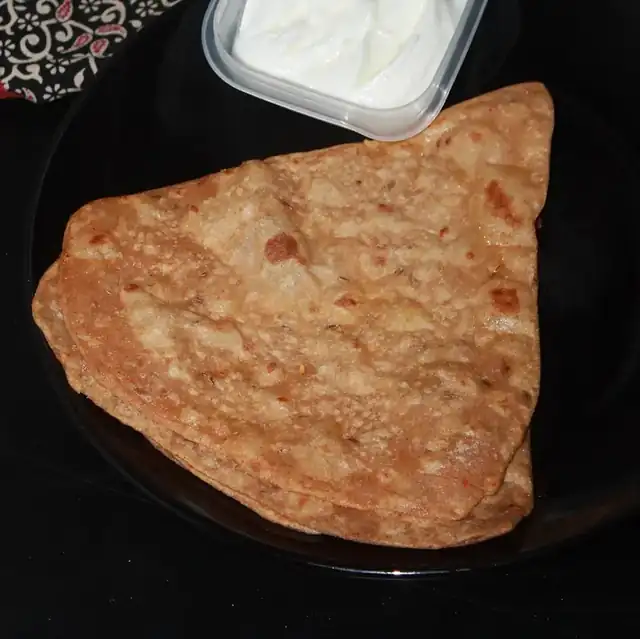
Paratha (also known by other spellings) is a flatbread from the Indian subcontinent, consisting of a wheat dough, typically whole wheat, that is folded and rolled with ghee, forming multiple layers, and shallow fried. Paratha may be stuffed with various fillings, the most common being potato. Paratha is one of the most popular flatbreads in India. The folded, whole-wheat version is prevalent in the Northern Indian subcontinent, and is distinct from South Indian parotta, which uses refined flour. Variations also exist in the cuisines of Myanmar, Mauritius, Malaysia (where it is known as roti canai), and the Caribbean (where it is known as buss-up-shut).
Although paratha is sometimes said to have originated in Punjabi cuisine, it may have evolved from similar flatbreads from regions connected to India via the Silk Road. Possible origins include the Persian flatbread waraki or from breads introduced by Arabs in India. Sanskrit recipes for versions of paratha appeared in the 12th century. The popularity of paratha increased during the Mughal Empire, which introduced it across the region. During the British imperial era, indentured workers from India introduced paratha to Southeast Asia, the Caribbean, and Mauritius. In India, several versions of paratha were popularised after the 1947 partition.
Preparation
Like most Indian breads, paratha is wheat-based and unleavened. The dough is made of atta (whole wheat flour), water, and salt, which is covered in ghee. Oil may be used instead of ghee, and white flour (maida) may be used instead of whole wheat; maida is used for more tender, flaky parathas. Vegetables, herbs, and spices may be added; ajowan is a commonly used spice in plain paratha.
The common wheat, the dominant species of wheat in the northern Indian subcontinent, results in the light, spongy texture of North Indian breads such as paratha. The flour used in paratha is typically of low extraction, although high-extraction flour is sometimes used. It may also use resultant atta, the coarse byproduct of sifting atta. In commercial preparations, potato flakes may be used as a binding agent.
Varieties
Paratha exists in both plain and stuffed varieties. Dozens of varieties are commonly consumed. Regional variations differ based on cooking method or filling.
Plain varieties
India has two categories of plain paratha: North Indian paratha (also known as sada paratha), made from atta, and South Indian parotta, made from maida. Both are similarly flaky and layered, but the South Indian version achieves this texture through repeated stretching and coiling rather than rolling and folding.
Some versions of paratha have spiraling layers, forming a circle or square. Lachha paratha is a kind of North Indian paratha with many circular layers, formed by shaping a circle of dough into a coil before rolling it out again. It has a crispy texture and is the same size as a regular paratha. Ulte tave ke paratha is a North Indian paratha cooked on the bottom side of the pan, the same method as roomali roti.
Stuffed varieties
Many varieties of stuffed paratha exist. The most common is aloo paratha, with a spiced potato filling. Aloo paratha uses ingredients such as coriander leaf and green chilli and spices such as amchoor and garam masala, and its proportion of dough to filling may vary. Along with aloo paratha, the stuffed parathas common in Punjabi cuisine are gobhi paratha, with cauliflower, and mooli paratha, with radish. Keema paratha uses keema (minced meat), such as lamb, while methi paratha uses fenugreek leaves. Other common fillings include peas (matar), onions, spinach, and paneer. Aloo palak paratha contains both potatoes and spinach. Dal paratha is stuffed with cooked dal such as mung beans. Pudina paratha uses mint. Sweet parathas include gurh ka paratha (jaggery paratha).
Anda paratha contains beaten eggs; the paratha may simply be coated in eggs, or it may have a filling of eggs, onions, chilli, coriander seed, and ginger added during frying. Anda paratha is a common Punjabi breakfast. Among the Sunni Bohras of Gujarat, egg paratha, known as baida paratha, is a festive food.
Regional variants
The version eaten in the South Indian cuisines of Karnataka and Tamil Nadu is like a chapati made of maida. South Indian variations called Malabar parotta and Ceylon parotta resemble lachha paratha. Malabar parotta, from the cuisine of Kerala, has layers formed by kneading oil into the dough. Another preparation from Kerala is kothu parotta, a mixture of chopped parotta with other ingredients. Veechu parotta is a square-shaped parotta eaten in Tamil Nadu. Ceylon parotta is similar to this, with the addition of a minced meat filling. Madurai, Tamil Nadu, has a variant called bun parotta, shaped like a bun. Bidar, Karnataka, is home to the Bidari paratha, distinguished from regular paratha by the addition of a small amount of semolina flour.
In Bengali cuisine, the typical paratha—or porota—is triangular and usually combines atta and maida. This is common among both Hindu and Muslim Bengalis. Circular parathas also exist in the region, with five or six layers. The Dhakai paratha is deep-fried and has many layers, with a hollow centre. Taking its name from Dhaka, Bangladesh, it is also found in Kolkata, India. Mughlai paratha, a dish from Kolkata, which is prepared by folding a paratha over a filling with beaten eggs and chopped onions, sometimes with minced meat. It is one of the more complex forms of stuffed paratha. Another Bengali version, petai porota , is tossed and torn apart after cooking, resembling kothu parotta. It is a common street food meal, served with ghugni or aloo dum, and is eaten for breakfast.
Serving
Paratha may be served for any meal. Like other flatbreads in North Indian cuisine, it is served as the central component of a typical meal; the bread is eaten by using the hands to tear the bread and pick up the accompanying food. A stuffed paratha may be a full meal.
A wide range of foods may be served with paratha. Common accompaniments include curries, sabzi, pickle, and dahi (curd). Likewise, stuffed parathas such as aloo paratha are commonly served with curd or pickle. When served by vendors, paratha often comes with dahi or pickle included. A paratha may also be served with tea or raita, with which it can be rolled up and dipped. As a dessert, paratha may be eaten with brown sugar.
More to savor

Chicken Vindaloo
Vedhmi (Sweet Stuffed Flatbread)
Pita: A Flatbread Made for More Than Sandwiches