
The dish is a starting point for exploring a wider food story. The guide below looks more closely at its background and different forms. When you want to cook, visit the recipe collection for ingredient quantities and step-by-step methods.
Overview
A croissant is a Viennoiserie in a crescent shape made from a laminated yeast dough that sits between a bread and a puff pastry.
It is buttery and flaky, inspired by the shape of the Austrian kipferl, but using the Viennoiserie yeast-leavened laminated dough. Croissants are named for their crescent shape. The dough is layered with butter, rolled and folded several times in succession, then rolled into a thin sheet, in a technique called laminating. The process results in a layered, flaky texture, similar to a puff pastry.
Crescent-shaped breads have been made since the Renaissance, and crescent-shaped cakes possibly since antiquity. The modern croissant was developed in the early 20th century, when French bakers replaced the brioche dough of the kipferl with a yeast-leavened laminated dough.
In the late 1970s, the development of factory-made, frozen, preformed but unbaked dough made them into a fast food that could be freshly baked by unskilled labor. The croissant bakery, notably the La Croissanterie chain, was a French response to American-style fast food, and as of 2008, 30–40% of the croissants sold in French bakeries and patisseries were baked from frozen dough. Croissants are a common part of a continental breakfast in many European countries.
Culinary legends
Stories of how the kipferl – sometimes confused with the croissant – was created are widespread and persistent culinary legends, going back to the 19th century. However, there are no contemporary sources for any of these stories, and an aristocratic writer, writing in 1799, does not mention the kipferl in a long and extensive list of breakfast foods.
The legends include tales that it was invented in Europe to celebrate the defeat of the Umayyad forces by the Franks at the Battle of Tours in 732, with the shape representing the Islamic crescent; that it was invented in Buda; or, according to other sources, in Vienna in 1683 to celebrate the defeat of the Ottomans by Christian forces in the siege of the city, as a reference to the crescents on the Ottoman flags, when bakers staying up all night heard the tunneling operation and gave the alarm.
The Islamic origin story seems to have originated with the 20th-century writer Alfred Gottschalk, who gave two versions:
For this reason, the Islamic State attempted to ban croissants during the Syrian civil war.
Variants
Uncooked viennoiserie dough can also be wrapped around any praline, almond paste, or chocolate before it is baked (in the last case, it becomes like pain au chocolat, which has a different, non-crescent, shape), or sliced to include sweet or savoury fillings. It may be flavored with dried fruit such as sultanas or raisins, or other fruits such as apples. In France and Spain, croissants are generally sold without filling and eaten without added butter, but sometimes with almond filling.
In the United States, sweet fillings or toppings are sometimes used, and warm croissants may be filled with ham and cheese, or feta cheese and spinach. In the Levant, croissants are sold plain or filled with chocolate, cheese, almonds, or zaatar. In Germany, croissants are sometimes filled with Nutella or persipan; in southern Germany, there is also a popular variety of a croissant glazed with lye (Laugencroissant). In the German-speaking part of Switzerland, the croissant is typically called a Gipfeli. Variants include Buttergipfeli, for the traditional croissant, chocolate filled versions called Schoggigipfeli and Laugegipfeli which are actually a pretzel made in a crescent shape.
Argentina and Uruguay
Croissants are commonly served alongside coffee for breakfast, aperitivo (a light mid-morning meal), or merienda (a mid-afternoon meal). They are referred to as medialunas ('half moons') because of their shape and are typically coated with a sweet glaze (medialunas de manteca, 'half moons of butter'). Another variant is a medialuna de grasa ('half moon of lard'), which is not always sweet.
Italy
A cousin of the croissant is the Italian cornetto (in Central and Southern Italy) or brioche (in Northern Italy). These variants are often considered to be the same, but that is not completely true: the French version tends to be crispy, whereas an Italian cornetto or brioche is usually softer. Furthermore, the cornetto vuoto is commonly accompanied by variants with filling, which include crema pasticciera (custard), apricot jam or chocolate cream. They often come covered with powdered sugar or other toppings. Cornetto with cappuccino at the bar is one of the most common breakfasts in Italy.
Poland
On 11 November, St. Martin's Day is celebrated in the Polish region of Greater Poland, mainly in its capital city Poznań. On this day, the people of Poznań purchase and eat considerable amounts of sweet, crescent-shaped pastries called rogale świętomarcińskie ('St. Martin's croissants'). They are made specially for this occasion from puff pastry filled with ground white poppy seeds, almonds, raisins, and nuts.
Portugal
The first type of Portuguese croissant is similar to the French, and can be plain or filled with custard, chocolate, fruit jam, or a typical Portuguese cream made of egg yolk and sugar, doce de ovo. It is customary for these to also have powdered sugar on top. The second version has a similar consistency to brioche and is commonly eaten with ham and cheese. Sometimes this type is also served like toast, with a spread of butter. While the first type of croissant is considered sweet and is eaten during breakfast or tea, the second type is a more filling meal and is usually considered a sandwich and often prepared for picnics or as travel food.
Both types share the same name (i.e., croissant) but are typically found in different bakeries: the sweet croissant is more commonly found in Portuguese pâtisseries and the brioche croissant is usually found in coffeehouses.
More to savor
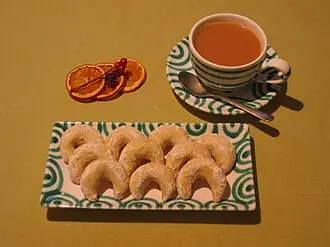
Vanillekipferl (Almond Crescent Cookies)
Chocolate Crinkles
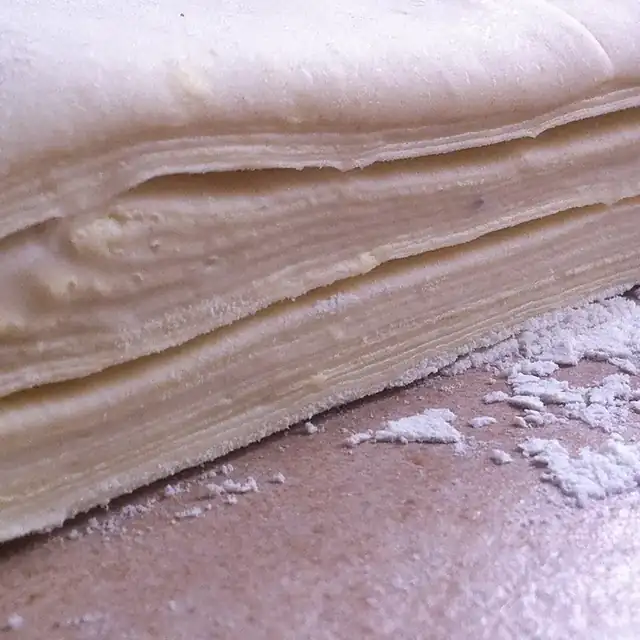
Puff Pastry: The Layers Behind a Light, Flaky Bite