This longer reference provides the background behind the topic. Read it alongside the recipe collection when you want to connect an ingredient or food idea with a dish to prepare.
In this story
OverviewDescriptionReproductive biologyGermination and seedling growthPhylogenyProductionCulinaryOverview
is a genus, native to the Andes and Mesoamerica, of herbaceous fruits in the gourd family, Cucurbitaceae (also known as cucurbits or cucurbi). Five edible species are grown and consumed for their flesh and seeds. They are variously known as squash, pumpkin, or gourd, depending on species, variety, and local parlance. Other kinds of gourd, also called bottle gourds, are native to Africa and belong to the genus Lagenaria, which is in the same family and subfamily as Cucurbita, but in a different tribe; their young fruits are eaten much like those of the Cucurbita species.
There is debate about the taxonomy of the genus, and the number of accepted species varies from 13 to 30. The five domesticated species are Cucurbita argyrosperma, C. ficifolia, C. maxima, C. moschata, and C. pepo, all of which can be treated as winter squash because the full-grown fruits can be stored for months. However, C. pepo includes some cultivars that are better used only as summer squash.
Most Cucurbita species are herbaceous vines that grow several meters in length and have tendrils, but non-vining "bush" cultivars of C. pepo and C. maxima have also been developed. The yellow or orange flowers on a Cucurbita plant are of two types: female and male. The female flowers produce the fruit and the male flowers produce pollen. Many North and Central American species are visited by specialist bee pollinators, but other insects with more general feeding habits, such as honey bees, also visit.
Description
Cucurbita species fall into two main groups. The first consists of annual or short-lived perennial vines which are mesophytic, meaning they require a more or less continuous water supply. The second group are perennials growing in arid zones which are xerophytic, meaning they tolerate dry conditions. Cultivated Cucurbita species were derived from the first group. Growing 5 to 15 m in height or length, the plant stem produces tendrils to help it climb adjacent plants and structures or extend along the ground. Most species do not readily root from the nodes; a notable exception is C. ficifolia, and the four other cultivated mesophytes do this to a lesser extent. The vine of the perennial Cucurbita can become semiwoody if left to grow.
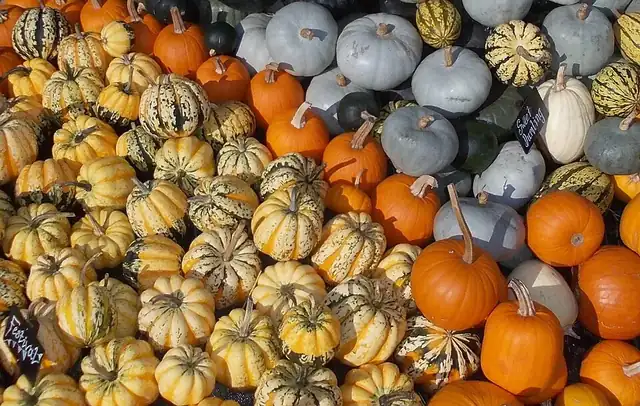
There is wide variation in size, shape, and color among Cucurbita fruits, and even within a single species. C. ficifolia is an exception, being highly uniform in appearance. The morphological variation in the species C. pepo and C. maxima is so vast that its various subspecies and cultivars have been misidentified as totally separate species.
Reproductive biology
All species of Cucurbita have 20 pairs of chromosomes.
Many North and Central American species are visited by specialist pollinators in the apid tribe Eucerini, especially the genera Peponapis and Xenoglossa, and these squash bees can be crucial to the flowers producing fruit after pollination.
Germination and seedling growth
Seeds with maximum germination potential develop (in C. moschata) by 45 days after anthesis, and seed weight reaches its maximum 70 days after anthesis. Some varieties of C. pepo germinate best with eight hours of sunlight daily and a planting depth of 12 mm. Seeds planted deeper than 125 mm are not likely to germinate. In C. foetidissima, a weedy species, plants younger than 19 days old are not able to sprout from the roots after removing the shoots. In a seed batch with 90 percent germination rate, over 90 percent of the plants had sprouted after 29 days from planting.
Experiments have shown that when more pollen is applied to the stigma, as well as the fruit containing more seeds and being larger (the xenia effect mentioned above), the germination of the seeds is also faster and more likely, and the seedlings are larger. Various combinations of mineral nutrients and light have a significant effect during the various stages of plant growth. These effects vary significantly between the different species of Cucurbita. A type of stored phosphorus called phytate forms in seed tissues as spherical crystalline intrusions in protein bodies called globoids. Along with other nutrients, phytate is used completely during seedling growth. Heavy metal contamination, including cadmium, has a significant negative impact on plant growth. Cucurbita plants grown in the spring tend to grow larger than those grown in the autumn.
Phylogeny
The full phylogeny of this genus is unknown, and research was ongoing in 2014. The following cladogram of Cucurbita phylogeny is based upon a 2002 study of mitochondrial DNA by Sanjur and colleagues.
Production
In 2024, the world production of squashes (including gourds and pumpkins) was 34.6 million tonnes, led by India with 27% of the total. China, Egypt and the Russia were secondary producers.
Culinary
The family Cucurbitaceae has many species used as human food. Cucurbita species are some of the most important of those, with various species being prepared and eaten in many ways. Although the stems and skins tend to be more bitter than the flesh, the fruits and seeds of cultivated varieties are usually quite edible and need little or no preparation. Cross-pollination with toxic types can cause bitterness in plants of the next generation, and these should not be eaten. The flowers and young leaves and shoot tips can also be consumed. The seeds and fruits of most varieties can be stored for long periods of time, particularly the sweet-tasting winter varieties with their thick, inedible skins. Summer squash have a thin, edible skin.
The seeds of both types can be roasted, eaten raw, made into pumpkin seed oil, ground into a flour or meal, or otherwise prepared. Squashes are primarily grown for the fresh food market.
Long before European contact, Cucurbita had been a major food source for the native peoples of the Americas. The species became an important food for European settlers, including the Pilgrims, who even featured it at the first Thanksgiving. Commercially produced pumpkin commonly used in pumpkin pie is most often varieties of C. moschata; Libby's, by far the largest producer of processed pumpkin, uses a proprietary strain of the Dickinson pumpkin variety of C. moschata for its canned pumpkin. Other foods that can be made using members of this genus include biscuits, bread, cheesecake, desserts, donuts, granola, ice cream, lasagna dishes, pancakes, pudding, pumpkin butter, salads, soups, and stuffing. Squash soup is a dish in African cuisine. The xerophytic species are proving useful in the search for nutritious foods that grow well in arid regions.
More to savor

Chicken Vindaloo

Lancashire Corned Beef Hash
Dragon fruit at the Table: The Food Behind the Name